

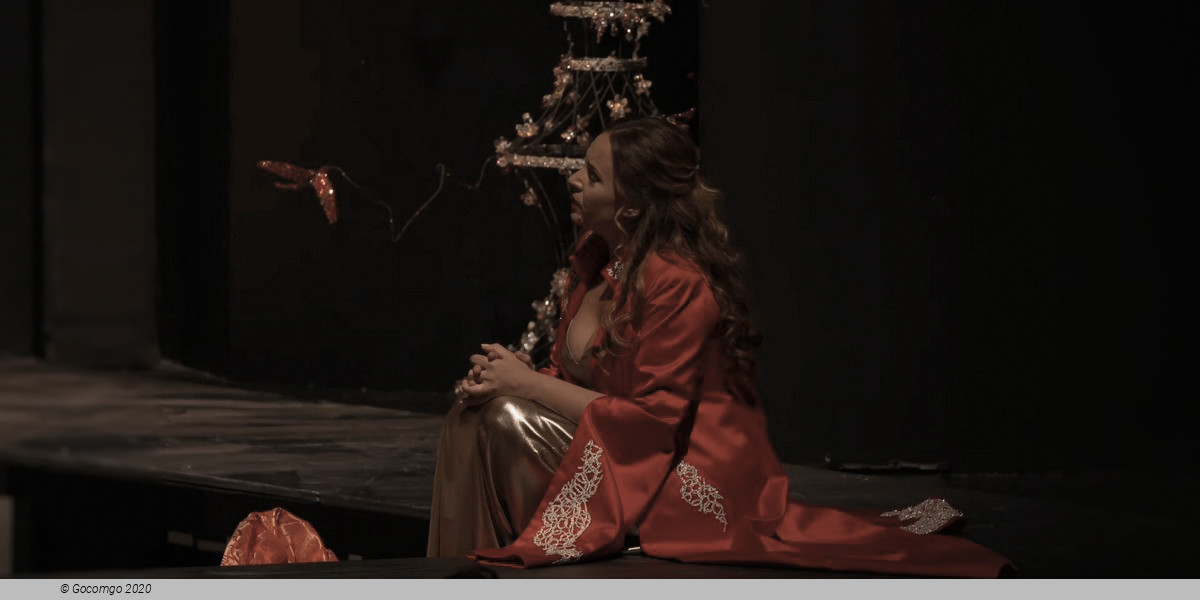
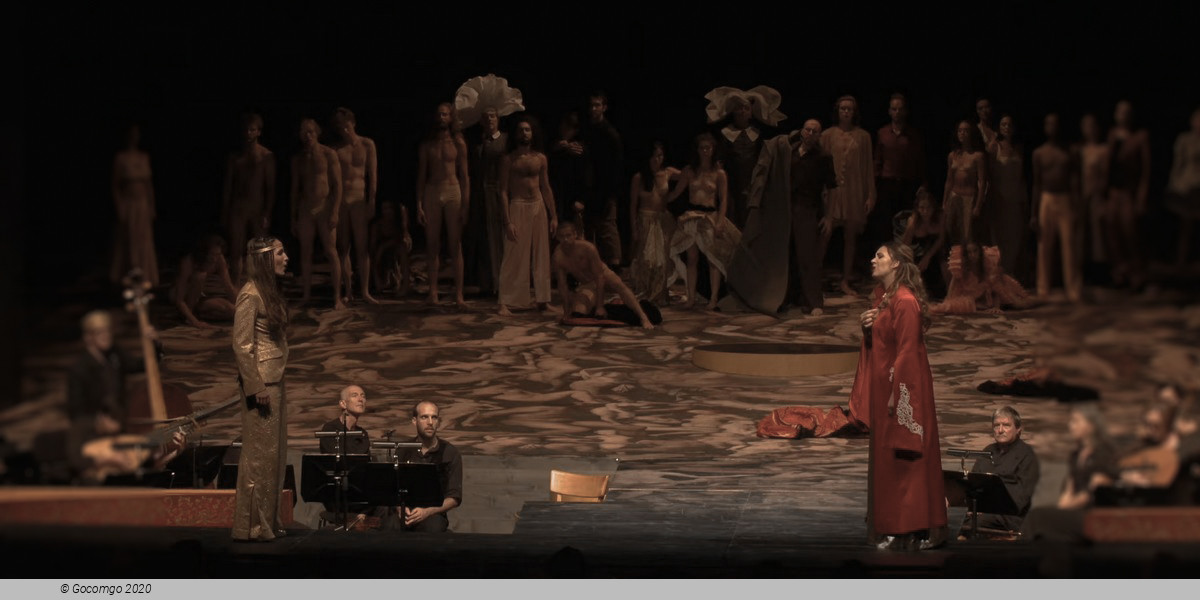
Staatsoper Unter den Linden (Berlin State Opera) 3 December 2022 - L'incoronazione di Poppea | GoComGo.com

L'incoronazione di Poppea

Staatsoper Unter den Linden (Berlin State Opera), Staatsoper Unter den Linden, Berlin, Germany
All photos (5)
Select date and time
7 PM

E-tickets: Print at home or at the box office of the event if so specified. You will find more information in your booking confirmation email.

You can only select the category, and not the exact seats.
If you order 2 or 3 tickets: your seats will be next to each other.
If you order 4 or more tickets: your seats will be next to each other, or, if this is not possible, we will provide a combination of groups of seats (at least in pairs, for example 2+2 or 2+3).

Important Info
Type: Opera
City: Berlin, Germany
Starts at: 19:00
Acts: 3
Intervals: 1
Duration: 3h 25min
Sung in: Italian
Titles in: German,English

E-tickets: Print at home or at the box office of the event if so specified. You will find more information in your booking confirmation email.

You can only select the category, and not the exact seats.
If you order 2 or 3 tickets: your seats will be next to each other.
If you order 4 or more tickets: your seats will be next to each other, or, if this is not possible, we will provide a combination of groups of seats (at least in pairs, for example 2+2 or 2+3).

Overview

In his last opera, Claudio Monteverdi drew for the first time on material with real historical figures, and thus created the first "sex-and-crime story" in operatic history. Like a political thriller, this early Baroque masterpiece tells a story of power and passion and of occasions where it is abused.

Poppea Sabina, the most beautiful woman in Rome, wants nothing less than to be Empress at the side of Emperor Nerone. To this end, she uses all her seductive powers to persuade Nerone to assassinate his wife, Ottavia. When the imperial philosopher Seneca opposes this plan, he has to pay for it with his life. Meanwhile, Ottavia in turn incites the spurned and deceived Ottone to kill her power-hungry rival Poppea. However, the murder is thwarted in time: Ottavia is shunned and Poppea fulfils her plans, wishes and dreams.
At the end of their opera, Monteverdi and his librettist Busenello demonstrate their bitter view of the world: all their characters have flaws, and ultimately, those allowed to triumph are those who act most unscrupulously. Monteverdi manages the feat of exposing his partially caricatured figures, whose melodies are very differently characterized, in a sometimes humorous fashion while also creating empathy for them. His extremely expressive music, with sensual melodies, bold harmonies and astoundingly avant-garde style, tempts us to cheer on the adulterers, despite their scandalous behaviour.

History
Premiere of this production: Teatro Santi Giovanni e Paolo in Venice

L'incoronazione di Poppea (The Coronation of Poppaea) is an Italian opera by Claudio Monteverdi. It was Monteverdi's last opera, with a libretto by Giovanni Francesco Busenello, and was first performed at the Teatro Santi Giovanni e Paolo in Venice during the 1643 carnival season. One of the first operas to use historical events and people, it describes how Poppaea, mistress of the Roman emperor Nero, is able to achieve her ambition and be crowned empress. The opera was revived in Naples in 1651, but was then neglected until the rediscovery of the score in 1888, after which it became the subject of scholarly attention in the late 19th and early 20th centuries. Since the 1960s, the opera has been performed and recorded many times.

Synopsis

The action takes place in Imperial Rome around AD 60, in and around Poppea's villa and in various locations within the imperial palace.

Prologue

The goddesses of Fortune and Virtue dispute which of them has the most power over humankind. They are interrupted by the god of Love, who claims greater power than either: "I tell the virtues what to do, I govern the fortunes of men."When they have heard his story, he says, they will admit his superior powers.

Act 1

The upper body, unclothed, of a young woman carrying a thin transparent cloth. She has tight curled hair swept from her face, and is facing towards the left although her eyes look directly from the painting. A plaque in front of her carries the words "Sabina Poppea".

Ottone arrives at Poppea's villa, intent on pursuing his love. Seeing the house guarded by the Emperor Nerone's soldiers he realises he has been supplanted, and his love song turns to a lament: "Ah, ah, perfidious Poppea!" He leaves, and the waiting soldiers gossip about their master's amorous affairs, his neglect of matters of state and his treatment of the Empress Ottavia. Nerone and Poppea enter and exchange words of love before Nerone departs. Poppea is warned by her nurse, Arnalta, to be careful of the empress's wrath and to distrust Nerone's apparent love for her, but Poppea is confident: "I fear no setback at all."

The scene switches to the palace, where Ottavia bemoans her lot; "Despised queen, wretched consort of the emperor!" Her nurse suggests she take a lover of her own, advice which Ottavia angrily rejects. Seneca, Nerone's former tutor, addresses the empress with flattering words, and is mocked by Ottavia's page, Valleto, who threatens to set fire to the old man's beard. Left alone, Seneca receives a warning from the goddess Pallade that his life is in danger. Nerone enters and confides that he intends to displace Ottavia and marry Poppea. Seneca demurs; such a move would be divisive and unpopular. "I care nothing for the senate and the people," replies Nerone, and when the sage persists he is furiously dismissed. Poppea joins Nerone, and tells him that Seneca claims to be the power behind the imperial throne. This so angers Nerone that he instructs his guards to order Seneca to commit suicide.

After Nerone leaves, Ottone steps forward and after failing to persuade Poppea to reinstate him in her affections, privately resolves to kill her. He is then comforted by a noblewoman, Drusilla; realising that he can never regain Poppea he offers to marry Drusilla, who joyfully accepts him. But Ottone admits to himself: "Drusilla is on my lips, Poppea is in my heart."

Act 2

An elderly man, unclothed except for a loose cloth placed on his body, is supported in the arms of an associate, while others crowd around looking anxiously on.

In his garden, Seneca learns from the god Mercurio that he is soon to die. The order duly arrives from Nerone, and Seneca instructs his friends to prepare a suicide bath. His followers try to persuade him to remain alive, but he rejects their pleading. "The warm current of my guiltless blood shall carpet with royal purple my road to death." At the palace Ottavia's page flirts with a lady-in-waiting, while Nerone and the poet Lucano celebrate the death of Seneca in a drunken, cavorting song contest, and compose love songs in honour of Poppea. Elsewhere in the palace, Ottone, in a long soliloquy, ponders how he could have thought to kill Poppea with whom he remains hopelessly in love. He is interrupted by a summons from Ottavia, who to his dismay orders him to kill Poppea. Threatening to denounce him to Nerone unless he complies, she suggests that he disguise himself as a woman to commit the deed. Ottone agrees to do as she bids, privately calling on the gods to relieve him of his life. He then persuades Drusilla to lend him her clothes.

In the garden of Poppea's villa, Arnalta sings her mistress to sleep while the god of Love looks on. Ottone, now disguised as Drusilla, enters the garden and raises his sword to kill Poppea. Before he can do so, Love strikes the sword from his hand, and he runs away. His fleeing figure is seen by Arnalta and the now awakened Poppea, who believe that he is Drusilla. They call on their servants to give chase, while Love sings triumphantly "I protected her!"

Act 3

Drusilla muses on the life of happiness before her, when Arnalta arrives with a lictor. Arnalta accuses Drusilla of being Poppea's assailant, and she is arrested. As Nerone enters, Arnalta denounces Drusilla, who protests her innocence. Threatened with torture unless she names her accomplices, Drusilla decides to protect Ottone by confessing her own guilt. Nerone commands her to suffer a painful death, at which point Ottone rushes in and reveals the truth: that he had acted alone, at the command of the Empress Ottavia, and that Drusilla was innocent of complicity. Nerone is impressed by Drusilla's fortitude, and in an act of clemency spares Ottone's life, ordering him banished. Drusilla chooses exile with him. Nerone now feels entitled to act against Ottavia and she is exiled, too. This leaves the way open for him to marry Poppea, who is overjoyed: "No delay, no obstacle can come between us now."

Ottavia bids a quiet farewell to Rome, while in the throne room of the palace the coronation ceremony for Poppea is prepared. The Consuls and Tribunes enter, and after a brief eulogy place the crown on Poppea's head. Watching over the proceedings is the god of Love with his mother, Venere, and a divine chorus. Nerone and Poppea sing a rapturous love duet ("I gaze at you, I possess you") as the opera ends.

Venue Info

Staatsoper Unter den Linden (Berlin State Opera) - Berlin
Location   Unter den Linden 7

The Staatsoper Unter den Linden is one of the oldest and largest musical theaters in Germany. Founded in 1742 as the Royal Court Opera (German: Königliche Hofoper) under Frederick II. Located in Berlin, on the main street Unter den Linden.

King Frederick II of Prussia shortly after his accession to the throne commissioned the original building on the site. Construction work began in July 1741 with what was designed by Georg Wenzeslaus von Knobelsdorff to be the first part of a "Forum Fredericianum" on present-day Bebelplatz. Although not entirely completed, the Court Opera (Hofoper) was inaugurated with a performance of Carl Heinrich Graun's Cesare e Cleopatra on December 7, 1742. This event marked the beginning of the successful, 250-year co-operation between the Staatsoper and the Staatskapelle Berlin, the state orchestra, whose roots trace back to the 16th century.

In 1821, the Berlin Opera—hosted at the Schauspielhaus Berlin—gave the premiere of Weber's Der Freischütz. In 1842, Wilhelm Taubert instituted the tradition of regular symphonic concerts. In the same year, Giacomo Meyerbeer succeeded Gaspare Spontini as General Music Director. Felix Mendelssohn also conducted symphonic concerts for a year.

On August 18, 1843 the Linden Opera was destroyed by fire. The reconstruction of the building was supervised by architect Carl Ferdinand Langhans, and the Königliches Opernhaus (Royal Opera House) was inaugurated the following autumn by a performance of Meyerbeer's Ein Feldlager in Schlesien. In 1849, Otto Nicolai's Die lustigen Weiber von Windsor was premiered at the Royal Opera House, conducted by the composer.

1945: The Lindenoper was once again destroyed on February 3. The concerts were relocated to the Admiralspalast and the Schauspielhaus. On 18 February, Karajan conducted his last symphonic concert with the Staatskapelle in the Beethoven hall.

The second rebuilding took a long time. From 1945, the opera company played in the former Admiralspalast (today's Metropoltheater). From 1949, the company served as the state opera of East Germany. It moved back to its original home after the rebuilding in freely adapted baroque forms was finally completed in 1955. The newly rebuilt opera house was opened, again, with Wagner's Die Meistersinger von Nürnberg. The capacity is now about 1,300. After the Berlin Wall was built in 1961, the Opera was somewhat isolated, but still maintained a comprehensive repertoire that featured the classic and romantic period together with contemporary ballet and operas.

After reunification, the Linden Opera rejoined the operatic world. Important works that had already performed in the past were rediscovered and discussed anew within the framework of a "Berlin Dramaturgy". Baroque Opera in particular was at the center of attention, with Graun's Cleopatra e Cesare, Keiser's Croesus, Florian Leopold Gassmann's L'opera seria and Scarlatti's Griselda. These works were performed by Belgian conductor René Jacobs together with the Akademie für Alte Musik Berlin and the Freiburger Barockorchester on period instruments. In the 1990s, the opera was officially renamed Staatsoper Unter den Linden.

In 1992, the Argentine-Israeli conductor Daniel Barenboim was appointed Music Director. In 2000, the orchestra (according to its official website) elected Barenboim "conductor for life." During the 2002 Festtage, he led a Wagner cycle in ten parts, a production created in collaboration with director Harry Kupfer.

Since 2009, the Berlin State Opera has been undergoing considerable renovation work led by German architect HG Merz. The roof of the opera building was raised and the proscenium prolonged to improve the acoustics. Other renovation and extension works include the director's building, the below-ground connection building and the depot building. The latter will house the new rehearsal center.

The house was reopened in 2017 with premieres of Humperdinck's Hänsel und Gretel and Monteverdi's L'incoronazione di Poppea on one weekend.

Important Info
Type: Opera
City: Berlin, Germany
Starts at: 19:00
Acts: 3
Intervals: 1
Duration: 3h 25min
Sung in: Italian
Titles in: German,English
Top of page