
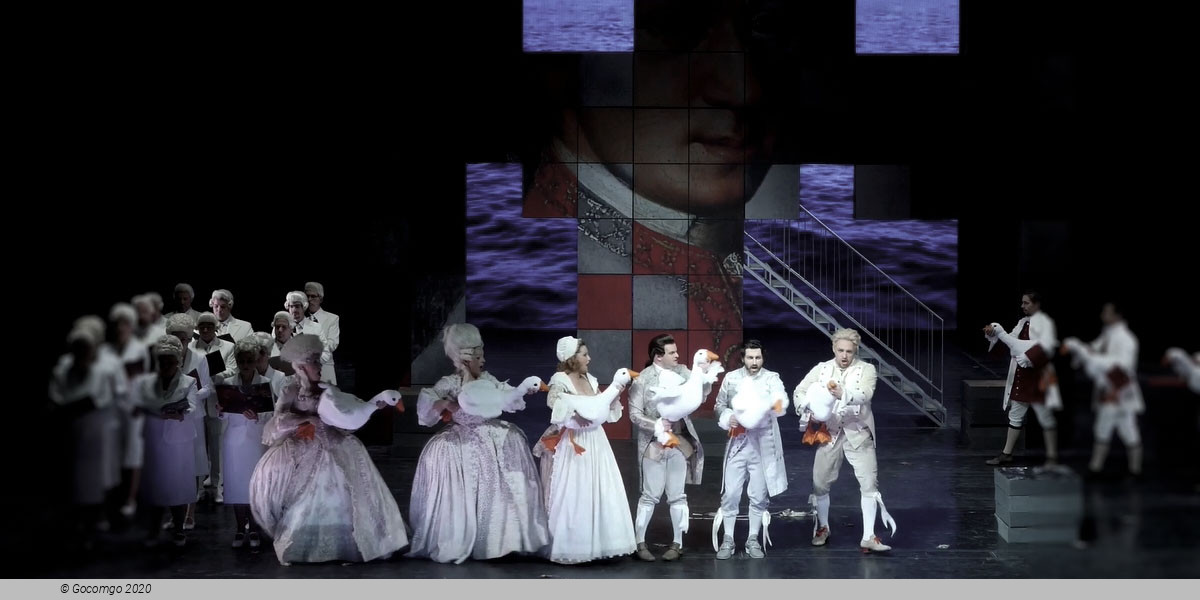
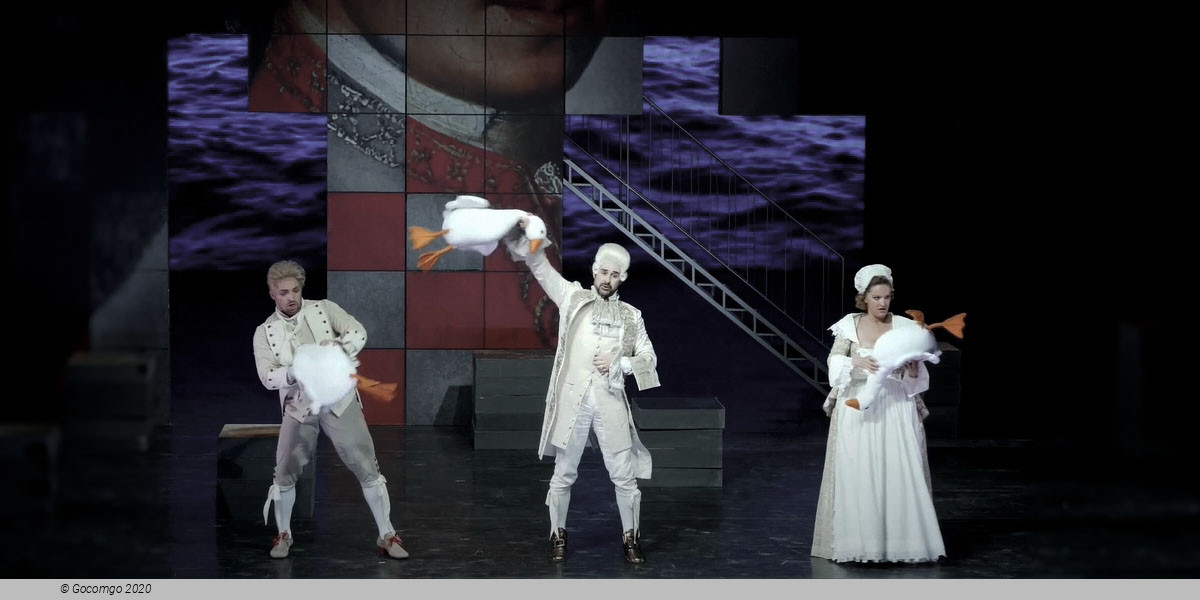
Hungarian State Opera House 11 March 2021 - L’oca del Cairo, ossia Lo sposo deluso (The Goose of Cairo or The Deluded Bridegroom) | GoComGo.com

L’oca del Cairo, ossia Lo sposo deluso (The Goose of Cairo or The Deluded Bridegroom)

Hungarian State Opera House, Eiffel Art Studios – Miklós Bánffy Stage, Budapest, Hungary
All photos (15)
Select date and time
8 PM
Request for Tickets
Important Info
Type: Opera
City: Budapest, Hungary
Starts at: 20:00
Acts: 2
Duration: 2h 30min
Sung in: Italian
Titles in: Hungarian,English

E-tickets: Print at home or at the box office of the event if so specified. You will find more information in your booking confirmation email.

You can only select the category, and not the exact seats.
If you order 2 or 3 tickets: your seats will be next to each other.
If you order 4 or more tickets: your seats will be next to each other, or, if this is not possible, we will provide a combination of groups of seats (at least in pairs, for example 2+2 or 2+3).

Overview

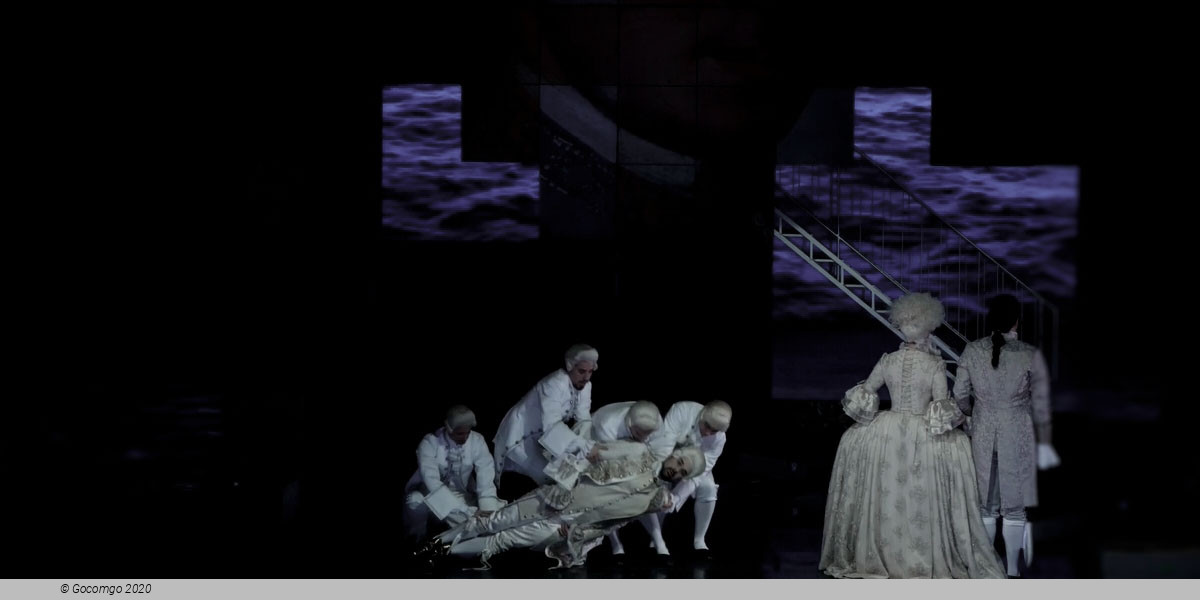
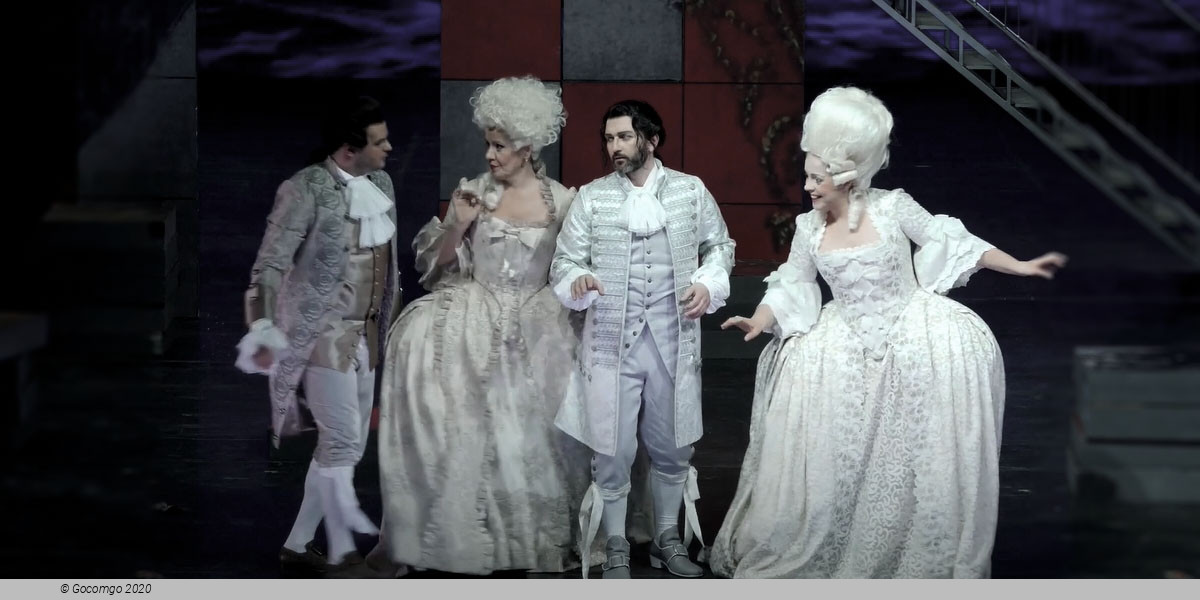
After the success of Die Entführung aus dem Serail, Mozart set himself to composing two new operas, but gave up on both of them. In terms of style. We can regard the two fragmentary comedies L'oca del Cairo and Lo sposo deluso as precursors to Figaro and Così, and at times even the world of Don Giovanni is discernable. The completed parts were never staged in Mozart's lifetime, but since his death, however, several successful pasticcios, meaning performances sewn together from excerpts from multiple musical works, have been made.  An idea cherished by General Director Szilveszter Ókovács for 25 years: to present Mozart's thus-far unknown opera, under the baton of Pál Németh and in a production directed by Attila Toronykőy.

History
Premiere of this production: Frankfurt

L'oca del Cairo (The Goose of Cairo or The Cairo Goose) is an incomplete Italian opera buffa in three acts, begun by Wolfgang Amadeus Mozart in July 1783 but abandoned in October. The complete libretto by Giovanni Battista Varesco remains. Mozart composed seven of the ten numbers of the first act, plus some recitative, as well a sketch for a further aria; the extant music amounts to about 45 minutes.

Lo sposo deluso, ossia La rivalità di tre donne per un solo amante (The Deluded Bridegroom, or The Rivalry of Three Women for One Lover) is a two-act opera buffa, K. 430, composed by Wolfgang Amadeus Mozart between 1783 and 1784. However, the opera was never completed and only a 20-minute fragment from act 1 exists.

Synopsis

Act 1

In the castle of Ripaseccha, the no-longer-youthful and miserly marquis Don Pippo is preparing for his wedding, to the great amusement of his secretary, Calandrino. Don Pippo’s ward, Celidora demands that her guardian keep his promise by finally giving her away in marriage to the young man she loves, Biondello, who has been hanging around the house of the marquis for a year now. Don Pippo tells her that they will be celebrating a double wedding that evening. It won’t be Biondello that Celidora is marrying, however, because Don Pippo is giving her to a wealthy Roman count of similar age whose own ward he himself, it so happens, is preparing to marry.

Biondello looks woefully at the marquis, who laughs at the boy and dismisses him: the impoverished lad can have Celidora when the singing of the goose of Cairo makes dollars rain down from the sky. Calandrino racks his brains to figure out how he can help Biondello get his beloved back, but Don Pippo locks the girl in the castle’s tower in order to prevent any trickery.

The marquis happily welcomes the Roman guests as they arrive in the house: they are his veiled bride and his future father-in-law/son-in-law, the noble-spirited and sophisticated Lionetto. As Don Pippo accompanies the count to the castle tower to introduce him to his future wife, Celidora, Calandrino is forced to entertain Don Pippo’s bride. The woman removes her veil, and the secretary is astonished to behold Lavina, his beloved. He immediately resolves to spirit her away. When Don Pippo returns to find the two lovers in each other’s arms, he has Lavina locked in the tower together with Celidora and entrusts the key to Auretta, the chambermaid.

 Calandrino woos the tower key out of Auretta’s hands, a scene that is nevertheless witnessed by Chichibio, the stable-boy… who is also Auretta’s lover. He immediately grows jealous.

The “big meeting” between Count Lionetto and Celidora takes place: it turns out that Don Pippo has sent the love letters that Celidora wrote to Biondello to Lionetto, who for some reason addresses the girl as “Clarice”. Celidora bitterly announces that the old man will only be her husband when the singing of the goose of Cairo makes dollars rain down from the sky.

Act 2

After his afternoon nap, Don Pippo feverishly instructs Auretta and Chichibio to prepare everything for the double wedding. The chambermaid and the stable-boy, however, decide that the lovers should be together and resolve to help the youngsters avoid the forced marriages.

In great secrecy, Calandrino brings the girls down from the tower. Celidora and Biondello fall into each other’s arms, and the lad produces money to help his lover out of her trouble. Lionetto surprises them and, left alone with Celidora, objects that she is not the same person as Clarice, whom her “father” said so many good things about, as she was neither learned nor even virtuous. Celidora bitterly explains to Lionetto that she has always been in love with someone else and that her guardian has a heart of stone. Finally, she tosses the money in front of the older man and hurries off. After some moments of thought, Lionetto addresses Chichibio, who is right then stealing around the area in a goose costume, and tells him to inform his master that the two lovers are getting ready to abscond right now. He himself decides to put an end to the drama; he gathers up the money from the floor, along with the goose costume that the stable-boy has left there, and hurries off.

The four lovers are prevented from fleeing by the river in front of the castle, so they summon workers to quickly build a bridge over the water. The work is feverishly being carried out when Auretta and Chichibio bring news: Don Pippo is approaching!

The marquis indeed arrives, and in a terrible rage is about to throw the entire company in prison right away. Suddenly, however, Count Lionetto appears from the tower dressed as a goose and tossing gold dollars to the ground. He attempts to appeal to Don Pippo’s better nature: “Now I can see that, on this earth, everyone should only marry for love. Two old ganders caused this fuss, and now this famous specimen will bring peace: I myself am the ‘goose of Cairo’, and I myself am the ‘deluded bridegroom’!”

Don Pippo, a Spanish Marquess, keeps his only daughter Celidora locked up in his tower. She is betrothed to Count Lionetto, but her true love is Biondello, a wealthy gentleman. Biondello makes a bet with the Marquis that if he can rescue Celidora from the tower within a year he wins her hand in marriage. He succeeds by having himself smuggled into the tower garden inside a large mechanical goose.

Don Pippo, a Spanish Marquess, keeps his only daughter Celidora locked up in his tower. She is betrothed to Count Lionetto, but her true love is Biondello, a wealthy gentleman. Biondello makes a bet with the Marquis that if he can rescue Celidora from the tower within a year he wins her hand in marriage. He succeeds by having himself smuggled into the tower garden inside a large mechanical goose.

Venue Info

Hungarian State Opera House - Budapest
Location   Andrássy út 22

The Hungarian State Opera House (Hungarian: Magyar Állami Operaház) is a neo-Renaissance opera house located in central Budapest, on Andrássy út. The Hungarian State Opera House is the main opera house of the country and the second largest opera house in Budapest and in Hungary. Today, the opera house is home to the Budapest Opera Ball, a society event dating back to 1886. The Theatre was designed by Miklós Ybl, a major figure of 19th-century Hungarian architecture.

Construction began in 1875, funded by the city of Budapest and by Emperor Franz Joseph I of Austria-Hungary, and the new house opened to the public on the 27 September 1884. Before the closure of the "Népszínház" in Budapest, it was the third largest opera building in the city; today it is the second largest opera house in Budapest and in Hungary.

Touring groups had performed operas in the city from the early 19th century, but as Legány notes, "a new epoch began after 1835 when part of the Kasa National Opera and Theatrical Troupe arrived in Buda". They took over the Castle Theatre and, in 1835, were joined by another part of the troupe, after which performances of operas were given under conductor Ferenc Erkel. By 1837 they had established themselves at the Magyar Színház (Hungarian Theatre) and by 1840, it had become the "Nemzeti Színház" (National Theatre). Upon its completion, the opera section moved into the Hungarian Royal Opera House, with performances quickly gaining a reputation for excellence in a repertory of about 45 to 50 operas and about 130 annual performances. 

Many important artists were guests here including the composer Gustav Mahler, who was director in Budapest from 1888 to 1891 and Otto Klemperer, who was music director for three years from 1947 to 1950.

It is a richly decorated building and is considered one of the architect's masterpieces. It was built in neo-Renaissance style, with elements of Baroque. Ornamentation includes paintings and sculptures by leading figures of Hungarian art including Bertalan Székely, Mór Than, and Károly Lotz. Although in size and capacity it is not among the greatest, in beauty and the quality of acoustics the Budapest Opera House is considered to be amongst the finest opera houses in the world.

The auditorium holds 1,261 people. It is horseshoe-shaped and – according to measurements done in the 1970s by a group of international engineers – has the third best acoustics in Europe after La Scala in Milan and the Palais Garnier in Paris. Although many opera houses have been built since the Budapest Opera House is still among the best in terms of acoustics.

In front of the building are statues of Ferenc Erkel and Franz Liszt. Liszt is the best-known Hungarian composer. Erkel composed the Hungarian national anthem, and was the first music director of the Opera House; he was also the founder of the Budapest Philharmonic Orchestra.

Each year the season lasts from September to the end of June and, in addition to opera performances, the House is home to the Hungarian National Ballet.

There are guided tours of the building in six languages (English, German, Spanish, French, Italian, and Hungarian) almost every day.

Important Info
Type: Opera
City: Budapest, Hungary
Starts at: 20:00
Acts: 2
Duration: 2h 30min
Sung in: Italian
Titles in: Hungarian,English
Top of page