
Berliner Philharmonie 26 October 2019 - François-Xavier Roth and Pierre-Laurent Aimard | GoComGo.com

François-Xavier Roth and Pierre-Laurent Aimard

Berliner Philharmonie, Berlin, Germany
All photos (1)
Select date and time
7 PM
Request for Tickets
Important Info
Type: Classical Concert
City: Berlin, Germany
Starts at: 19:00
Duration:

E-tickets: Print at home or at the box office of the event if so specified. You will find more information in your booking confirmation email.

You can only select the category, and not the exact seats.
If you order 2 or 3 tickets: your seats will be next to each other.
If you order 4 or more tickets: your seats will be next to each other, or, if this is not possible, we will provide a combination of groups of seats (at least in pairs, for example 2+2 or 2+3).

Programme
Joseph Haydn: Symphony No. 59 in A major “Fire Symphony”
Béla Bartók: Concerto for Piano and Orchestra No. 3, Sz 119
Béla Bartók: Dance Suite, Sz 77
Edgard Varèse: Arcana for large Orchestra (revised version from 1960)
Overview

Pierre-Laurent Aimard is one of the foremost musicians of our time – a “thinker at the piano” (The Washington Post). Together with François-Xavier Roth, general music director of the city of Cologne, he performs Béla Bartók’s Third Piano Concerto, a work permeated by a soft parlando tone and gentle melancholy. The other works on the programme are wonderfully energetic – albeit in very different ways: Joseph Haydn’s “Fire Symphony”, and Arcana by Edgard Varèse.

The motto for this concert programme could be “transformations”. Each work on the programme illuminates the concept in its very own way: Edgard Varèse was inspired to compose his orchestral work Arcana by the teachings of Paracelsus, a great doctor, alchemist and mystic of the 16th century who sought a universal remedy with the ability to heal, transform and renew people. Throughout his life, Varèse was considered a provocateur, one who aimed to transfer the music that had been passed down into a new soundscape. His pieces are noise-like, harsh, aggressive, erratic, and they uniquely reflect the modern lifestyle in the first half of the 20th century. The composer, originally from France, emigrated to the USA in 1915; with Amériques and Arcana he then composed the two monumental orchestral works with which he proved himself one of the most innovative minds of his time.

Béla Bartók’s Third Piano Concerto was also composed in the US, but under completely different circumstances: after his emigration, the Hungarian did not succeed in making a livelihood in America. Public interest in his works remained limited, and only commissions from leading artists, above all Sergei Koussevitzky, provided some income. When the composer conceptualised his Third Piano Concerto for his wife, the pianist Ditta Pásztory, he was critically ill and already at the brink of death. He struck a note in the concerto that audiences had not experienced in his two other piano concertos: ruminative, romantic, full of devotion. Bartók reverts to Baroque compositional techniques like the fugue and counterpoint, combining them with the characteristically Hungarian idiom typical of his music. In the words of Pierre-Laurent Aimard, the programme’s soloist, the challenge of the concerto lies in shaping the phrasing so that “it sounds Baroque but also Bartók-like.”

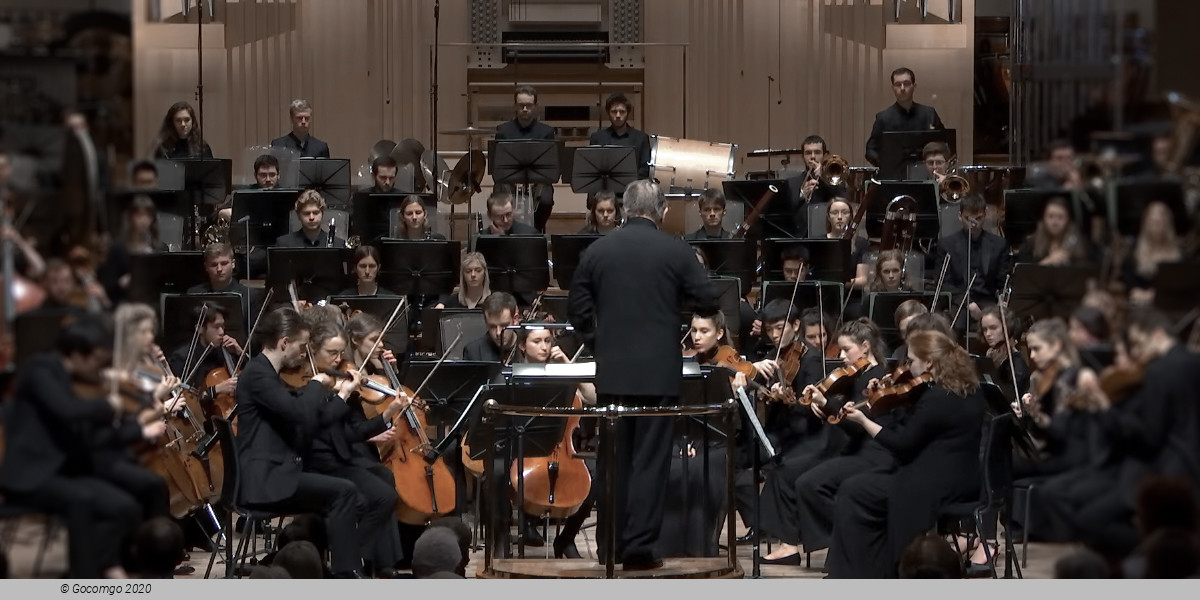
The programme will kick off with Joseph Haydn’s so-called Fire Symphony. The nickname, which was given to the work only later, stems from the assumption that Haydn composed the work as an interlude for a play called the Feuersbrunst (conflagration). With its impulsive, dramatic gesture, the symphony is captivating. Haydn works with short, succinct, opposing motives which he sometimes derives from each other, varies individually, and which give the piece a sweeping rhythmic magnetic “pull effect”. François-Xavier Roth will conduct the Berliner Philharmoniker. When he shapes programmes as conductor, he enjoys looking for the balance between old and new music, and he’s also a recognised specialist in Edgard Varèse’s oeuvre.

Venue Info

Berliner Philharmonie - Berlin
Location   Herbert-von-Karajan-Str. 1

The Berliner Philharmonie is a concert hall in Berlin, Germany and home to the Berlin Philharmonic Orchestra. The Philharmonie lies on the south edge of the city's Tiergarten and just west of the former Berlin Wall. The Philharmonie is on Herbert-von-Karajan-Straße, named for the orchestra's longest-serving principal conductor. The building forms part of the Kulturforum complex of cultural institutions close to Potsdamer Platz.

The Philharmonie consists of two venues, the Grand Hall (Großer Saal) with 2,440 seats and the Chamber Music Hall (Kammermusiksaal) with 1,180 seats. Though conceived together, the smaller hall was opened in the 1980s, some twenty years after the main building.

Hans Scharoun designed the building, which was constructed over the years 1960–1963. It opened on 15 October 1963 with Herbert von Karajan conducting Beethoven's 9th Symphony. It was built to replace the old Philharmonie, destroyed by British bombers on 30 January 1944, the eleventh anniversary of Hitler becoming Chancellor. The hall is a singular building, asymmetrical and tentlike, with the main concert hall in the shape of a pentagon. The height of the rows of seats increases irregularly with distance from the stage. The stage is at the centre of the hall, surrounded by seating on all sides. The so-called vineyard-style seating arrangement (with terraces rising around a central orchestral platform) was pioneered by this building, and became a model for other concert halls, including the Sydney Opera House (1973), Denver's Boettcher Concert Hall (1978), the Gewandhaus in Leipzig (1981), Walt Disney Concert Hall in Los Angeles (2003), and the Philharmonie de Paris (2014).

Jazz pianist Dave Brubeck and his quartet recorded three live performances at the hall; Dave Brubeck in Berlin (1964), Live at the Berlin Philharmonie (1970), and We're All Together Again for the First Time (1973). Miles Davis's 1969 live performance at the hall has also been released on DVD.

On 20 May 2008 a fire broke out at the hall. A quarter of the roof suffered considerable damage as firefighters cut openings to reach the flames beneath the roof. The hall interior sustained water damage but was otherwise "generally unharmed". Firefighters limited damage using foam. The cause of the fire was attributed to welding work, and no serious damage was caused either to the structure or interior of the building. Performances resumed, as scheduled, on 1 June 2008 with a concert by the San Francisco Symphony Youth Orchestra.

The main organ was built by Karl Schuke, Berlin, in 1965, and renovated in 1992, 2012 and 2016. It has four manuals and 91 stops. The pipes of the choir organs and the Tuba 16' and Tuba 8' stops are not assigned to any group and can be played from all four manuals and the pedals.

Important Info
Type: Classical Concert
City: Berlin, Germany
Starts at: 19:00
Duration:
Top of page