
Berliner Philharmonie 18 September 2019 - Karajan Academy of the Berliner Philharmoniker | GoComGo.com

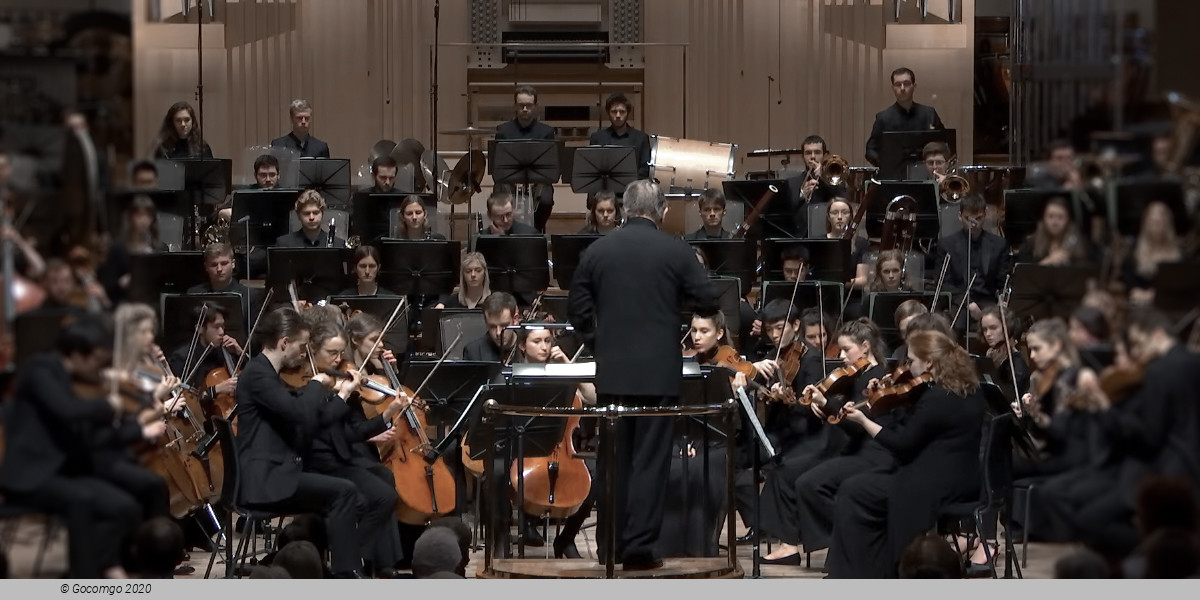
Karajan Academy of the Berliner Philharmoniker

Berliner Philharmonie, Chamber Music Hall, Berlin, Germany
All photos (1)
Select date and time
8 PM
Request for Tickets
Important Info
Type: Classical Concert
City: Berlin, Germany
Starts at: 20:00
Duration:

E-tickets: Print at home or at the box office of the event if so specified. You will find more information in your booking confirmation email.

You can only select the category, and not the exact seats.
If you order 2 or 3 tickets: your seats will be next to each other.
If you order 4 or more tickets: your seats will be next to each other, or, if this is not possible, we will provide a combination of groups of seats (at least in pairs, for example 2+2 or 2+3).

Festival

Musikfest Berlin 2019

From 30 August to 19 September 2019, the concert season in Berlin will be launched by Musikfest Berlin, hosted by Berliner Festspiele in cooperation with the Foundation Berliner Philharmoniker. Over 21 days, 26 events at the Philharmonie, its Chamber Music Hall and at Konzerthaus Berlin will present 65 works by around 25 composers, featuring 22 instrumental and vocal ensembles and more than 50 soloists from the international music scene.

Programme
Karajan-Akademie der Berliner Philharmoniker
Olga Neuwirth: Aello – ballet mécanomorphe
Gérard Grisey: Quatre chants pour franchir le seuil
Overview

For the first time at the Musikfest Berlin

The strength of this programme lies in its polarities: Grisey’s “Vier Gesänge, um die Schwelle zu überschreiten” moves both along the threshold of hearing and the existential threshold of death. Neuwirth’s “Aello”, in contrast, embodies a piece of vitality and beauty.

Touch down. The thread of French music (and music that it inspired) continued from the opening concert throughout the whole festival programme. With Gérard Grisey’s final work, completed only a few weeks before his death, it reaches its finale. Grisey, who explored the inner life of tones with the help of a computer and went on to apply the knowledge he gained this way in a creative manner, insisted that he composed not with notes but with tones, not with written but with aural shapes. “He viewed sound as a living creature, and time as its territory and atmosphere.” (Carsten Fastner) On the one hand, his “Vier Gesänge, um die Schwelle zu überschreiten” deal with the threshold (German: Schwelle) of hearing, because they retreat to the silent level of the concert hall (which is significantly higher than zero) in their interludes. But they also mean the existential threshold. As text-inspired musical meditations, they talk about notions of death and its inevitability. The music ends with a delicate lullaby “for the awakening of humankind, finally freed from its nightmare” (Grisey).

Before Grisey, the programme features the total opposite, the dissolution of boundaries towards history, to Bach’s Brandenburg Concertos, above all the Fourth with its concertising flutes. At times, the mythical, whirlwind-footed Aello, friend of humankind, resounds in Olga Neuwirth’s dialogue with and about Bach, at others, the typewriter in the ensemble sounds like the “divine sewing-machine” that the French writer Collette was occasionally reminded of when listening to Bach. “Aello” is a piece about vitality and beauty.

Venue Info

Berliner Philharmonie - Berlin
Location   Herbert-von-Karajan-Str. 1

The Berliner Philharmonie is a concert hall in Berlin, Germany and home to the Berlin Philharmonic Orchestra. The Philharmonie lies on the south edge of the city's Tiergarten and just west of the former Berlin Wall. The Philharmonie is on Herbert-von-Karajan-Straße, named for the orchestra's longest-serving principal conductor. The building forms part of the Kulturforum complex of cultural institutions close to Potsdamer Platz.

The Philharmonie consists of two venues, the Grand Hall (Großer Saal) with 2,440 seats and the Chamber Music Hall (Kammermusiksaal) with 1,180 seats. Though conceived together, the smaller hall was opened in the 1980s, some twenty years after the main building.

Hans Scharoun designed the building, which was constructed over the years 1960–1963. It opened on 15 October 1963 with Herbert von Karajan conducting Beethoven's 9th Symphony. It was built to replace the old Philharmonie, destroyed by British bombers on 30 January 1944, the eleventh anniversary of Hitler becoming Chancellor. The hall is a singular building, asymmetrical and tentlike, with the main concert hall in the shape of a pentagon. The height of the rows of seats increases irregularly with distance from the stage. The stage is at the centre of the hall, surrounded by seating on all sides. The so-called vineyard-style seating arrangement (with terraces rising around a central orchestral platform) was pioneered by this building, and became a model for other concert halls, including the Sydney Opera House (1973), Denver's Boettcher Concert Hall (1978), the Gewandhaus in Leipzig (1981), Walt Disney Concert Hall in Los Angeles (2003), and the Philharmonie de Paris (2014).

Jazz pianist Dave Brubeck and his quartet recorded three live performances at the hall; Dave Brubeck in Berlin (1964), Live at the Berlin Philharmonie (1970), and We're All Together Again for the First Time (1973). Miles Davis's 1969 live performance at the hall has also been released on DVD.

On 20 May 2008 a fire broke out at the hall. A quarter of the roof suffered considerable damage as firefighters cut openings to reach the flames beneath the roof. The hall interior sustained water damage but was otherwise "generally unharmed". Firefighters limited damage using foam. The cause of the fire was attributed to welding work, and no serious damage was caused either to the structure or interior of the building. Performances resumed, as scheduled, on 1 June 2008 with a concert by the San Francisco Symphony Youth Orchestra.

The main organ was built by Karl Schuke, Berlin, in 1965, and renovated in 1992, 2012 and 2016. It has four manuals and 91 stops. The pipes of the choir organs and the Tuba 16' and Tuba 8' stops are not assigned to any group and can be played from all four manuals and the pedals.

Important Info
Type: Classical Concert
City: Berlin, Germany
Starts at: 20:00
Duration:
Top of page