
Volksoper Vienna 8 October 2020 - Hollands Meister | GoComGo.com

Hollands Meister

Volksoper Vienna, Vienna, Austria
All photos (1)
Select date and time
7 PM
Request for Tickets
Important Info
Type: Ballet
City: Vienna, Austria
Starts at: 19:00
Intervals: 2

E-tickets: Print at home or at the box office of the event if so specified. You will find more information in your booking confirmation email.

You can only select the category, and not the exact seats.
If you order 2 or 3 tickets: your seats will be next to each other.
If you order 4 or more tickets: your seats will be next to each other, or, if this is not possible, we will provide a combination of groups of seats (at least in pairs, for example 2+2 or 2+3).

Overview

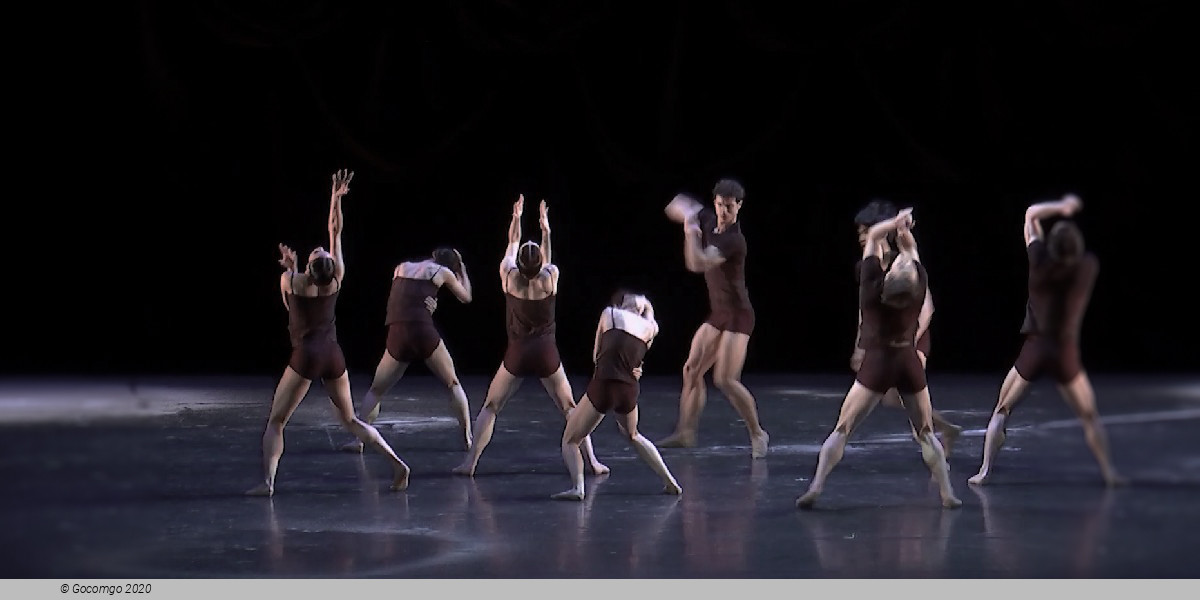
The founding of the Nederlands Dans Theater in 1959 opened a new chapter in the history of ballet. Important modern dance stimuli continue to emanate from the Netherlands to this day. Martin Schläpfer has now combined three masterpieces from the repertoire of the Vienna State Ballet by the former directors of The Hague Company – Jiří Kylián, Hans van Manen as well as Sol León & Paul Lightfoot – into a programme that can be experienced at the Vienna State Ballet for the first time in this form.

"Skew-Whiff" puts no limits on the imagination when it comes to playfully trying out a wide range of movements: the outcome is a piece of wonderful fun by the choreographer duo Sol León & Paul Lightfoot. On the other hand, Hans van Manen’s "Adagio Hammerklavier", a ballet set to Beethoven, is a sublime masterpiece in terms of its concentration and clarity: "Light as a feather and floating, a breeze, a dream of ballet", writes the dance critic Jochen Schmidt. And Jiří Kylián created a key work of the 20th century with his "Symphony of Psalms", based on Stravinsky’s composition of the same name. In his characteristically pacey, flowing language of movement, he unfurls a fascinating, spiritual architecture before our very eyes. 

Choreographer Hans van Manen focuses on movement. Not narrating a plot, not creating dance dramas, but seeking out the beauty of lines and developing engaging exchanges between his dancers’ bodies in space.

The choreographer names George Balanchine as his idol and the primary source of his inspiration. Hans van Manen’s emergence as a creator occurred at a time when the world – having seen the kind of production created by the Russian-American in which only the music and classical dance are of importance – was absorbed by the plot-less ballet.
At that time, choreographers selected the language of dance exercises each in their own way. Some preferred traditional classicism, such as Harald Lander with Études, while others – such as Serge Lifar with Suite en blanc – attempted to expand the range of movements familiar from daily class by adding unusual poses. Yet others added to the classical lexis with elements of the techniques of modern dance. Hans van Manen is one of the latter. He had an idea of the technique of Martha Graham and tried out the freedom of mixing genres in productions by Roland Petit when he danced in his company in the late 1950s, but all these influences in his choreographic language are nothing more than the spice to the basic ingredient of classical dance. Van Manen remained a follower of classicism.
In his native Holland, he was introduced to classical dance by Sonia Gaskell who had trained under Lyubov Yegorova. It is quite obvious that it was she who encouraged the dancer and future choreographer’s admiration for the Russian school and for centuries-old traditions that provide inspiration and open the doors to creativity. In Holland there was no such powerful dance base and van Manen, looking back at the start of his path, says with a shade of regret that he had to invent the bicycle, and that freedom of combining movements that are like fundamental truths in Russia was absorbed from his very first classes when he was searching for and finding his own self.
Leningrad and the Mariinsky (then the Kirov) became a kind of ballet Mecca for van Manen. George Balanchine had come from there. He carried on the traditions. And the exceptional dazzle of talent with which Balanchine used these traditions to create something new made him an idol in the eyes of many. Including van Manen.
Van Manen never hid his desire to follow in the footsteps of Balanchine, revelling in his movements that were born from classicism. He is interested in how dancers move and what figures their bodies can form in duets and ensembles. (It is no coincidence that van Manen is also an acclaimed photographer). Unlike Balanchine, however, he does not see dance as the triumph of form. Van Manen says that his ballets are “not abstract.” Van Manen projects emotions and feelings onto the limbs of bodies in formfitting leotards, and in his productions he tells dramas about relationships between people, at the same time excluding fables and lifelikeness. In his ballets it is important for the lines that the choreographer has conceived to meet with lines of human emotions. He demands emotionality from his dancers, saying that he “wants to see people on the stage, not robots.”
Emotions come from the music. And with van Manen the range is incredibly broad – from Bach’s metaphysics to the full-bodied passions and life energy of Piazzolla and Villa-Lobos. When he works with the music, van Manen does not follow the path taken by Balanchine, a graduate of a conservatoire and for whom the professional analysis of a work and reading the score were natural requirements when staging a work. Van Manen relies on his own hearing and responsiveness to the emotional and imagistic structure of the musical material chosen.
Van Manen does not test the limits of the human body. And finding a balance with maximum speed, physical characteristics and intensity of passions is not his style. He creates movements and renders the play of geometric lines human.

History

Skew-Whiff requires a virtuoso technique and comic abilities from artists. How complicated it is to demonstrate the perfect flexibility and clumsiness at the same time, to keep up with the furious pace of the music and leisurely roll over from emotion to emotion, draw a difficult and fancy choreographic pattern and make funny faces. Only big artists can do that.

Premiere of this production: 04 October 1973, Dutch National Ballet, Amsterdam

Symphony of Psalms (1978) is a work for 16 dancers that, set to Igor Stravinsky’s choral symphony of the same name, “brings together dance and the divine.” 

Venue Info

Volksoper Vienna - Vienna
Location   Währinger Strasse 78

The Vienna Volksoper is a major opera house in Vienna, Austria. It produces three hundred performances of twenty-five German language productions during an annual season which runs from September through June.

Volksoper Vienna was built in 1898 as the Kaiserjubiläum-Stadttheater (Kaiser's Jubilee Civic Theatre), originally producing only plays. Because of the very brief construction period (10 months) the first director Adam Müller-Gutenbrunn had to start with debts of 160,000 gulden. After this inauspicious startup the Kaiserjubiläum-Stadttheater had to declare bankruptcy five years later in 1903.

On 1 September 1903 Rainer Simons took over the house and renamed it the Kaiserjubiläum-Stadttheater - Volksoper (public opera). His intention was to continue the production of plays but also establish series of opera and operetta. The first Viennese performances of Tosca and Salome were given at the Volksoper in 1907 and 1910 respectively. World-famous singers such as Maria Jeritza, Leo Slezak and Richard Tauber appeared there; the conductor Alexander Zemlinsky became the first bandmaster in 1906.

In the years up to and through the First World War the Volksoper attained a position as Vienna's second prestige opera house. In 1919, Felix Weingartner became Artistic Director and Principal Conductor. He was followed as Director by Hugo Gruder-Guntram. After 1929, it focused on light opera, and under Gruder-Guntram undertook a number of summer tours to Abbazia in 1935, Cairo and Alexandria in 1937 and throughout Italy in 1938, with guest appearances from Richard Tauber. After the Second World War, the Vienna Volksoper became the alternative venue to the devastated Vienna State Opera. In 1955 the Volksoper returned to its former role of presenting opera, operetta, and musicals.

From September 1991 to June 1996 the Vienna Volksoper was under a collective leadership with the Vienna State Opera. In 1999 the Volksoper became a 100% subsidiary of the Bundestheater-Holding. Since 1 September 2007 Robert Meyer has headed the Volksoper as artistic director together with the business manager Christoph Ladstätter. Each season includes about 25 productions, a total of approximately 300 performances—a performance almost every day. In addition to opera, operetta, musicals and ballet, there are special performances and children's programs.

Important Info
Type: Ballet
City: Vienna, Austria
Starts at: 19:00
Intervals: 2
Top of page