









Metropolitan Opera: Songs of Bukovina Tickets | Event Dates & Schedule | GoComGo.com

Songs of Bukovina Tickets

Metropolitan Opera, New York, USA
Important Info
Type: Ballet
City: New York, USA

E-tickets: Print at home or at the box office of the event if so specified. You will find more information in your booking confirmation email.

You can only select the category, and not the exact seats.
If you order 2 or 3 tickets: your seats will be next to each other.
If you order 4 or more tickets: your seats will be next to each other, or, if this is not possible, we will provide a combination of groups of seats (at least in pairs, for example 2+2 or 2+3).

Cast
Performers
Choose the date to see the peformers
Overview

Set to the music of Leonid Desyatnikov, Songs of Bukovina explores the folk traditions of the Eastern European mountains.

A world premiere of Alexei Ratmansky’s “Songs of Bukovina” was one of the highlights of American Ballet Theatre’s fall season at the Lincoln Center. The ballet is choreographed to the commissioned score by Leonid Desyatnikov, namely a selection of preludes from his newly-minted, incandescent Bukovinian Songs (24 Preludes for Piano). (The music in its entirety will be premiered in Russia next spring.) This is the sixth ballet of Ratmansky-Desyatnikov creative team and the third with the entirely new music. Previously, the choreographer made two ballets: “Lost Illusions” (2011) for Bolshoi Ballet and “Opera” (2013) for La Scala Ballet, for which Desyatnikov was commissioned the score.

There is much to admire in “Songs of Bukovina.” It reveals before our eyes the world that is quiet, luminous, and downright happy (as opposed to the poignant “Odessa,” which shakes you to the core, leaving you gasping for air.) In fact, to watch this “Songs” is to partake in a festive village gathering and to experience what it feels like to be on a sunny afternoon in the area of the title, Bukovina, a picturesque region located on the northern side of Carpathians. When you watch “Songs,” you envision the bright rays of the sun illuminating the ground and almost feel a breeze of fresh mountain air. (These effects are in no small part due to the gorgeous lighting, created by Brad Fields, which floods the stage with an appealing golden glow and create a summery atmosphere.)

Throughout the piece, the folk-inspired choreography has a jubilant, cheerful feel to it—the proceedings evoke an engagement celebration of sorts—though a few moments of sadness and grief creep in here and there. There are four supporting couples (but they rarely assume the secondary role), plus the principal couple, whom I perceived as a bride and groom.

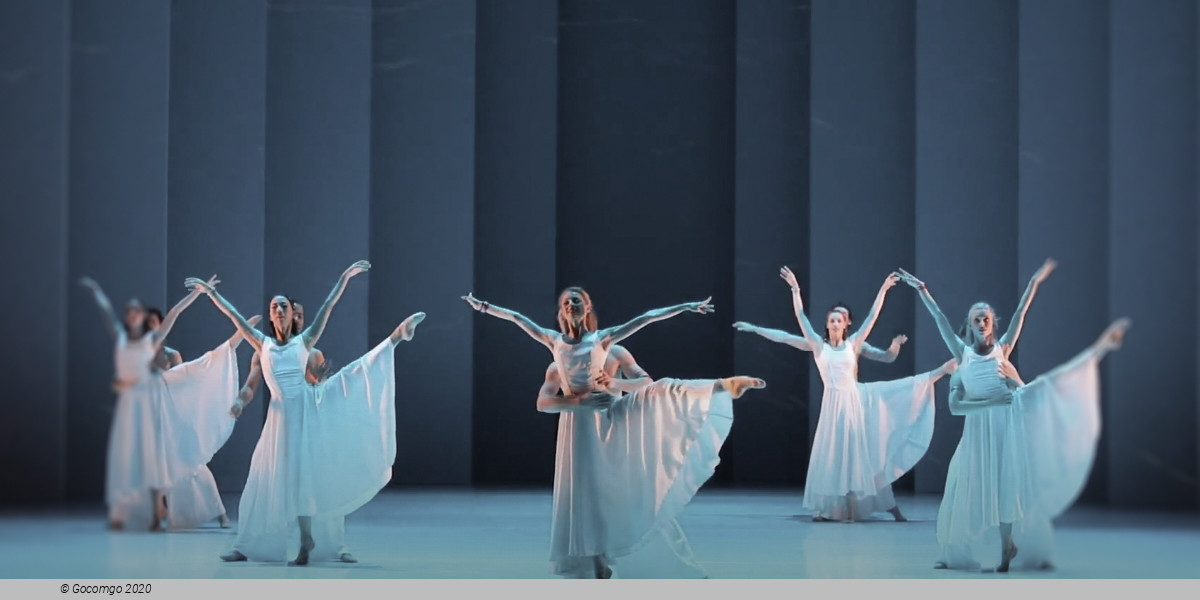
The women of the ensemble are dressed in what looks like the stylized folkloric attire, their pale silky dresses adorned with aprons and colorful ribbons, their hair braided and styled in a crown-like fashion. The leading ballerina, however, stands out from the crowd, wearing an alluring bright red dress. The costumes for the men are effective, but less attractive—plain white shirts and dark tights in assorted solid colors.

The ballet has a fragmented nature and resembles a collection of short stories or episodes. For the accompaniment, Ratmansky selected a dozen evanescent preludes from the original set of twenty-four; each one is different from the others in rhythm, texture, and tone, ranging from jazzy and spritely to meditative and slow.

In its use of folk motifs, “Songs of Bukovina” vividly echoes Ratmansky’s momentous “Russian Seasons,” another ballet set to Desyatnikov’s music. (Yet I found “Songs” to be more placid and restrained and somewhat less dramatically and visually intoxicating than “Seasons.”) Also, in some ways, particularly in its prevailing atmosphere of community and friendship and its piano-only accompaniment and five-couple structure, this ballet is akin to Jerome Robbins’s masterpiece “Dances at a Gathering.”

Ratmansky’s mastery of movement vocabulary finds its reflection in every moment and leitmotif of “Songs.” The choreography for the ensemble is intricate and fluid, its structural geometry infinitely varied and visually appealing; and there are many wonderful moments for the principals, too. There is an achingly beautiful solo for the leading ballerina, danced with exquisite poignancy and fragility by the excellent Isabella Boylston. Tranquil and sorrowful, her monologue looked as though the bride was bidding farewell to the carefree gayety of her girlhood. In another episode, she walks on the floor with her feet firmly flat as if underscoring solidity and steadiness of her new role as a future wife and a mother. In another episode, her partner, Gabe Stone Shayer, is dancing his heart out in a different kind of farewell: surrounded by his best men, he evokes a soldier going away to war.

There are so many ways to read and interpret Ratmansky’s ballets—his choreographic language is so rich in color, emotion, purpose, and meaning. “Songs” is no exception; and I look forward to seeing and rediscovering this piece again.

When, after the performance, the dancers came onto stage to take a bow, they were joined by Alexei Goribol, the Russian pianist, who played Desyatnikov’s preludes during the ballet and to whom the music was dedicated. Goribol, looking visibly moved, pointed to the theater and acknowledged the composer, who was sitting in the audience. A living composer attending the performance of his work—events like this, alas, don’t happen in ballet that often.

There is much to admire in “Songs of Bukovina.” It reveals before our eyes the world that is quiet, luminous, and downright happy (as opposed to the poignant “Odessa,” which shakes you to the core, leaving you gasping for air.) In fact, to watch this “Songs” is to partake in a festive village gathering and to experience what it feels like to be on a sunny afternoon in the area of the title, Bukovina, a picturesque region located on the northern side of Carpathians. When you watch “Songs,” you envision the bright rays of the sun illuminating the ground and almost feel a breeze of fresh mountain air. (These effects are in no small part due to the gorgeous lighting, created by Brad Fields, which floods the stage with an appealing golden glow and create a summery atmosphere.)

History

Experience the magic of three one-act ballets choreographed by MacArthur Genius Alexei Ratmanksy on the occasion of his 10th Anniversary as ABT Artist in Residence. Tales of youthful love, selfless devotion and exuberant folk traditions are colorfully brought to life in Songs of Bukovina, On the Dnieper and a World Premiere featuring ABT’s versatile dancers.

Venue Info

Metropolitan Opera - New York
Location   30 Lincoln Center

The Metropolitan Opera is an opera company based in New York City, resident at the Metropolitan Opera House at the Lincoln Center for the Performing Arts. The Metropolitan Opera is the largest classical music theatre in North America. It presents about 27 different operas each year from late September through May. As of 2018, the company's current music director is Yannick Nézet-Séguin.

The Metropolitan Opera Company was founded in 1883 as an alternative to New York's old established Academy of Music opera house. The subscribers to the Academy's limited number of private boxes represented the highest stratum in New York society. By 1880, these "old money" families were loath to admit New York's newly wealthy industrialists into their long-established social circle. Frustrated with being excluded, the Metropolitan Opera's founding subscribers determined to build a new opera house that would outshine the old Academy in every way. A group of 22 men assembled at Delmonico's restaurant on April 28, 1880. They elected officers and established subscriptions for ownership in the new company. The new theater, built at 39th and Broadway, would include three tiers of private boxes in which the scions of New York's powerful new industrial families could display their wealth and establish their social prominence. The first Met subscribers included members of the Morgan, Roosevelt, and Vanderbilt families, all of whom had been excluded from the Academy. The new Metropolitan Opera House opened on October 22, 1883, and was an immediate success, both socially and artistically. The Academy of Music's opera season folded just three years after the Met opened.

The operas are presented in a rotating repertory schedule, with up to seven performances of four different works staged each week. Performances are given in the evening Monday through Saturday with a matinée on Saturday. Several operas are presented in new productions each season. Sometimes these are borrowed from or shared with other opera companies. The rest of the year's operas are given in revivals of productions from previous seasons. The 2015–16 season comprised 227 performances of 25 operas.

The operas in the Met's repertoire consist of a wide range of works, from 18th-century Baroque and 19th-century Bel canto to the Minimalism of the late 20th century. These operas are presented in staged productions that range in style from those with elaborate traditional decors to others that feature modern conceptual designs.

The Met's performing company consists of a large symphony-sized orchestra, a chorus, a children's choir, and many supporting and leading solo singers. The company also employs numerous free-lance dancers, actors, musicians, and other performers throughout the season. The Met's roster of singers includes both international and American artists, some of whose careers have been developed through the Met's young artists programs. While many singers appear periodically as guests with the company, others, such as Renée Fleming and Plácido Domingo, long maintained a close association with the Met, appearing many times each season until they retired.

Important Info
Type: Ballet
City: New York, USA

E-tickets: Print at home or at the box office of the event if so specified. You will find more information in your booking confirmation email.

You can only select the category, and not the exact seats.
If you order 2 or 3 tickets: your seats will be next to each other.
If you order 4 or more tickets: your seats will be next to each other, or, if this is not possible, we will provide a combination of groups of seats (at least in pairs, for example 2+2 or 2+3).

Top of page