
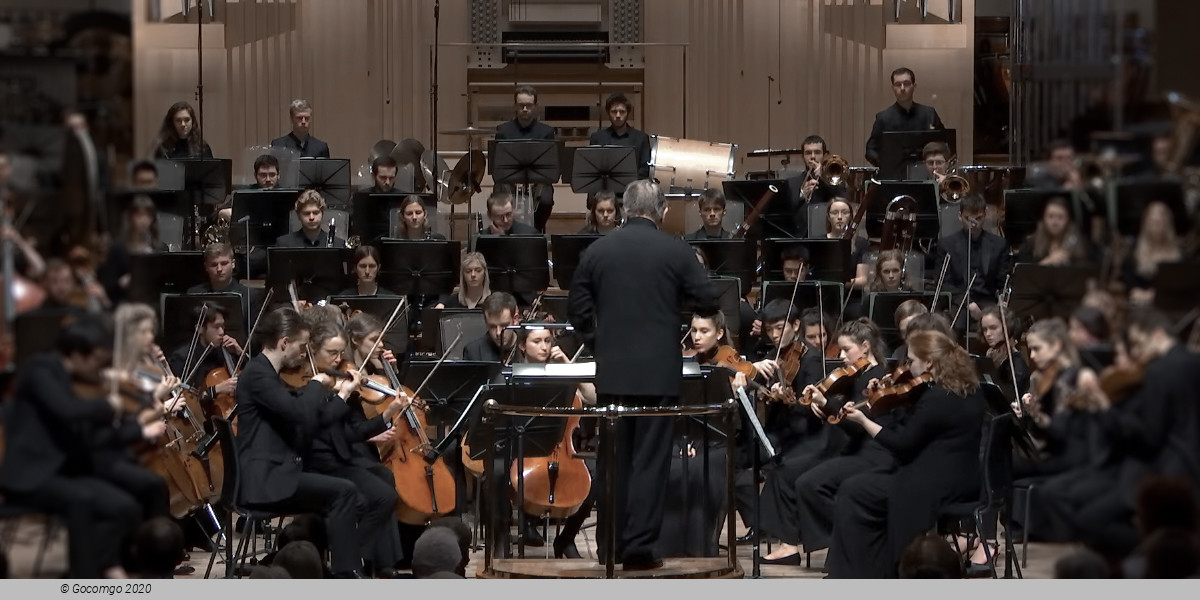
Teatro Alla Scala: Musical encounter (Chamber music concert George Gershwin et Negro spirituals) Tickets | Event Dates & Schedule | GoComGo.com

Musical encounter (Chamber music concert George Gershwin et Negro spirituals) Tickets

Teatro Alla Scala, Milan, Italy
Important Info
Type: Classical Concert
City: Milan, Italy

E-tickets: Print at home or at the box office of the event if so specified. You will find more information in your booking confirmation email.

You can only select the category, and not the exact seats.
If you order 2 or 3 tickets: your seats will be next to each other.
If you order 4 or more tickets: your seats will be next to each other, or, if this is not possible, we will provide a combination of groups of seats (at least in pairs, for example 2+2 or 2+3).

Cast
Performers
Choose the date to see the peformers
Overview

Sequences

  • Obie Edwin Philpot

He’s got the whole world in his hand

  • Florence Price

My soul’s been anchored in the lord

  • Jerome Kern

Ol’ man river

  • John Carter

Sometimes I feel like a motherless child

  • George Gershwin

What You Want Wid Bess

  • Julia Perry

I’m a lil’ poor orphan in this world

  • George Gershwin

My man’s gone now

  • Herbert Mells

Here is one

Burden’d chile

  • George Gershwin

I love you Porgy

I got plenty o’ nuttin

Summertime

  • Herbert Mells

I’ve got religion

  • George Gershwin

Bess you is my woman now

  • Margaret Bonds

He’s got the whole world in his hand

  • Uzee Brown

I want to die easy when I die

"He's Got the Whole World in His Hands" is a traditional American spiritual, first published in 1927. It became an international pop hit in 1957-58 in a recording by English singer Laurie London, and has been recorded by many other singers and choirs.

By many sources, including his published obituary, this song is said to have been written by Master Sergeant Obie Edwin Philpot, although he never held a copyright or earned a royalty. 

The song was first published in the paperbound hymnal Spirituals Triumphant, Old and New in 1927. In 1933, it was collected by Frank Warner from the singing of Sue Thomas in North Carolina. It was also recorded by other collectors such as Robert Sonkin of the Library of Congress, who recorded it in Gee's Bend, Alabama in 1941. That version is still available at the Library's American Folklife Center.

Frank Warner performed the song during the 1940s and 1950s, and introduced it to the American folk scene. Warner recorded it on the Elektra album American Folk Songs and Ballads in 1952. It was quickly picked up by both American gospel singers and British skiffle and pop musicians.

"Sometimes I Feel Like a Motherless Child" (or simply "Motherless Child") is a traditional Negro spiritual. It dates back to the era of slavery in the United States. An early performance of the song dates back to the 1870s by the Fisk Jubilee Singers. Like many traditional songs, it has many variations and has been recorded widely.

The song is an expression of pain and despair as it conveys the hopelessness of a child who has been torn from her or his parents. Under one interpretation, the repetitive singing of the word "sometimes" offers a measure of hope, as it suggests that at least "sometimes" I do not feel like a motherless child.

Although the plaintive words can be interpreted literally, they might alternatively be metaphoric. The "motherless child" could be an enslaved person separated from and yearning for his or her African homeland, his or her spouse, parents, siblings, or child(ren) (from all or any of which he or she may have been separated in the trafficking process) or an enslaved person suffering "a long ways from home"—home being heaven—or most likely all.

"Ol' Man River" (music by Jerome Kern, lyrics by Oscar Hammerstein II) is a show tune from the 1927 musical Show Boat that contrasts the struggles and hardships of African Americans with the endless, uncaring flow of the Mississippi River. It is sung from the point of view of a black stevedore on a showboat, and is the most famous song from the show. The song is meant to be performed in a slow tempo, it is sung complete once in the musical's lengthy first scene by the stevedore "Joe" who travels with the boat, and, in the stage version, is heard four more times in brief reprises. Joe serves as a sort of musical one-man Greek chorus, and the song, when reprised, comments on the action, as if saying, "This has happened, but the river keeps rolling on anyway."

The song is notable for several aspects: the lyrical pentatonic-scale melody, the subjects of toil and social class, metaphor to the Mississippi, and as a bass solo (rare in musicals, solos for baritones or tenors being more common).

Paul Whiteman and His Orchestra had a hit recording of the song in 1928, in a much faster tempo than Kern and Hammerstein intended, and featuring Bing Crosby on vocals and Bix Beiderbecke on cornet. A second version, by Paul Whiteman with bass singer Paul Robeson on vocals and sung in a dance tempo, was inducted into the Grammy Hall of Fame in 2006. In 2004, Robeson's version finished at #24 on AFI's 100 Years...100 Songs survey of top tunes in American cinema.

"My Man's Gone Now" is an aria composed by George Gershwin, with lyrics by DuBose Heyward, written for the opera Porgy and Bess (1935).

Sung in the original production by Ruby Elzy, it has been covered by many singers, notably Ella Fitzgerald (on the 1958 Porgy and Bess album), Leontyne Price, Audra McDonald (who would later sing the part of Bess), Nina Simone, Sarah Vaughan, and Shirley Horn, among others.

"I Loves You, Porgy" is a duet from the opera Porgy and Bess with music by George Gershwin and lyrics by Ira Gershwin. It was published in 1935.

Background
Originally a duet by Anne Brown and Todd Duncan in the 1935 production and in the 1942 revival of the opera, "I Loves You, Porgy" has been recorded as a solo number by a number of popular vocalists and jazz musicians, most notably Billie Holiday, Nina Simone, and Bill Evans. Nina Simone's recording of the song (from Little Girl Blue, 1958) was a Top 20 pop hit in the United States in the autumn of 1959. Simone's version went to number eighteen on the Billboard Hot 100 and number two on the R&B charts. A live version is featured in her 1964 album Nina Simone in Concert. Bill Evans's piano trio version recorded at the Village Vanguard in 1961, available on the CD re-issue of the album Waltz for Debby, is also acclaimed.

"Summertime" is an aria composed in 1934 by George Gershwin for the 1935 opera Porgy and Bess. The lyrics are by DuBose Heyward, the author of the novel Porgy on which the opera was based, although the song is also co-credited to Ira Gershwin by ASCAP.

The song soon became a popular and much recorded jazz standard, described as "without doubt ... one of the finest songs the composer ever wrote ... Gershwin's highly evocative writing brilliantly mixes elements of jazz and the song styles of blacks in the southeast United States from the early twentieth century". Composer and lyricist Stephen Sondheim has characterized Heyward's lyrics for "Summertime" and "My Man's Gone Now" as "the best lyrics in the musical theater".

"Bess, You Is My Woman Now" is a duet with music by George Gershwin and lyrics by Ira Gershwin. This song comes from the Gershwins' opera Porgy and Bess (1935) where it is sung by the main character Porgy and his beloved Bess. They express their love for each other and say that they now belong together.

The song has been covered a number of times by many artists since 1935 (Porgy and Bess (Ella Fitzgerald and Louis Armstrong album)). In 1959, Harry Belafonte recorded a duet with Lena Horne on their album Porgy and Bess. In 1954 Harry James released a version on his album Trumpet After Midnight (Columbia CL-553). Barbra Streisand recorded this song on her The Broadway Album from 1985, named "I Loves You, Porgy/Porgy, I's Your Woman Now (Bess, You Is My Woman Now)".

Venue Info

Teatro Alla Scala - Milan
Location   Via Filodrammatici, 2

Teatro Alla Scala is an opera house in Milan. Most of Italy's greatest operatic artists, and many of the finest singers from around the world, have appeared at La Scala. The theatre is regarded as one of the leading opera and ballet theatres globally. It is home to the La Scala Theatre Chorus, La Scala Theatre Ballet, La Scala Theatre Orchestra, and the Filarmonica della Scala orchestra.

The Teatro alla Scala was founded, under the auspices of the Empress Maria Theresa of Austria, to replace the Royal Ducal Theatre, which was destroyed by fire on 26 February 1776 and had until then been the home of opera in Milan. The cost of building the new theatre was borne by the owners of the boxes at the Ducal, in exchange for possession of the land on which stood the church of Santa Maria alla Scala (hence the name) and for renewed ownership of their boxes. Designed by the great neoclassical architect Giuseppe Piermarini, La Scala opened on 3 August 1778 with Antonio Salieri's opera L'Europa riconosciuta, to a libretto by Mattia Verazi.

With the advent of Rossini in 1812 (La pietra del paragone), the Teatro alla Scala was to become the appointed place of Italian opera seria: of its history dating back more than a century and of its subsequent tradition up till the present. The catalogue of Rossini's works performed until 1825 included: Il turco in Italia, La Cenerentola, Il barbiere di Siviglia, La donna del lago, Otello, Tancredi, Semiramide and Mosé. During that period the choreographies of Salvatore Viganò (1769-181) and of Carlo Blasis (1795-1878) also widened the theatre's artistic supremacy to include ballet.

An exceptional new season of serious opera opened between 1822 and 1825, with Chiara e Serafina by Gaetano Donizetti (1797-1848) and Il pirata by Vincenzo Bellini (1801-1835). The later operas of Donizetti performed at La Scala were (until 1850) Anna Bolena, Lucrezia Borgia, Torquato Tasso, La fille du régiment, La favorita, Linda di Chamonix, Don Pasquale, and Poliuto. These were followed (until 1836) by Bellini's I Capuleti e i Montecchi, Norma, La sonnambula, Beatrice di Tenda and I puritani.

In 1839 Oberto Conte di San Bonifacio inaugurated the cycle of operas by Giuseppe Verdi (1813-1901), the composer whose name is linked more than any other to the history of La Scala. After the dismal failure of Un giorno di regno, Nabucco was performed in 1842. It was the first, decisive triumph of Verdi's career. At the same time, the strong patriotic feelings stirred by Nabucco founded the "popularity" of opera seria and identified its image with the Scala.

Arturo Toscanini (1867-1957) became the artistic director and introduced radical reform into the theatre, both in its organisational aspects and in its relations with the public. Toscanini, one of the greatest conductors of all time, took up Verdi's musical inheritance and launched a tradition of interpretation that continued uninterruptedly and was renewed during the twentieth century. It was he who reappraised and regularly performed at the Scala the works of Richard Wagner (hitherto only belatedly and inadequately recognised). He also firmly extended the Scala's orchestral repertoire to include symphonic music.

In 1948 maestro Guido Cantelli (1920-1956) made his debut and established himself as one of the leading postwar conductors. Numerous opera performances productions (the Wagnerian cycle conducted in 1950 by Wilhelm Furtwängler, the Verdi repertoire by Victor De Sabata, etc), concerts (Herbert von Karajan, Dimitri Mitropoulos, Bruno Walter, etc), singers (Maria Callas, Renata Tebaldi, Giuseppe Di Stefano, Mario Del Monaco, etc), ballet performances (Margot Fonteyn, Serge Lifar, Maya Plissetskaya, Rudolf Nureyev), and productions (Luchino Visconti, Giorgio Strehler) belong not only to the history of the Scala, but to that of the history of musical theatre since the war.

In 1965 Claudio Abbado made his début at the Scala and in 1972 was named conductor of the Scala Orchestra. Until 1986 he directed among other works Il barbiere di Siviglia, Cenerentola, L'Italiana in Algeri by Rossini, Simon Boccanegra, Macbeth and Don Carlo by Verdi, the recent Al gran sole carico d'amore by Luigi Nono, and Pelléas et Mélisande by Claude Debussy. He also conducted numerous concerts. The chorus-master was Romano Gandolfi. In 1975 the ballet dancer Oriella Dorella debuted at La Scala. Among other contemporary composers, up till 1986 the Theatre continued to give works by Luciano Berio (La vera storia), Franco Donatoni (Atem) and Karlheinz Stockhausen (Samstag aus Licht).

In 1981 Riccardo Muti debuted at the Scala as an opera conductor (Mozart, Le nozze di Figaro). Giulio Bertola was appointed to direct the Chorus. In 1982 the Orchestra Filarmonica della Scala was established. In 1985 Alessandra Ferri made her debut at the Scala. In 1986 Riccardo Muti was appointed musical director. From 1989 to 1998 he reintroduced the best-loved works (Rigoletto, La traviata, Macbeth, La forza del destino) and numerous other titles by Verdi including Falstaff and Don Carlo.

In 1991 Roberto Gabbiani took over the directorship of the chorus. In 1997 La Scala was converted into a Foundation under private ownership, thus opening a decisive phase of modernisation.

On 7 December 2001 a new production of Otello, conducted by Muti, concluded the Verdi Year and, for the time being, performances at Piermarini’s original building in Piazza Scala. Major restoration and modernisation works of the Theatre began in January 2002.

The 2005-2006 Season, dedicated to the 250th anniversary of Mozart’s birth, was inaugurated by Idomeneo conducted by Daniel Harding. The 2006/07 season saw the return on 7 December of an opera by Verdi, Aida, conducted by Riccardo Chailly, and the launch of the Celebrations for the 50th Anniversary of Arturo Toscanini’s Death. On 7 December 2007 the 2007/08 season opened with Tristan und Isolde conducted by Daniel Barenboim. The opera marked the beginning of a closer collaboration between the Teatro alla Scala and the Israeli-Argentinian Maestro.

Important Info
Type: Classical Concert
City: Milan, Italy

E-tickets: Print at home or at the box office of the event if so specified. You will find more information in your booking confirmation email.

You can only select the category, and not the exact seats.
If you order 2 or 3 tickets: your seats will be next to each other.
If you order 4 or more tickets: your seats will be next to each other, or, if this is not possible, we will provide a combination of groups of seats (at least in pairs, for example 2+2 or 2+3).

Top of page