







Shanghai Oriental Art Center tickets 27 December 2026 - La Bayadère - Tatar State Academic Theatre Ballet | GoComGo.com

La Bayadère - Tatar State Academic Theatre Ballet

Shanghai Oriental Art Center, Opera Hall, Shanghai, China
Select date and time
2 PM 7:15 PM
From
US$ 81

E-tickets: Print at home or at the box office of the event if so specified. You will find more information in your booking confirmation email.

You can only select the category, and not the exact seats.
If you order 2 or 3 tickets: your seats will be next to each other.
If you order 4 or more tickets: your seats will be next to each other, or, if this is not possible, we will provide a combination of groups of seats (at least in pairs, for example 2+2 or 2+3).

Important Info
Type: Ballet
City: Shanghai, China
Starts at: 14:00
Duration:

E-tickets: Print at home or at the box office of the event if so specified. You will find more information in your booking confirmation email.

You can only select the category, and not the exact seats.
If you order 2 or 3 tickets: your seats will be next to each other.
If you order 4 or more tickets: your seats will be next to each other, or, if this is not possible, we will provide a combination of groups of seats (at least in pairs, for example 2+2 or 2+3).

Cast
Performers
Conductor: Andrey Anikhanov
Ballet dancer: Amanda Gomes
Ballet company: Musa Dzhalil Tatar Academic State Opera and Ballet Theatre
Ballet dancer: Oleg Ivenko
Ballet company: Tatarstan State Academic Ballet Theatre
Ballet dancer: Wagner Carvalho
Creators
Composer: Ludwig Minkus
Choreography: Marius Petipa
Choreography: Natalia Makarova
Librettist: Sergei Khudekov
Overview

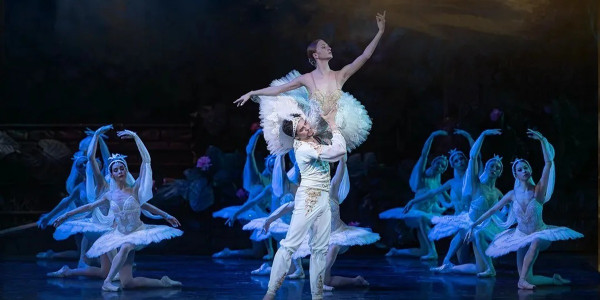
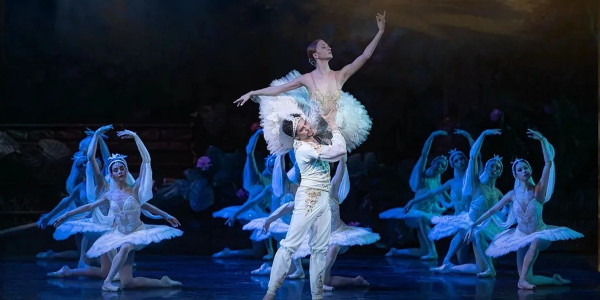
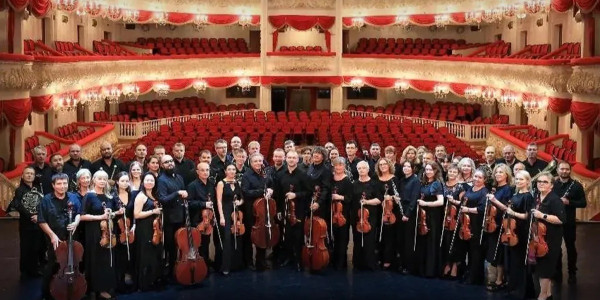
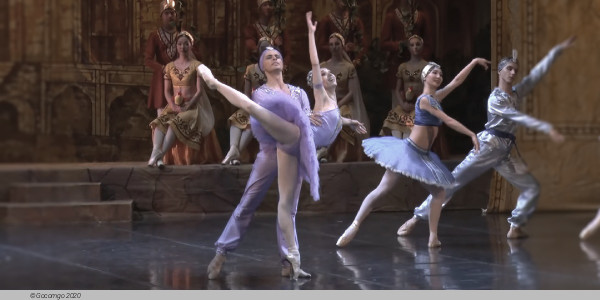
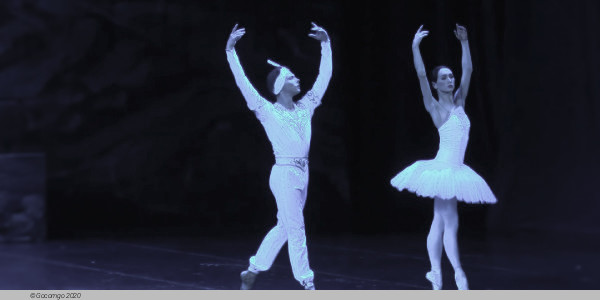
The Tatar State Academic Theatre presents La Bayadère with live symphony orchestra accompaniment.

This production brings the ballet to the stage with orchestral music performed live.

Cast (names transliterated)

Ballet artistic director: Vladimir Yakovlev. Conductor: Andrey Anikhanov (guest conductor). Main artists: Oleg Ivenko, Kristina Andreeva, Amanda Gomes, Wagner Carvalho, Mikhail Timaev, Anton Polodiuk. Live symphony orchestra of the theatre.

Casting may change on the day.

The ballet company and orchestra of the Tatar State Academic Opera and Ballet Theatre present La Bayadère with live symphonic accompaniment.

The Tatar State Academic Opera and Ballet Theatre named after Musa Jalil, based in Kazan, is represented by its ballet company and orchestra. According to the organiser, the theatre won Russia's Onegin national award in the Theatre category.

The announced touring cast includes principals Amanda Gomes, Wagner Carvalho and Oleg Ivenko.

Andrey Anikhanov is credited as conductor and as an Honored Artist of the Russian Federation. His biography also lists guest engagements with the Bolshoi Theatre and the Tatar Opera.

Every child needs their own ticket.

In 1980 Makarova staged her own version of the full-length work for the company, based largely on the Ponomarev/Chabukiani version she danced during her career with the Kirov Ballet. Makarova's production premiered on May 21, 1980 at the Metropolitan Opera House, and was shown live on PBS during the Live from Lincoln Center broadcast. Makarova danced the role of Nikiya herself, but was replaced by Marianna Tcherkassky due to an injury during the first act. The principal roles included Anthony Dowell as Solor, Cynthia Harvey as Gamzatti, Alexander Minz as the High Brahmin and Victor Barbee as the Rajah. The décor was designed by Pier Luigi Samaritani, with costumes by Theoni V. Aldredge. The premiere was a triumph for American Ballet Theatre, and the company has performed it consistently ever since.

History
Premiere of this production: 23 January 1877, Imperial Bolshoi Kamenny Theatre in St. Petersburg, Russia

La Bayadère (en. The Temple Dancer) is a ballet, originally staged in four acts and seven tableaux by French choreographer Marius Petipa to the music of Ludwig Minkus. The ballet was staged especially for the benefit performance of the Russian Prima ballerina Ekaterina Vazem, who created the principal role of Nikiya.

Synopsis

Set in the Royal India of the past, La Bayadère is a story of eternal love, mystery, fate, vengeance, and justice.  The ballet relates the drama of a temple dancer (bayadère), Nikiya, who is loved by Solor, a noble warrior.  She is also loved by the High Brahmin, but does not love him in return, as she does Solor.

Act I

Scene I, Outside Temple in the Sacred Forest.

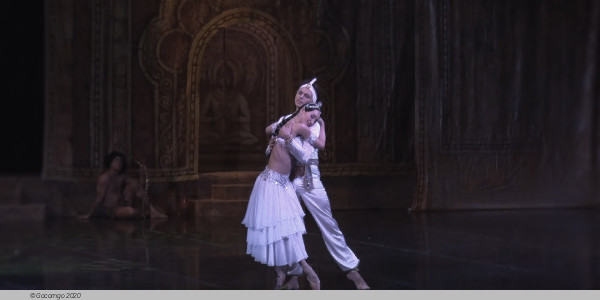
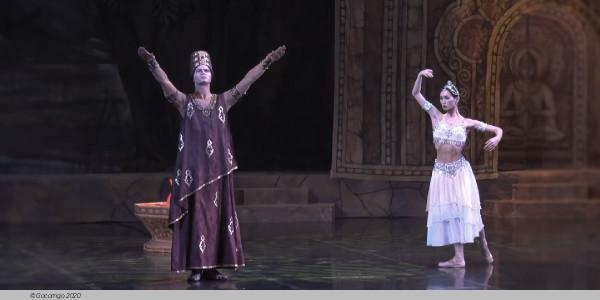
The High Brahmin, priests, and temple dancers are celebrating the Indian Ritual of Fire.  Nikiya, the most beautiful of the bayadères, has been chosen to be consecrated the lead temple dancer.  The High Brahmin declares his love for Nikiya, but is rejected by her.  Nikiya meets secretly with Solor later that evening.  They dance together and swear eternal love over the Sacred Fire, but are discovered by the jealous High Brahmin, who vows to kill Solor.

Scene II, A Room in the Palace.

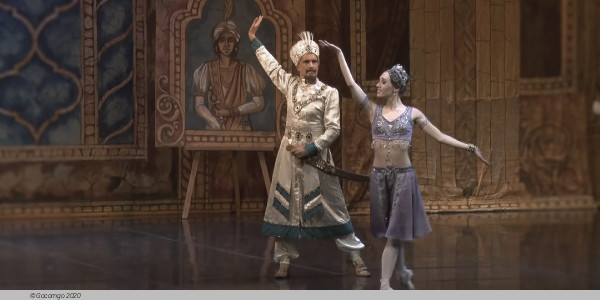
The Rajah has decided to reward Solor’s valor and decrees that the warrior will marry his daughter, Gamzatti.  Gamzatti falls in love with Solor’s portrait, and when they meet, he is overwhelmed by her beauty.  Even though he has sworn eternal love to Nikiya, he cannot defy the wishes of the Rajah and agrees to marry Gamzatti.  The High Brahmin informs the Rajah of Nikiya and Solor’s secret love, hoping that the Rajah will do away with Solor.  Instead, the Rajah decides to kill Nikiya.

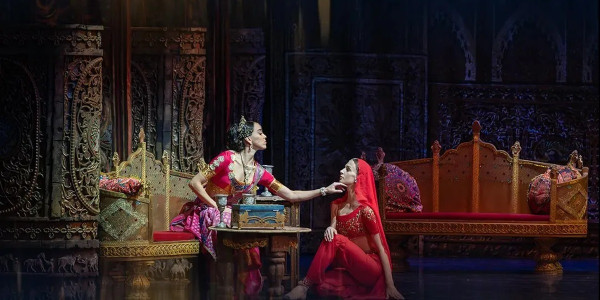
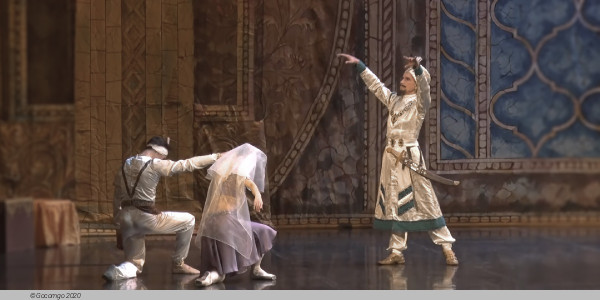
This conversation is overhead by Gamzatti, who summons Nikiya to her rooms and attempts to bribe Nikiya to give up Solor.  Refusing, Nikiya frantically attempts to kill  Gamzatti.  Nikiya flees and Gamzatti swears to destroy her.

Scene III, The Garden of the Palace.

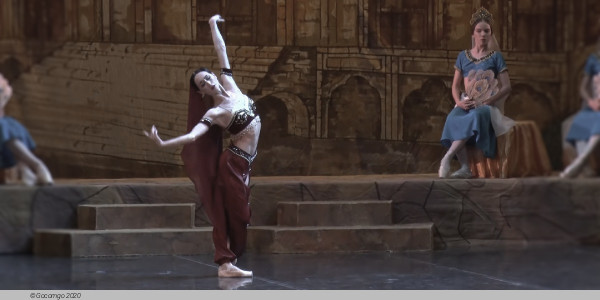
At the betrothal of Solor and Gamzatti, Nikiya is commanded to dance.  Gamzatti presents her with a basket of flowers that Nikiya believes to be from Solor, and which conceals a deadly snake.  Nikiya is bitten, and when Solor leaves with Gamzatti, she refuses the proffered antidote and dies.

Act II. The Tent of Solor.

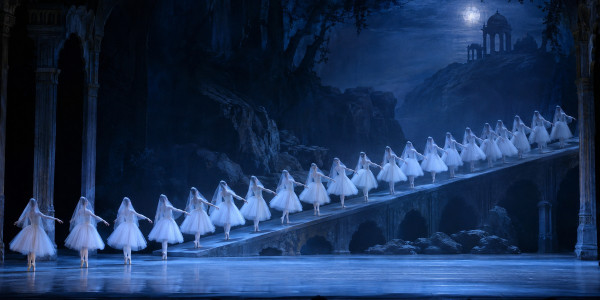
Solor, grief‑stricken and under the influence of opium, dreams of being reunited with Nikiya in the Kingdom of the Shades.  Awakening, he realizes that he must prepare to marry Gamzatti.

Act III. The Temple.

The vision of Nikiya remains with Solor as the wedding ceremony begins at the Sacred Temple.  As Solor and Gamzatti say their vows and are blessed by the High Brahmin, the vengeance of the gods is unleashed, and the temple and all the celebrants are destroyed.  Nikiya and Solor are once again united in eternal love.

Venue Info

Shanghai Oriental Art Center - Shanghai
Location   425 Dingxiang Lu, near Century Blvd

The Shanghai Oriental Art Center is one of the leading performance and cultural facilities in Shanghai. The five interconnected hemispherical halls or "petals" are shaped to resemble a butterfly orchid from above. They comprise the Entrance Hall, the Concert Hall, the Opera Hall, the Performance Hall, and the Exhibition Hall. The high-tech ceiling changes color during the night to reflect the nature of the performances inside. Located off Century Avenue in Pudong, the SHOAC was opened with a New Year's Eve concert in 2004 and officially opened on July 1, 2005.

Various cultural and musical performances are held in the center, beginning from the 2005 Berlin Philharmonic Orchestra Shanghai Concert. It's a regular venue for concert performances and its popular "Chinese Traditional Opera Series" hosts performances by the China National Opera, the Shanghai Jingju Theatre Company and Shanghai Kunqu Company, and the Shanghai Yueju Opera Troupe. The OAC's Saturday Brunch Concerts claim audiences of over 100 000 every year.

The building was designed by French architect Paul Andreu and the Huadong Architectural Design & Research Institute. The façades are mainly laminated glass incorporating perforated metal sheets. The dark granite floors and multi-layered glass screen walls aim to create a softly diffused forest floor effect. The separate "petals" of the construction are hung with large distinctly colored pebbles to differentiate them. The backstage facilities include an Orchestra Rehearsal Hall, Choir Rehearsal Hall, Dance Rehearsal Hall, and Integrated Rehearsal Hall.

Concert Hall
The Concert Hall has 1953 seats, a computer-controlled elevating stage, and an 88-diapason 5-layer organ by Austria's Rieger Pipe Organ. It houses 2 VIP and 7 regular dressing rooms.

Opera Hall
The Opera Hall has 1015 seats, divided into three areas and designed to recreate the intimate experience of Italian opera houses. The orchestra pit is 120 m2 and able to accommodate up to 100 musicians. The central stage provides computer-controlled side, ice, and ballet platforms in addition to the main large-scale platform. It houses 2 VIP and 15 common dressing rooms.

Performance Hall
The Performance Hall has 333 seats and is modeled on semicircular Roman theaters. Its performance floor is golden Swiss pearwood. It has 4 dressing rooms.

Exhibition Hall
The Exhibition Hall is located on the second floor of its petal of the Oriental Art Center. It covers 250 m2 and has 9.8-meter  high walls.

Other facilities
The venue also features ancillary public facilities, including the 100-seat Paris Shanghai French restaurant open daily for lunch and dinner, the 530-square-meter (5,700 sq ft) Café Salon Etoile and an adjacent gift store, and 11 piano training classrooms. The Shanghai Gallery of Antique Music Boxes and Automata is located at the SHOAC, displaying over 200 antique music boxes and European automata, including the oldest extant music box in the world, constructed in 1796 by Antoine Favre-Salomon.

Important Info
Type: Ballet
City: Shanghai, China
Starts at: 14:00
Duration:
Top of page