









Royal Opera House (Covent Garden) 18 December 2019 - Concerto / Enigma Variations / Raymonda Act III | GoComGo.com

Concerto / Enigma Variations / Raymonda Act III

Royal Opera House (Covent Garden), London, Great Britain
All photos (1)
Select date and time
1:30 PM 7 PM
Request for Tickets
Important Info
Type: Ballet
City: London, Great Britain
Starts at: 19:00
Duration:

E-tickets: Print at home or at the box office of the event if so specified. You will find more information in your booking confirmation email.

You can only select the category, and not the exact seats.
If you order 2 or 3 tickets: your seats will be next to each other.
If you order 4 or more tickets: your seats will be next to each other, or, if this is not possible, we will provide a combination of groups of seats (at least in pairs, for example 2+2 or 2+3).

Overview

From The Royal Ballet’s classical origins to the home-grown choreographers who put British ballet on the world stage, this programme highlights the versatility of the Company.

From The Royal Ballet’s classical origins in the works of Petipa, to the home-grown choreographers who put British ballet on the world stage, this mixed programme highlights the versatility of the Company. Petipa’s Raymonda Act III is Russian classical ballet summarized in one act, full of sparkle and precise technique, while Ashton’s Enigma Variations is quintessentially British in every way – from its score by Elgar and period designs by Julia Trevelyan Oman, to Ashton’s signature style, the essence of British ballet. Concerto, MacMillan’s fusion of classical technique with a contemporary mind, completes a programme that shows the breadth of the Company’s heritage.

Youthful energy and technical precision are combined in Kenneth MacMillan’s virtuoso ballet, set to Shostakovich’s Second Piano Concerto.

The essence of British ballet, with music by Elgar, period designs by Julia Trevelyan Oman and Ashton's signature choreographic style.

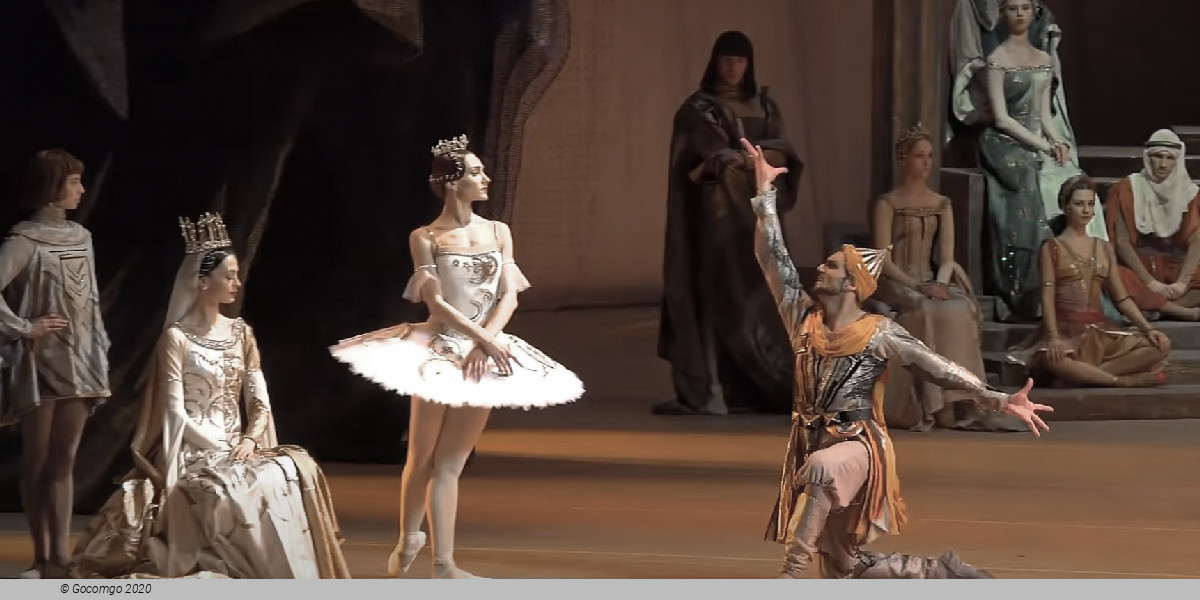
The final act of Petipa's grand ballet classic, which contains some of the greatest choreography in Russian ballet, was adapted by Rudolf Nureyev.

The full-length Raymonda has been revived many times throughout its performance history. One of the most noted production being staged Act III by Rudolf Nureyev for the Royal Ballet and the Norwegian Ballet (Oslo).


History
Premiere of this production: 30 November 1966, Deutsche Oper, Berlin

Concerto is a one-act ballet in three movements created by Kenneth MacMillan in 1966 for the Berliner Ballett. The music is Dmitri Shostakovich's Second Piano Concerto (1957).

Premiere of this production: 25 October 1968, Royal Opera House, London

Enigma Variations (My Friends Pictured Within) is a one-act ballet by Frederick Ashton, to the music of the Variations on an Original Theme (Enigma Variations), Op. 36, by Edward Elgar. The work was first given by the Royal Ballet at the Royal Opera House, Covent Garden, London, on 25 October 1968. It has been revived in every subsequent decade.

Edward Elgar composed his Variations on an Original Theme, Op. 36, popularly known as the Enigma Variations, between October 1898 and February 1899. It is an orchestral work comprising fourteen variations on an original theme.

Premiere of this production: 19 January 1898, Imperial Mariinsky Theatre, Saint Petersburg, Russia

Raymonda  is a ballet in three acts, four scenes with an apotheosis, choreographed by Marius Petipa to music by Alexander Glazunov, his Opus 57. First presented by the Imperial Ballet at the Imperial Mariinsky Theatre on 19 January [O.S. 7 January] 1898 in Saint Petersburg, Russia. The ballet was created especially for the benefit performance of the Italian ballerina Pierina Legnani, who created the title role. Among the ballet's most celebrated passages is the Pas classique hongrois (a.k.a. Raymonda Pas de dix) from the third act, which is often performed independently.

Synopsis

The piece shows an imaginary gathering of Elgar and his friends at the Elgars' house in Worcestershire. The composer, at this point in his career struggling and little known, is awaiting a message from London. While they are waiting, the Elgars and their friends are portrayed in dances representing their personalities. After the last of these, Ashton contributes his own "enigma"; a telegram arrives: the characters know, but the audience does not, that it is from the celebrated conductor Hans Richter agreeing to conduct Elgar's new work. There is an exuberant finale.

Ashton, drawing on a commentary written by the composer in 1929, included in the programme alongside the cast list the notes in the third column, below. The words in quotation marks are by Elgar.

Act III

The Wedding

Raymonda and Jean de Brienne are finally married and King Andrew II of Hungary gives the newly wedded couple his blessing. In his honour, everyone at court is dressed in Hungarian fashion and perform a range of Hungarian-style dances, ending in an Apotheosis where everyone comes together in a knightly tournament.

Act I
Scene 1: Raymonda's feast

At the castle of Doris, preparations are under way for the celebrations of the young countess Raymonda’s name day. Countess Sybille, her aunt, chides those who are present, including Raymonda's two friends Henrietta and Clémence, and the two troubadours Béranger and Bernard, for their idleness and their passion for dancing, telling them of the legendary White Lady, the protector of the castle, who warns the Doris household every time one of its members is in danger and casts punishment on those who do not fulfil their duties. The young people laugh at the countess’s superstitions and continue to celebrate. The seneschal of the Doris castle announces the arrival of a messenger, sent by Raymonda's fiancé, the noble crusader knight, Jean de Brienne, bearing a letter for his beloved. Raymonda rejoices when she reads that King Andrew II of Hungary, for whom Jean de Brienne has fought, is returning home in triumph and Jean de Brienne will arrive at the Doris castle the next day for their wedding. Suddenly, the celebrations are interrupted when the seneschal announces the arrival of an uninvited Saracen knight, Abderakhman and his entourage, who have stopped at the castle seeking shelter for the night. Captivated by Raymonda's beauty, Abderakhman falls in love with her at once and resolves to do anything to win her. The party lasts late into the night and, left alone and exhausted by the day, Raymonda lies down on a couch and falls asleep. As she sleeps, she begins to dream that the White Lady appears illuminated by the moonlight and, with an imperious gesture, orders Raymonda to follow her.

Scene 2: The Visions

The White Lady, without making a sound, advances along the terrace. Raymonda follows her in a state of unconsciousness. At a signal from the White Lady, the garden is wrapped in mist. A moment later, the mist vanishes and Jean de Brienne appears. Overjoyed, Raymonda runs into his arms and they are surrounded by glory, knights and celestial maidens. The garden is illuminated by a fantastic light and Raymonda expresses her joy to the White Lady, who interrupts her enthusiasm with a vision of what awaits her. Raymonda wants to return to her fiancé, but instead, she finds Abderakhman, who has taken Jean de Brienne's place. Abderakhman declares his passionate love for her, but Raymonda, though confused and upset, is quick to reject him. Imps and elves appear from everywhere surrounding Raymonda, who begs the White Lady to save her and Abderakhman tries to take Raymonda by force. Raymonda cries out and falls to the ground in a faint. The frightful vision disappears along with the White Lady.

Act II
The Courtyard of the Castle

The feast in honour of Jean de Brienne's arrival is taking place. Raymonda welcomes her guests, but cannot hide her uneasiness caused by Jean de Brienne’s delay. Abderakhman approaches her repeatedly and reveals his passion for her, but remembering the warnings of the White Lady, Raymonda rejects him with contempt. Abderakhman becomes even more insistent and realises the only way to possess Raymonda is by force. He calls his slaves to dance for her, after which he summons his cup bearers and they pour a potion into everyone’s cup, causing all the guests to become drunk. Seizing his chance, Abderakhman grabs Raymonda in an attempt to abduct her, but luckily Jean de Brienne arrives just in time, accompanied by King Andrew II and his knights. Jean de Brienne saves Raymonda from the hands of the Saracens and tries to seize Abderakhman. The King commands the two rivals to put an end to the matter in a duel, during which the White Lady appears on the castle tower. Abderakhman is dazed and dies, slain by Jean de Brienne's sword. Raymonda joyfully embraces her fiancé and the two reaffirm their love as the King joins their hands.

Act III
The Wedding

Raymonda and Jean de Brienne are finally married and King Andrew II of Hungary gives the newly wedded couple his blessing. In his honour, everyone at court is dressed in Hungarian fashion and perform a range of Hungarian-style dances, ending in an Apotheosis where everyone comes together in a knightly tournament.

Venue Info

Royal Opera House (Covent Garden) - London
Location   Bow St, Covent Garden

The Royal Opera House (ROH) is an opera house and major performing arts venue in London and Great Britain. It is the home of The Royal Opera, The Royal Ballet, and the Orchestra of the Royal Opera House.

The large building is often referred to as simply "Covent Garden", after a previous use of the site of the opera house's original construction in 1732. It is the home of The Royal Opera, The Royal Ballet, and the Orchestra of the Royal Opera House. Originally called the Theatre Royal, it served primarily as a playhouse for the first hundred years of its history. In 1734, the first ballet was presented. A year later, Handel's first season of operas began. Many of his operas and oratorios were specifically written for Covent Garden and had their premieres there.

The current building is the third theatre on the site following disastrous fires in 1808 and 1856. The façade, foyer, and auditorium date from 1858, but almost every other element of the present complex dates from an extensive reconstruction in the 1990s. The main auditorium seats 2,256 people, making it the third largest in London, and consists of four tiers of boxes and balconies and the amphitheatre gallery. The proscenium is 12.20 m wide and 14.80 m high. The main auditorium is a Grade I listed building.

The Royal Opera, under the direction of Antonio Pappano, is one of the world’s leading opera companies. Based in the iconic Covent Garden theatre, it is renowned both for its outstanding performances of traditional opera and for commissioning new works by today’s leading opera composers, such as Harrison Birtwistle, Mark-Anthony Turnage and Thomas Adès.

The Royal Ballet is one of the world’s greatest ballet companies. Under the directorship of Kevin O’Hare, the Company unites tradition and innovation in world-class performances at our Covent Garden home.

The Company’s extensive repertory embraces 19th-century classics, the singular legacy of works by Founder Choreographer Frederick Ashton and Principal Choreographer Kenneth MacMillan and a compelling new canon by Resident Choreographer Wayne McGregor and Artistic Associate Christopher Wheeldon.

The Orchestra performs in concerts of their own, including performances at the Royal Opera House with Antonio Pappano. They have also performed at venues worldwide including Symphony Hall (Birmingham), Cadogan Hall, the Vienna Konzerthaus and on tour with The Royal Opera.

Members of the Orchestra play an active role in events across the Royal Opera House, including working with the Learning and Participation teams. The Orchestra accompanies performances that are streamed all over the world, including through cinema screenings and broadcasts. They appear on many CDs and DVDs including Pappano’s acclaimed studio recording of Tristan und Isolde with Plácido Domingo and Nina Stemme.

The Orchestra of the Royal Opera House was founded in 1946 when the Royal Opera House reopened after World War II.

Important Info
Type: Ballet
City: London, Great Britain
Starts at: 19:00
Duration:
Top of page