

Prague National Theatre 13 January 2023 - The Jacobin | GoComGo.com

The Jacobin

Prague National Theatre, The National Theatre, Prague, Czech Republic
All photos (1)
Select date and time
7 PM

E-tickets: Print at home or at the box office of the event if so specified. You will find more information in your booking confirmation email.

You can only select the category, and not the exact seats.
If you order 2 or 3 tickets: your seats will be next to each other.
If you order 4 or more tickets: your seats will be next to each other, or, if this is not possible, we will provide a combination of groups of seats (at least in pairs, for example 2+2 or 2+3).

Important Info
Type: Opera
City: Prague, Czech Republic
Starts at: 19:00
Acts: 3
Intervals: 2
Duration: 3h
Sung in: Czech
Titles in: Czech,English

E-tickets: Print at home or at the box office of the event if so specified. You will find more information in your booking confirmation email.

You can only select the category, and not the exact seats.
If you order 2 or 3 tickets: your seats will be next to each other.
If you order 4 or more tickets: your seats will be next to each other, or, if this is not possible, we will provide a combination of groups of seats (at least in pairs, for example 2+2 or 2+3).

Overview

A playful, humorous and tender production for children and adults alike. Let’s return to our schooldays for a while!

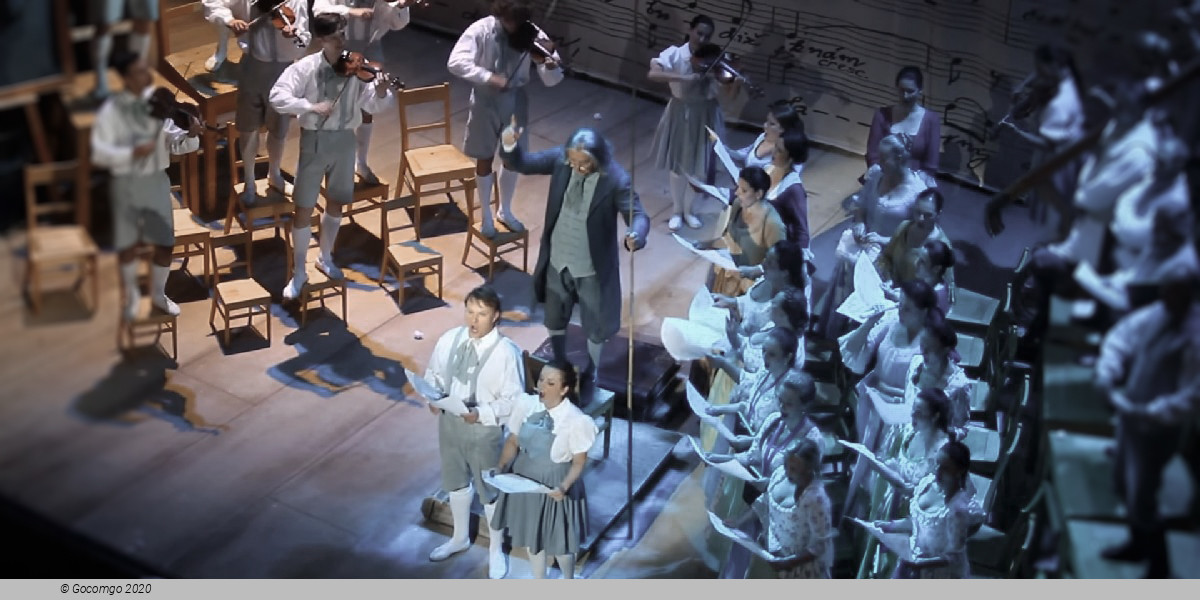
Dvořák’s The Jacobin is one of the most popular and most frequently performed Czech operas. Set in the 18th century, the plot unfurls in a small Czech town, to which a “suspicious” native returns after having lived abroad for years. The stage director Jiří Heřman takes us to the school where the teacher Benda rehearses with the pupils a famous festive cantata, while other protagonists recall their loves, or are taught a lesson.

At the end of the 18th century, Bohuš, a count’s son, who at one time was hounded out by his father owing to his liberalism, returns from Paris to his native small town in Bohemia. Yet before he is allowed to reconcile, he and his wife are caught up in a slew of provincial intrigues which the locals direct both at themselves and – because of his being suspected of “Jacobinism” – against the couple. The opera features a number of stock and popular dramatic types – the happily amorous Jiří and Terinka, between whom the arrogant burgrave Filip wants to drive a wedge; the count’s power-hungry nephew Adolf; as well as the good-natured teacher Benda. The scene at the school during which Benda is rehearsing with the children a festive cantata in honour of the new master is one of the most remarkable in Czech opera.

As in many other similarly tuned Czech dramatic works, here too all the accumulated conflicts are resolved amicably. Besides the traditional title of the opera, The Jacobin, the stage director Jiří Heřman foregrounds the libretto’s lesser-known original name, Mother’s Song, which actually far more appositely indicates that which Dvořák’s opera is all about – tenderness, noble-mindedness, loving care, and the ability of music to soften even the most hardened of hearts.

History
Premiere of this production: 30 November 1888, National Theatre, Prague

The Jacobin (Jakobín in Czech) is an opera in three acts by Antonín Dvořák to an original Czech libretto by Marie Červinková-Riegrová. Červinková-Riegrová took some of the story's characters from the story by Alois Jirásek, "At the Ducal Court", but devised her own plot about them.

Synopsis

Place: a small country town in Bohemia
Time: 1793

Act 1
Bohuš has returned to his home-town, incognito, with his wife Julie. His mother is dead and his father, the Count, has disowned him and has become a recluse. Meanwhile, the Count's Burgrave pays court to the schoolmaster Benda's daughter, Terinka, who is, however, in love with Jiří. The Burgrave is suspicious of Bohuš and Julie, especially as they have come from Paris, where the Count's son is said to be allied with the Jacobins. To everyone's surprise, the Count himself now appears, confirming that he no longer regards Bohuš as his son, and that his heir will be his nephew Adolf. Adolf and the Burgrave rejoice, while Bohuš and Julie, hidden among the crowd, are horrified at the turn that events have taken.

Act 2
In the school, Benda rehearses a chorus of children and townsfolk, together with Terinka and Jiří as soloists, in a cantata which will celebrate Adolf's new position. After the rehearsal, Terinka and Jiří declare their love, but Benda returns and announces that his daughter must marry the Burgrave. An argument develops, but suddenly the people return, alarmed at the rumour that sinister Jacobins have arrived in the town. The townsfolk run away in terror as Bohuš and Julie arrive to ask Benda if he can accommodate them for a few days. He is inclined to refuse, but when they reveal that they are Czechs who have sustained themselves in foreign countries through singing the songs of their native land, he, Terinka and Jiří are overcome with emotion and are happy to shelter them. The Burgrave comes to woo Terinka, but she rejects him. When Jiří defies him, the Burgrave threatens to force him into the army, but suddenly Adolf enters, wanting to find out if the "Jacobin" (Bohuš) has been arrested. The Burgrave prevaricates, but Bohuš himself arrives and reveals who he is. He and Adolf quarrel, and Adolf orders Bohuš's arrest.

Act 3
At the castle, Jiří tries to see the Count to tell him that his son has been imprisoned, but is himself arrested at the behest of Adolf and the Burgrave. Lotinka admits Julie and Benda, and goes to fetch the Count. Julie hides, and Benda tries to prepare the old man for a reconciliation with Bohuš. The Count, however, is still angry with his son for marrying and leaving Bohemia and for his alleged Jacobin sympathies. Benda departs, and the Count laments his lonely life and wonders whether he has, after all, misjudged his son. Offstage, Julie sings a song that the late Countess used to sing to Bohuš when he was a child, and the Count, recognising it and overcome with emotion, asks Julie where she learnt it. Once he discovers that it was his son who taught it to her, his anger returns, but Julie is able to convince him that Bohuš, far from being a Jacobin, supported the Girondins and had been condemned to death by the Jacobins. She now reveals that Bohuš is in prison and that she is his wife, but the celebrations are about to start, and she leaves.

The children and townsfolk rejoice, and the Count announces that he will present his successor to them. Adolf is overjoyed, but the Count first enquires of him and the Burgrave whether there are any prisoners that he can pardon as part of the festivities. They reluctantly admit that there are, and Bohuš and Jiří are summoned. The Burgrave realises that the game is up as the Count denounces the scheming Adolf and embraces Bohuš and Julie. Bohuš praises the loyalty of Jiří and Terinka, and the Count joins their hands. Benda gives them his blessing, and the opera ends with a minuet, a polka and a chorus praising the Count and his new-found happiness with his son and his family.

Venue Info

Prague National Theatre - Prague
Location   Národní 2

The National Theatre is the prime stage of the Czech Republic. It is also one of the symbols of national identity and a part of the European cultural space, with a tradition spanning more than 130 years. It is the bearer of the national cultural heritage, as well as a space for free artistic creation.

The National Theatre (Czech: Národní divadlo) in Prague is known as the alma mater of Czech opera, and as the national monument of Czech history and art.

The National Theatre belongs to the most important Czech cultural institutions, with a rich artistic tradition, which helped to preserve and develop the most important features of the nation–the Czech language and a sense for a Czech musical and dramatic way of thinking.

Today, the National Theatre is made up of four artistic companies – the Opera, Drama, Ballet and Laterna magika. It artistically manages four stages – the three historical buildings: the National Theatre (1883), the State Opera (1888), and the Estates Theatre (1783), and the more recently opened New Stage (1983). The Opera, Drama and Ballet companies perform not only titles from the ample classical legacy, in addition to Czech works, they also focus on contemporary international creation.

Grand opening

The National Theatre was opened for the first time on 11 June 1881, to honour the visit of Crown Prince Rudolf of Austria. Bedřich Smetana's opera Libuše was given its world premiere, conducted by Adolf Čech. Another 11 performances were presented after that. Then the theatre was closed down to enable the completion of the finishing touches. While this work was under way a fire broke out on 12 August 1881, which destroyed the copper dome, the auditorium, and the stage of the theatre.

The fire was seen as a national catastrophe and was met with a mighty wave of determination to take up a new collection: Within 47 days a million guldens were collected. This national enthusiasm, however, did not correspond to the behind-the-scenes battles that flared up following the catastrophe. Architect Josef Zítek was no longer in the running, and his pupil architect Josef Schulz was summoned to work on the reconstruction. He was the one to assert the expansion of the edifice to include the block of flats belonging to Dr. Polák that was situated behind the building of the Provisional Theatre. He made this building a part of the National Theatre and simultaneously changed somewhat the area of the auditorium to improve visibility. He did, however, take into account with utmost sensitivity the style of Zítek's design, and so he managed to merge three buildings by various architects to form an absolute unity of style.

Important Info
Type: Opera
City: Prague, Czech Republic
Starts at: 19:00
Acts: 3
Intervals: 2
Duration: 3h
Sung in: Czech
Titles in: Czech,English
Top of page