
Prague National Theatre 16 September 2023 - Schwanda the Bagpiper | GoComGo.com

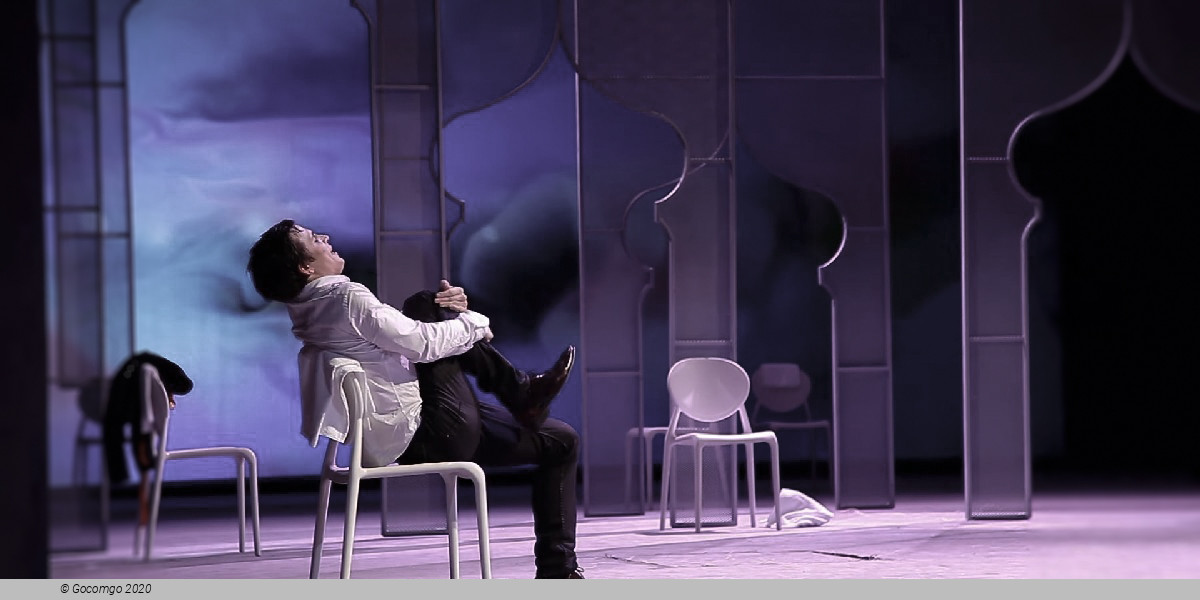
Schwanda the Bagpiper

Prague National Theatre, The National Theatre, Prague, Czech Republic
All photos (1)
Select date and time
5 PM

E-tickets: Print at home or at the box office of the event if so specified. You will find more information in your booking confirmation email.

You can only select the category, and not the exact seats.
If you order 2 or 3 tickets: your seats will be next to each other.
If you order 4 or more tickets: your seats will be next to each other, or, if this is not possible, we will provide a combination of groups of seats (at least in pairs, for example 2+2 or 2+3).

Important Info
Type: Opera
City: Prague, Czech Republic
Starts at: 17:00
Sung in: Czech
Titles in: English

E-tickets: Print at home or at the box office of the event if so specified. You will find more information in your booking confirmation email.

You can only select the category, and not the exact seats.
If you order 2 or 3 tickets: your seats will be next to each other.
If you order 4 or more tickets: your seats will be next to each other, or, if this is not possible, we will provide a combination of groups of seats (at least in pairs, for example 2+2 or 2+3).

Overview

An extraordinary performance of the opera Schwanda the Bagpiper by the Czech (and later on, American too) composer Jaromír Weinberger. Weinberger’s fabulous – and truly folksy – opera garnered ovations at many theatres in Europe. As translated by Max Brod in 1931 Schwanda the Bagpiper was even staged at the Metropolitan Opera in New York.

“Czechs, German, citizens of the world – gather round! See a fairy tale in two acts and five scenes, penned by Miloš Kareš and adapted by Max Brod. What is it about? About lime-trees in bloom. About Queens of Darkness who fail to do what they desire to do. About bandits who do great good. About the Devil who loses a card-game. Dorotka is here. And Švanda can do incredible things – with that instrument of his. Long live the Czech bagpiper! Long live Dorotka! Horses, varlets, men with scythes, a soup for lunch, an astronomical clock stolen from the Devil, carriages, carts, bells of all tunes, thunders and thunderbolts, ominous figures, bats and an infernal marriage game. In the end, they all shout: Hail!” That is how the stage director Vladimír Morávek invites audiences of all generations, particularly children and their parents, to attend an extraordinary performance of the opera Schwanda the Bagpiper by the Czech (and later on, American too) composer Jaromír Weinberger. Along with Smetana, Dvořák, Janáček and Martinů, he was one of the select few Czechs whose music gained global acclaim. In the mid-1920s, during the time of the first Czechoslovak Republic, Weinberger and the humourist Miloš Kareš wrote a loose sequel to J. K. Tyl’s tall story The Strakonice Bagpiper. Švanda is married to his beloved Dorotka, yet he feels restless at home. And so, when the bandit Babinský tells him what is there to enjoy abroad ...

What follows is a crazy story, something like an opera-comic strip, giving an account of the adventures of Švanda the bagpiper and his bandit companion, who experience merry, as well as rather torrid moments. And whenever it seems that our heroes are done for good, the best of the Czech nature prevails – craftiness and love of music.

History
Premiere of this production: 27 April 1927, Czech National Opera, Prague

Schwanda the Bagpiper (Czech: Švanda dudák), written in 1926, is an opera in two acts (five scenes), with music by Jaromír Weinberger to a Czech libretto by Miloš Kareš, based on the drama Strakonický dudák aneb Hody divých žen (The Bagpiper of Strakonice) by Josef Kajetán Tyl. Its first performance was in Prague at the Czech National Opera on 27 April 1927; and the first German production followed (in the translation by Max Brod as Schwanda der Dudelsackpfeifer), at Breslau on 16 December 1928. After that success, German-language productions proliferated around the world, with over 2000 performances taking place during the next decade.

Synopsis

It has been a week since Švanda and Dorota married. The robber Babinský takes refuge in their farmhouse, and immediately falls for Dorota. Babinský quickly convinces Švanda of the tedium of married life, and persuades him to go off on an adventure. They arrive at the Queen's court, where she is under the power of a wicked Magician. The Queen had made a deal with the Magician where she consented to the death of the Prince, her betrothed, in exchange for a heart of ice (and thus no human feeling) and a diamond scepter, symbolic of her power. Švanda plays his bagpipes, which breaks the spell. The Queen then offers herself to Švanda in marriage. Švanda accepts, kissing her, but then Dorota appears, which angers the Queen. The Queen, her heart now again of ice, has Švanda and Dorota imprisoned and Švanda condemned to death.

Babinský helps save Švanda by replacing the executioner's axe with a broom. Švanda plays his bagpipes again, enchanting the crowd gathered for the execution, and escapes with Dorota. Dorota herself is now angry at Švanda and questions his fidelity. Švanda retorts that if he ever kissed the Queen, may he go to Hell. Forgetting that he did kiss the Queen, Švanda immediately drops through the earth into Hell. Babinský then tells Dorota that he loves her, but she makes him promise to rescue Švanda.

In Hell, the Devil asks Švanda to play for him, since he has nothing to do, because no one will play cards with the Devil because he always cheats. Švanda at first refuses, but then Babinský appears and challenges the Devil to a card game. By cheating even more than the Devil, Babinský wins the game and rescues Švanda. (It is at this point that Švanda plays the music that forms the famous Fugue.) At the end, Švanda and Dorota are reconciled, and Babinský sorrowfully leaves, in search of new adventures.

Venue Info

Prague National Theatre - Prague
Location   Národní 2

The National Theatre is the prime stage of the Czech Republic. It is also one of the symbols of national identity and a part of the European cultural space, with a tradition spanning more than 130 years. It is the bearer of the national cultural heritage, as well as a space for free artistic creation.

The National Theatre (Czech: Národní divadlo) in Prague is known as the alma mater of Czech opera, and as the national monument of Czech history and art.

The National Theatre belongs to the most important Czech cultural institutions, with a rich artistic tradition, which helped to preserve and develop the most important features of the nation–the Czech language and a sense for a Czech musical and dramatic way of thinking.

Today, the National Theatre is made up of four artistic companies – the Opera, Drama, Ballet and Laterna magika. It artistically manages four stages – the three historical buildings: the National Theatre (1883), the State Opera (1888), and the Estates Theatre (1783), and the more recently opened New Stage (1983). The Opera, Drama and Ballet companies perform not only titles from the ample classical legacy, in addition to Czech works, they also focus on contemporary international creation.

Grand opening

The National Theatre was opened for the first time on 11 June 1881, to honour the visit of Crown Prince Rudolf of Austria. Bedřich Smetana's opera Libuše was given its world premiere, conducted by Adolf Čech. Another 11 performances were presented after that. Then the theatre was closed down to enable the completion of the finishing touches. While this work was under way a fire broke out on 12 August 1881, which destroyed the copper dome, the auditorium, and the stage of the theatre.

The fire was seen as a national catastrophe and was met with a mighty wave of determination to take up a new collection: Within 47 days a million guldens were collected. This national enthusiasm, however, did not correspond to the behind-the-scenes battles that flared up following the catastrophe. Architect Josef Zítek was no longer in the running, and his pupil architect Josef Schulz was summoned to work on the reconstruction. He was the one to assert the expansion of the edifice to include the block of flats belonging to Dr. Polák that was situated behind the building of the Provisional Theatre. He made this building a part of the National Theatre and simultaneously changed somewhat the area of the auditorium to improve visibility. He did, however, take into account with utmost sensitivity the style of Zítek's design, and so he managed to merge three buildings by various architects to form an absolute unity of style.

Important Info
Type: Opera
City: Prague, Czech Republic
Starts at: 17:00
Sung in: Czech
Titles in: English
Top of page