
Prague National Theatre 17 November 2022 - Flammen | GoComGo.com

Flammen

Prague National Theatre, The State Opera, Prague, Czech Republic
All photos (1)
Select date and time
7 PM

E-tickets: Print at home or at the box office of the event if so specified. You will find more information in your booking confirmation email.

You can only select the category, and not the exact seats.
If you order 2 or 3 tickets: your seats will be next to each other.
If you order 4 or more tickets: your seats will be next to each other, or, if this is not possible, we will provide a combination of groups of seats (at least in pairs, for example 2+2 or 2+3).

Important Info
Type: Opera
City: Prague, Czech Republic
Starts at: 19:00
Intervals: 1
Duration: 2h 10min
Sung in: Czech

E-tickets: Print at home or at the box office of the event if so specified. You will find more information in your booking confirmation email.

You can only select the category, and not the exact seats.
If you order 2 or 3 tickets: your seats will be next to each other.
If you order 4 or more tickets: your seats will be next to each other, or, if this is not possible, we will provide a combination of groups of seats (at least in pairs, for example 2+2 or 2+3).

Overview

Immortality as punishment? Don Juan in the role of Ahasver.

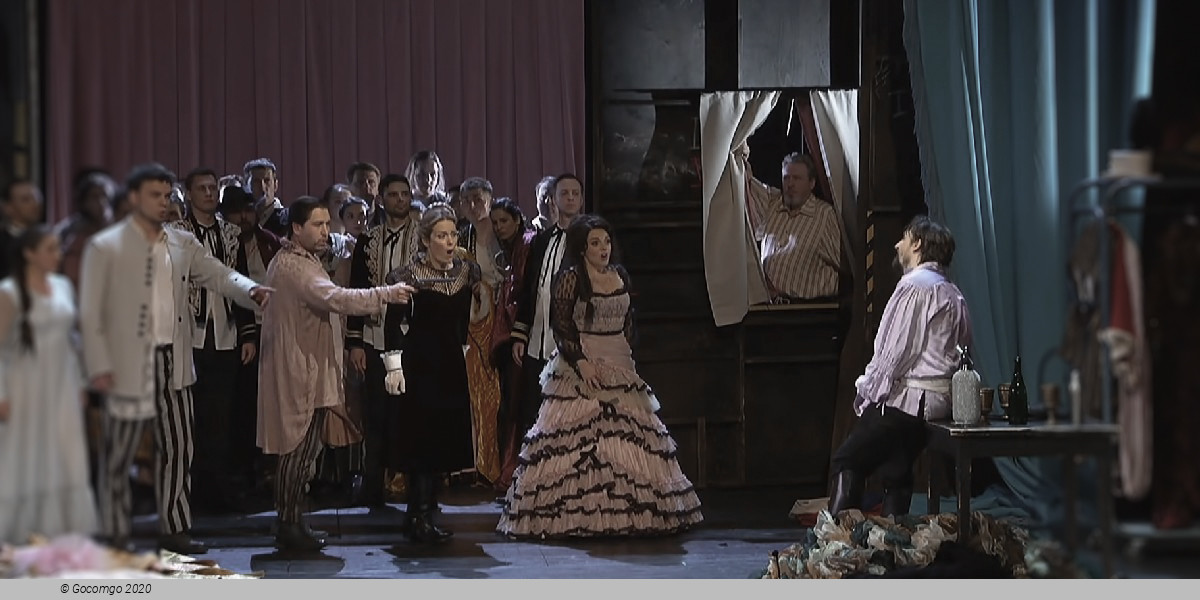
In the first few decades of the 20th century, Prague was a truly multicultural city, with the Czech and German artists inspiring each other. The German writer and translator Max Brod suggested to the composer Erwin Schulhoff, also of German descent, that a new play by the Czech writer Karel Josef Beneš might make a good basis for the libretto to his new opera.  Even though Beneš was yet to attain international acclaim for his psychological novels Uloupený život (Stolen Life) and Kouzelný dům (The Magic House), which would be adapted as films both at home and abroad, Schulhoff was intrigued by his unconventional retelling of the Don Juan legend. At the time, he was influenced by late Impressionism and Expressionism, but, like many other composers, he was engrossed by jazz and had a penchant for experimentation. All these inclinations duly reflected in his one and only opera, Flammen (referring to flames of love and death), blending elements of opera, pantomime and tone poem, which, following its premiere, in Czech, under the title Plameny, on 27 January 1932 in Brno, fell into oblivion for decades. Interest in the piece only revived in the 1990s, when, using Max Brod’s German translation and with the score partially changed, it was performed as Flammen in concert on 16 April 1994 in Berlin. In this version, it was published by Schott. The State Opera will stage the work in the original version, with K. J. Beneš’s Czech libretto.

When working on Flammen, its creators could not have anticipated that they would meet similar fates. For his participation in the anti-Nazi resistance movement, Beneš was sentenced to death, yet the verdict was changed to imprisonment (1941–1945). Schulhoff did not live to see the end of World War II. Labeled as a “degenerate” (Jewish) artist, he was incarcerated in the Wülzburg prison camp in Bavaria, where on 18 August 1942 he died of tuberculosis.

History
Premiere of this production: 27 January 1932, National Theatre (Národní Divadlo na Veveří), Brno

Flammen (Flames) is an opera in two acts and ten scenes composed by Erwin Schulhoff, his only opera. The original libretto in Czech was written by Karel Josef Beneš. Its story is a surrealist retelling of the Don Juan legend with elements from the legend of the Wandering Jew, and heavily influenced by Freudian psychology. Unlike the title character in Mozart's Don Giovanni based on the same legend, Don Juan is not punished by being dragged down to Hell but instead is condemned to live forever.

Synopsis

The opera is not a straight narrative, but rather a loosely connected set of ten scenes, each with its own name. Don Juan is in love with Death personified by La Morte, the only woman he has not been able to seduce. The Shadows (six women) function as a Greek chorus, commenting on the action and on Don Juan's past life.

Act 1
Scene 1 Nocturne

The Shadows sing of Don Juan's sexual exploits and La Morte's passion for him. To the sound of a solo flute, he enters a dark abandoned house to seduce yet another woman. Her moans of ecstasy are heard.

Scene 2 Fire Song
The Shadows sing of a woman whose desire for Don Juan is so great that she imagines his body to be the colour of fire.

Scene 3 Midnight Mass
Determined to reform his libertine ways, Don Juan enters a church for Midnight Mass but is seduced by a nun. La Morte plays a Gloria on the organ while the sound of foxtrot music is heard outside.

Scene 4 Chimera
Don Juan climbs a mountain of naked female bodies. At the summit he finds La Morte waiting for him.

Scene 5 Gallery
Don Juan enters a sculpture gallery filled with statues of men. The men are his dead ancestors, who unlike him managed to find happiness.

Scene 6 Dialogue
Don Juan talks to a woman, the same one who had previously appeared as a nun. Their dialogue is interrupted when Don Juan has a vision of another woman whose body is the colour of fire.

Scene 7 Tempest and Dialogue with the sea
Marguerite and Don Juan make love during a storm. La Morte appears and kills Marguerite. Don Juan stands before the sea and tells of his longing for death.

Act 2
Scene 8 Carnival Night
It is Carnival Night. Amidst a troupe of commedia dell'arte mimes, Don Juan and Donna Anna dance a foxtrot. Arlecchino foretells scenes of horror which will occur at midnight. Donna Anna rejects Don Juan's advances telling him "You are the very image of death." He then murders Donna Anna's husband, the Commendatore, and she commits suicide.

Scene 9 Banquet
Don Juan tries in vain to revive Donna Anna as a group of naked women begin dancing around him. Unable to stop them, he cries out to La Morte expressing his desire for her. She tells him that he will be closer to her as a living man rather than a dead one. The Commendatore then pronounces a curse on Don Juan, condemning him to live forever. On hearing the curse, Don Juan shoots himself, but instead of dying is turned into an even younger man.

Scene 10 Nocturne
Doomed to desperately repeating the cycle of his life over and over again, Don Juan enters the same darkened house where the opera began, accompanied by the same solo flute, to seduce yet another victim. La Morte and the Shadows lurk in the darkness singing, with the final words of the opera given to La Morte: "Salvation is so distant—again".

Venue Info

Prague National Theatre - Prague
Location   Národní 2

The National Theatre is the prime stage of the Czech Republic. It is also one of the symbols of national identity and a part of the European cultural space, with a tradition spanning more than 130 years. It is the bearer of the national cultural heritage, as well as a space for free artistic creation.

The National Theatre (Czech: Národní divadlo) in Prague is known as the alma mater of Czech opera, and as the national monument of Czech history and art.

The National Theatre belongs to the most important Czech cultural institutions, with a rich artistic tradition, which helped to preserve and develop the most important features of the nation–the Czech language and a sense for a Czech musical and dramatic way of thinking.

Today, the National Theatre is made up of four artistic companies – the Opera, Drama, Ballet and Laterna magika. It artistically manages four stages – the three historical buildings: the National Theatre (1883), the State Opera (1888), and the Estates Theatre (1783), and the more recently opened New Stage (1983). The Opera, Drama and Ballet companies perform not only titles from the ample classical legacy, in addition to Czech works, they also focus on contemporary international creation.

Grand opening

The National Theatre was opened for the first time on 11 June 1881, to honour the visit of Crown Prince Rudolf of Austria. Bedřich Smetana's opera Libuše was given its world premiere, conducted by Adolf Čech. Another 11 performances were presented after that. Then the theatre was closed down to enable the completion of the finishing touches. While this work was under way a fire broke out on 12 August 1881, which destroyed the copper dome, the auditorium, and the stage of the theatre.

The fire was seen as a national catastrophe and was met with a mighty wave of determination to take up a new collection: Within 47 days a million guldens were collected. This national enthusiasm, however, did not correspond to the behind-the-scenes battles that flared up following the catastrophe. Architect Josef Zítek was no longer in the running, and his pupil architect Josef Schulz was summoned to work on the reconstruction. He was the one to assert the expansion of the edifice to include the block of flats belonging to Dr. Polák that was situated behind the building of the Provisional Theatre. He made this building a part of the National Theatre and simultaneously changed somewhat the area of the auditorium to improve visibility. He did, however, take into account with utmost sensitivity the style of Zítek's design, and so he managed to merge three buildings by various architects to form an absolute unity of style.

Important Info
Type: Opera
City: Prague, Czech Republic
Starts at: 19:00
Intervals: 1
Duration: 2h 10min
Sung in: Czech
Top of page