









Prague National Theatre 20 November 2022 - Betrothal in a Dream | GoComGo.com

Betrothal in a Dream

Prague National Theatre, The State Opera, Prague, Czech Republic
All photos (1)
Select date and time
7 PM

E-tickets: Print at home or at the box office of the event if so specified. You will find more information in your booking confirmation email.

You can only select the category, and not the exact seats.
If you order 2 or 3 tickets: your seats will be next to each other.
If you order 4 or more tickets: your seats will be next to each other, or, if this is not possible, we will provide a combination of groups of seats (at least in pairs, for example 2+2 or 2+3).

Important Info
Type: Opera
City: Prague, Czech Republic
Starts at: 19:00
Duration: 2h 20min

E-tickets: Print at home or at the box office of the event if so specified. You will find more information in your booking confirmation email.

You can only select the category, and not the exact seats.
If you order 2 or 3 tickets: your seats will be next to each other.
If you order 4 or more tickets: your seats will be next to each other, or, if this is not possible, we will provide a combination of groups of seats (at least in pairs, for example 2+2 or 2+3).

Overview

Hans Krása wrote the opera Verlobung im Traum (Betrothal in a Dream), based on F. M. Dostoyevsky’s novella Uncle’s Dream, during a happy period of his life. After short periode in Berlin at the age of 29 he returned to his beloved native Prague to absorb all the intellectual stimuli the Czech capital afforded. Krása liked visiting the renowned Café Arco in the centre of the city, a place at which the Czech artists Emil Filla, Bohumil Kubišta, Antonín Procházka and others got together to immerse in lively debate with their German-speaking colleagues, including Franz Werfel and Egon Erwin Kisch. Among those who frequented the café were Franz Kafka and Milena Jesenská, whom Krása befriended. His name can even be found in Kafka’s Letters to Milena.

Krása created his Verlobung im Traum between 1928 and 1930. The libretto was penned by Rudolf (Rudi) Thomas, editor-in-chief of the Prager Tagblatt daily, and the poet Rudolf Fuchs. Krása plunged into composing immediately upon receiving the final wording of the text, probably in the summer of 1928. Working with the utmost diligence, by the autumn of that year he could present parts of the opera within a private music evening. Those in attendance included Viktor Ullmann, who summed up his impressions in the Bohemia magazine as follows: “He's no professional. His music happens effortlessly as in checkmate. But what arises is a work of noctambulism certainty. Krása's opera-in-progress, based on Dostoevsky's novel Uncle's Dream, promises music of strong substance, unless you ask the gazelle to perform the strong tricks of an elephant. Particularly charming, among the excerpts I could recognise, are the casually and confidently shaped quintet from the first act, with its gentle melody, and the happy idea of an ensemble in connection with the aria 'Casta diva' from Bellini's Norma.” In September 1930, Der Auftakt reported that Krása had completed the opera, which at the time was titled Feďa (Fedya).

The opera is set in Mordasov, a small Russian town, circa 1850. The local archivist recalls a visit paid by one Fyodor Dostoyevsky, a novelist who wanted to be told the story of Zina, a beautiful girl who once lived in the town, the hapless Fedya, the treacherous Pavel, an eccentric prince and Marya Alexandrovna, Zina’s mother, whose scheming muddles up her daughter’s life. Yet the archivist’s job is to record, not assess, stories. He thus merely recounts and leaves it upon the listeners to judge at their own discretion.

The music of Verlobung im Traum is immensely intriguing; even though it is difficult to describe it in words, let us at least try: tone-painting areas, which are suddenly entered by arch-shaped melodies, fascinating, dynamic ensemble scenes, such excesses as a quotation of Bellini’s famous aria “Casta diva”and, above all, perfect chime between the music and the dramatic plot. The opera ends with a modest, simple melody evoking a Russian song, with a wonderful conclusion replete with profound humanity and hope. Apposite is the composer’s comment contained in a theatre programme: “By saying that I have drawn upon Schönberg, I would like to stress that in my compositions I strive to eschew, the unfortunately so popular, writing for the sake of writing, and in complete earnestness I declare that every beat, every recitative, every note even, must be coerced into being bound to the entirety.”

The opera received its premiere on 18 May 1933 within the Maifestspiele, conducted by Georg Széll and staged by Renato Mordo. The performance on 9 June 1933 was broadcast live on Czechoslovak Radio. Verlobung im Traum met with an enthusiastic response on the part of the audience and critics alike, and was even awarded the Czechoslovak State Prize. Renowned figures commended the piece in laudatory reviews – Max Brod in the Prager Tagblatt, Erich Steinhard in Der Auftakt or Hans Heinz Stuckenschmidt in the Berliner Zeitung. A reviewer under the initials V. T. wrote in the Czech newspaper Národní osvobození: “Hans Krása set the outstanding dramatic subject with a surprising maturity and appeal. His ideas are truly singular, concisely rendering the characters and appositely fitting the story. Youth mainly vents here in harmonic trifles, vivid rhythm and sound, and an uncompromising choice of means; yet the work is definitely honest in heart and remarkably effective.” After World War II, the music material was for a long time deemed lost, until one day the Israeli conductor Israel Yinon came across in a Vienna archive a folio marked “Property of the German Theatre Society in Prague”, which, astonishingly, contained the score of Verlobung im Traum, including Georg Széll’s conducting notes. Based on the discovered material, in 1994 the opera was staged anew within a collaboration of the State Opera Prague and the Nationaltheater Mannheim. The revival premiered on 27 March 1994 at the State Opera in Prague, in a production directed by Karel Drgáč.

History
Premiere of this production: 18 May 1933, Neues deutsches Theater, Prague

Verlobung im Traum (Betrothal in a Dream) (1928–30) is a German-language opera in two acts by Czech composer Hans Krása with a libretto by Rudolf Fuchs and Rudolf Thomas after the novel Uncle's Dream by Feodor Dostoyevsky.

Synopsis

The action takes place in Mordasov, a small Russian town, around 1850.

Prologue

The archivist of Mordasov relates how writer Feodor Dostoevsky has recently paid a visit, researching the life of a certain Zina, a beautiful girl who once lived in the town, for a forthcoming novel.

Act I

Zina is in love with Fedya, a political revolutionary who is on the run from the authorities. Her overbearing mother, Maria Alexandrowna, learns than an aging Prince is visiting the town and sees an opportunity to marry her daughter off. She reasons with Zina that she would soon inherit the old man’s wealth and thus be able to afford proper care for Fedya who is grievously ill. Paul, an old family friend, is also in love with Zina and misses no opportunity to disparage Fedya to her. When the Prince arrives, he is courted and flattered by Zina’s mother who persuades him of her daughter’s beauty and talent. Zina, against her better nature, performs Bellini’s ‘Casta diva’ for the Prince who is enchanted. Maria’s sister-in-law, Nastassja, who feels compassion for the Prince, is appalled by the duplicity of the scheme. A letter arrives from Fedya to Zina, urging her to come quickly and visit him as he feels near to death, but is intercepted and destroyed by Paul. He and Nastassja swear to thwart Maria’s plans.

Act II

The Prince awakes from his afternoon siesta. He remembers proposing to a young girl earlier in the day but Paul convinces him that he must have dreamt the whole thing. The Prince admits he gets confused and decides to leave with Paul the next day. He goes to bid farewell to Maria and Zina and arrives to find the house full of women, invited by Nastassja to witness the ceremony. He rather shamefacedly confesses that he had a dream where he proposed to Zina but the furious Maria insists it was no dream. Zina finally snaps: she tells the Prince that he was duped into proposing to her, she is only interested in Fedya and would have married the Prince only for his money. The Prince appreciates her honesty and forgives her. As he takes his leave, he asks Zina to excuse his temerity for presuming she would ever want to marry him. Zina is overjoyed that she is now free to be with Fedya but a servant arrives to tell her the awful news: Fedya has died.

Epilogue

The archivist explains how, soon after this incident, Zina and her mother moved away and how Zina is now in a loveless marriage with a local official. Her beauty is intact but life and love have for her lost all meaning and purpose.

Venue Info

Prague National Theatre - Prague
Location   Národní 2

The National Theatre is the prime stage of the Czech Republic. It is also one of the symbols of national identity and a part of the European cultural space, with a tradition spanning more than 130 years. It is the bearer of the national cultural heritage, as well as a space for free artistic creation.

The National Theatre (Czech: Národní divadlo) in Prague is known as the alma mater of Czech opera, and as the national monument of Czech history and art.

The National Theatre belongs to the most important Czech cultural institutions, with a rich artistic tradition, which helped to preserve and develop the most important features of the nation–the Czech language and a sense for a Czech musical and dramatic way of thinking.

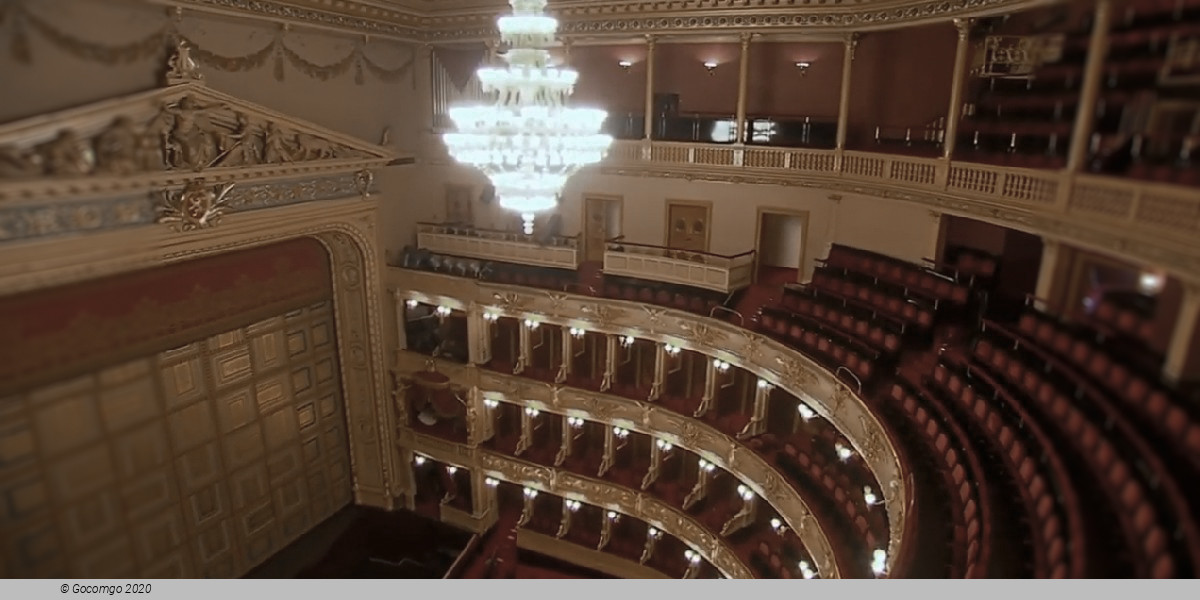
Today, the National Theatre is made up of four artistic companies – the Opera, Drama, Ballet and Laterna magika. It artistically manages four stages – the three historical buildings: the National Theatre (1883), the State Opera (1888), and the Estates Theatre (1783), and the more recently opened New Stage (1983). The Opera, Drama and Ballet companies perform not only titles from the ample classical legacy, in addition to Czech works, they also focus on contemporary international creation.

Grand opening

The National Theatre was opened for the first time on 11 June 1881, to honour the visit of Crown Prince Rudolf of Austria. Bedřich Smetana's opera Libuše was given its world premiere, conducted by Adolf Čech. Another 11 performances were presented after that. Then the theatre was closed down to enable the completion of the finishing touches. While this work was under way a fire broke out on 12 August 1881, which destroyed the copper dome, the auditorium, and the stage of the theatre.

The fire was seen as a national catastrophe and was met with a mighty wave of determination to take up a new collection: Within 47 days a million guldens were collected. This national enthusiasm, however, did not correspond to the behind-the-scenes battles that flared up following the catastrophe. Architect Josef Zítek was no longer in the running, and his pupil architect Josef Schulz was summoned to work on the reconstruction. He was the one to assert the expansion of the edifice to include the block of flats belonging to Dr. Polák that was situated behind the building of the Provisional Theatre. He made this building a part of the National Theatre and simultaneously changed somewhat the area of the auditorium to improve visibility. He did, however, take into account with utmost sensitivity the style of Zítek's design, and so he managed to merge three buildings by various architects to form an absolute unity of style.

Important Info
Type: Opera
City: Prague, Czech Republic
Starts at: 19:00
Duration: 2h 20min
Top of page