
Palazzo Mauro de André 17 June 2019 - Martha Graham Dance Company | GoComGo.com

Martha Graham Dance Company

Palazzo Mauro de André, Ravenna, Italy
All photos (1)
Select date and time
9:30 PM
Request for Tickets
Important Info
Type: Ballet
City: Ravenna, Italy
Starts at: 21:30
Duration:

E-tickets: Print at home or at the box office of the event if so specified. You will find more information in your booking confirmation email.

You can only select the category, and not the exact seats.
If you order 2 or 3 tickets: your seats will be next to each other.
If you order 4 or more tickets: your seats will be next to each other, or, if this is not possible, we will provide a combination of groups of seats (at least in pairs, for example 2+2 or 2+3).

Festival

Ravenna Festival 2019

Ravenna is located on north central Italy, in Emilia-Romagna County. The city holds two music and opera festivals. The first and the longer one  takes place between mid June till mid July and the second  the shorter one is held in November.

Overview

28 years from her death, Martha’s indelible imprint still remains in the Company she founded, which continues to foster her spirit and legacy. For example in Errand into the Maze (1947), from the “mythological” period of the “Lady of Modern Dance”: after the original sets by Noguchi were destroyed by Hurricane Sandy, the title was revived in a stripped-down version focusing on choreographic intensity. While the iconic solo of Lamentation is re-read by contemporary authors as a set of personal homages, the thrust of the pelvis Martha experimented with in Ekstasis has now been re-imagined by Virginie Mécène. The brilliant finale features Diversion of Angels, where Martha looked towards the future with a plotless ballet taking its themes from the infinite aspects and expressions of love.

Errand into the Maze is a Martha Graham ballet based on a poem by Ben Belitt set to music by Gian Carlo Menotti. The surrealistic set was designed by Isamu Noguchi, the costumes by Graham herself. The dance uses the Greek myth of Ariadne and the Minotaur to explore the theme of conquering one’s inner demons, more specifically the fear of sexual intimacy. The piece premiered at the Ziegfeld Theatre on February 28, 1947, with Graham as the protagonist, a sort of female Theseus, and Mark Ryder as the Minotaur-like character.

Errand into the Maze is one of the choreographer's best-known and most popular ballets. It remains in the Martha Graham Dance Company repertory.

Performed to music by Lehman Engel, Ekstasis premiered on May 4, 1933, at New York's Guild Theatre. The solo work was danced by Martha Graham. The New York Telegraph (May 6, 1933) noted that the work was the "most appealing of the premiers" [sic] and Musical America (May 25, 1933) said it "was an impressive dance suite on a much more heroic scale— a work in which Miss Graham was led to exploit her best resources to the full."

The Lamentation Variations was commissioned by the Martha Graham Center of Contemporary Dance, Inc. with support from Francis Mason. Paul Variation was commissioned for the Martha Graham Center of Contemporary Dance, Inc. by the Opéra National de Paris.

Diversion of Angels, initially titled Wilderness Stair, is a Martha Graham ballet performed to an original score by Norman Dello Joio. The premiere on August 13, 1948, at the Palmer Auditorium in New London, Connecticut, included a set designed by Isamu Noguchi. It was eliminated at the second performance. Diversion of Angels is in the Martha Graham Dance Company repertoire and that of American Ballet Theatre (since 1999).

History
Premiere of this production: 28 February 1947, Ziegfeld Theatre

The dance uses the Greek myth of Ariadne and the Minotaur to explore the theme of conquering one’s inner demons, more specifically the fear of sexual intimacy.

Premiere of this production: 13 August 1948, Palmer Auditorium, New London, Connecticut

Diversion of Angels, initially titled Wilderness Stair, is a Martha Graham ballet performed to an original score by Norman Dello Joio. The premiere on August 13, 1948, at the Palmer Auditorium in New London, Connecticut, included a set designed by Isamu Noguchi. It was eliminated at the second performance. Diversion of Angels is in the Martha Graham Dance Company repertoire and that of American Ballet Theatre (since 1999).

Synopsis

The original program notes describe the action as “that errand-journey into the maze of the heart to face and do battle with the Creature of Fear.” Barely fifteen minutes in length, Errand into the Maze is designed almost as a solo work, with the bull-horned, staff (bone)-carrying Creature of Fear serving more as a prop than an active participant.

The unnamed female protagonist weaves her way through a rope maze outlined on the stage to arrive at a set (originally by Isamu Noguchi) that includes a suggestive v-shaped wooden frame (like a tree, or a woman’s crotch). She is confronted three times by the creature, ultimately overpowering him. He drops the bone/staff as he sinks to the floor in surrender. The heroine dances in the void between the two vertical set elements as the curtain falls.

Although the dance is story-less, Graham described it as a representation of three aspects of love. It may also be interpreted as three facets of one woman's character. Some Graham scholars claim the paintings of Wassily Kandinsky influenced the work.

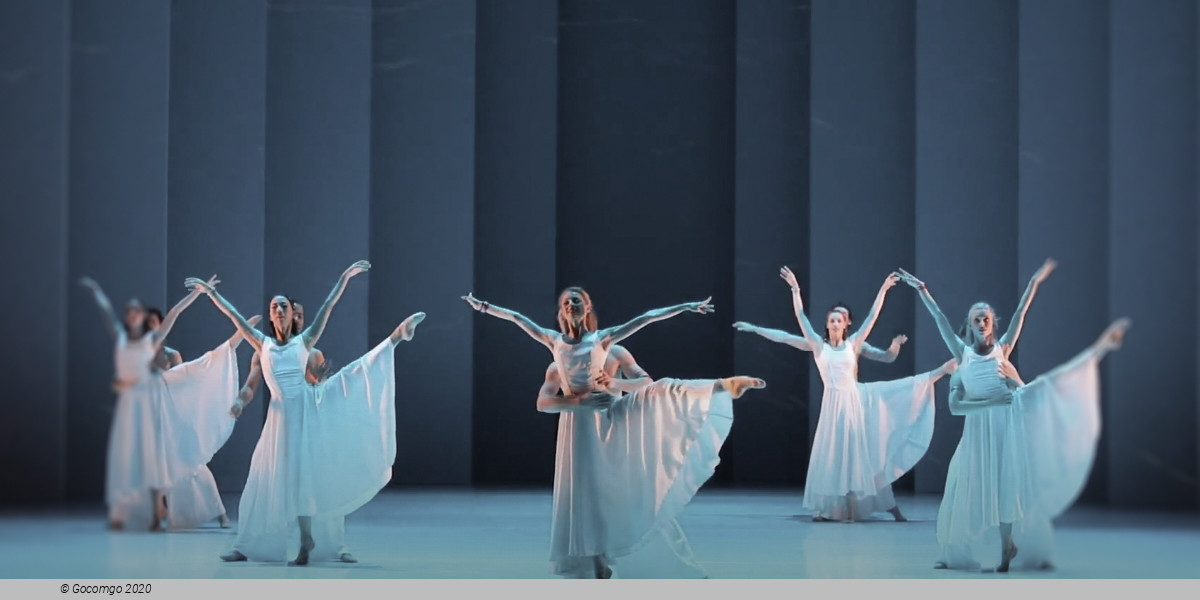
The piece is staged for three couples and a corps de ballet. The women are costumed in yellow, red or white; the men, and corps members, are dressed in beige. The original performers were Helen McGehee and Stuart Hodes as Adolescent Love (yellow), Pearl Lang and Robert Cohan as Romantic Love (red) and Natanya Neumann and Mark Ryder as Mature Love (white). Dorothea Douglas, Joan Skinner, Dorothy Berea, Erick Hawkins, May O’Donnell and Dale Sehnert completed the cast. Romantic Love was renamed Erotic Love during the 1980s.

At the ballet’s premiere, the program notes contained a Ben Belitt poem referencing the action, “It is the place of the Rock and Ladder, the raven, the blessing, the tempter, the rose. It is the wish of the single-hearted, the undivided; play after the spirit’s labor; games, flights, fancies, configurations of the lover’s intention; the believed Possibility, at once strenuous and tender; humors of innocence, garlands, evangels, Joy on the wilderness stair; diversion of angels.”

In comparison to much of Graham's oeuvre, the ballet is joyful, exuberant and lyrical.

Venue Info

Palazzo Mauro de André - Ravenna
Location   Viale Europa, 1

The Arts and Performing Arts Building is a rarest example of contemporary architecture in Ravenna and it has proven to be one of the most functional indoor facilities nationwide. 

A source of pride, in short, for the city. The project bears the signature of a particularly refined architect, Carlo Maria Sadich, designer, among other things, of the ephemeral structures of the Estate Romana (Roman Summer) at the Circus Maximus in 1984. Desired by the Ferruzzi Group and named after an associate who died prematurely, Mauro De André, the brother of the singer-songwriter Fabrizio, the Pala was inaugurated in October 1990 and since then hosts major sporting, business, and artistic events. Starting with, the same year it was inaugurated, the concert led by Valerj Gergiev, with the participation of Mstislav Rostropovič and Uto Ughi. The entire complex has three excellent architectural features. First, a huge, 33-metre high, white square dome, composed of a reticular metal structure covered by a translucent membrane made of fibreglass. A real gem was added to the structure: Alberto Burri’s “Grande Ferro R” sculpture, which brings to mind the hull of a capsized ship. Finally, there’s the “Danteum”, a hypostyle hall which serves as an access to the Pala and consists of pillars and columns; the external pillars are made of exposed stone with columns in the middle: nine are iron and red (Hell), nine are made of Carrara marble (Purgatory) and nine are made of crystal (Heaven). The mosaic made by Elisa Montessori and Luciana Nocturnes are also absolutely beautiful. The interior has 3,800 seats, but the area can be changed by moving the movable tiers which, sliding on rails, can be placed open-style on the back. Every year the Pala hosts some of the most important events of the Festival. The inauguration of such a special relationship was held in 1992 with the Special Concert for the 500th anniversary of the discovery of America, with Riccardo Muti leading the Philadelphia Orchestra.

Important Info
Type: Ballet
City: Ravenna, Italy
Starts at: 21:30
Duration:
Top of page