

Opera National de Paris 2 November 2021 - L’Elisir d’amore | GoComGo.com

L’Elisir d’amore

Opera National de Paris, Opéra Bastille, Paris, France
All photos (15)
Select date and time
7:30 PM

E-tickets: Print at home or at the box office of the event if so specified. You will find more information in your booking confirmation email.

You can only select the category, and not the exact seats.
If you order 2 or 3 tickets: your seats will be next to each other.
If you order 4 or more tickets: your seats will be next to each other, or, if this is not possible, we will provide a combination of groups of seats (at least in pairs, for example 2+2 or 2+3).

Important Info
Type: Opera
City: Paris, France
Starts at: 19:30
Acts: 2
Intervals: 1
Duration: 2h 45min
Sung in: Italian

E-tickets: Print at home or at the box office of the event if so specified. You will find more information in your booking confirmation email.

You can only select the category, and not the exact seats.
If you order 2 or 3 tickets: your seats will be next to each other.
If you order 4 or more tickets: your seats will be next to each other, or, if this is not possible, we will provide a combination of groups of seats (at least in pairs, for example 2+2 or 2+3).

Overview

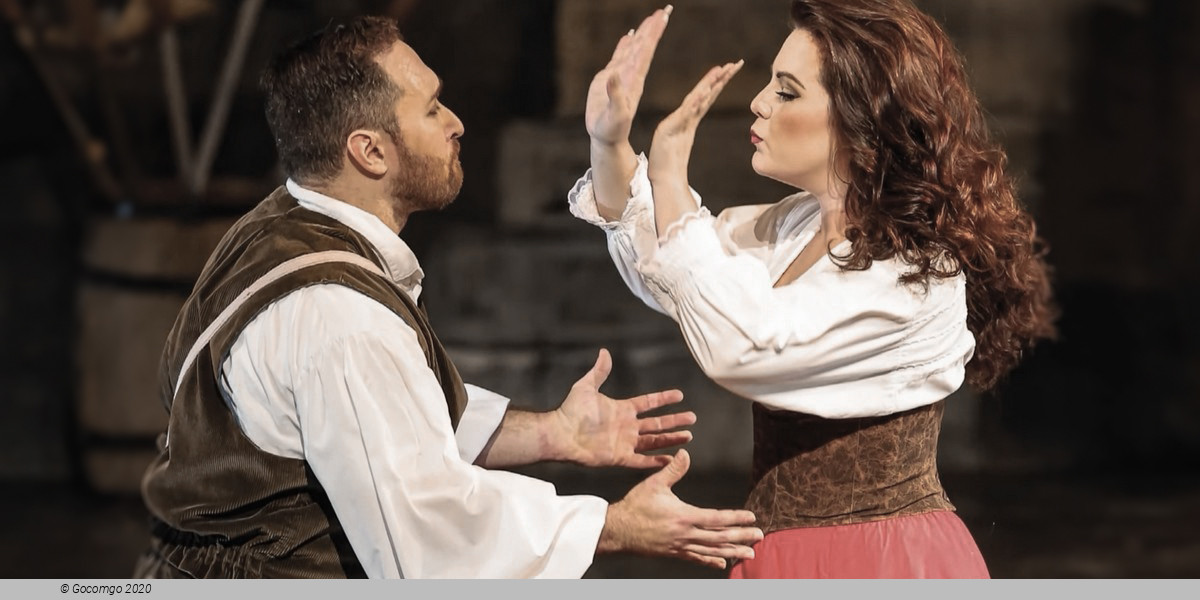
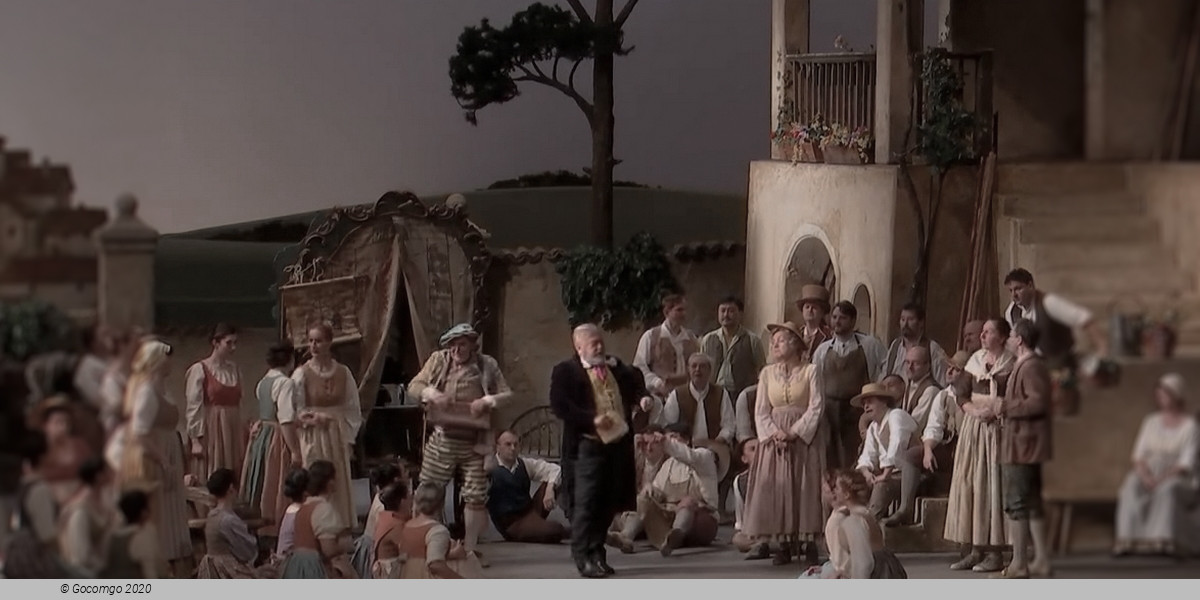
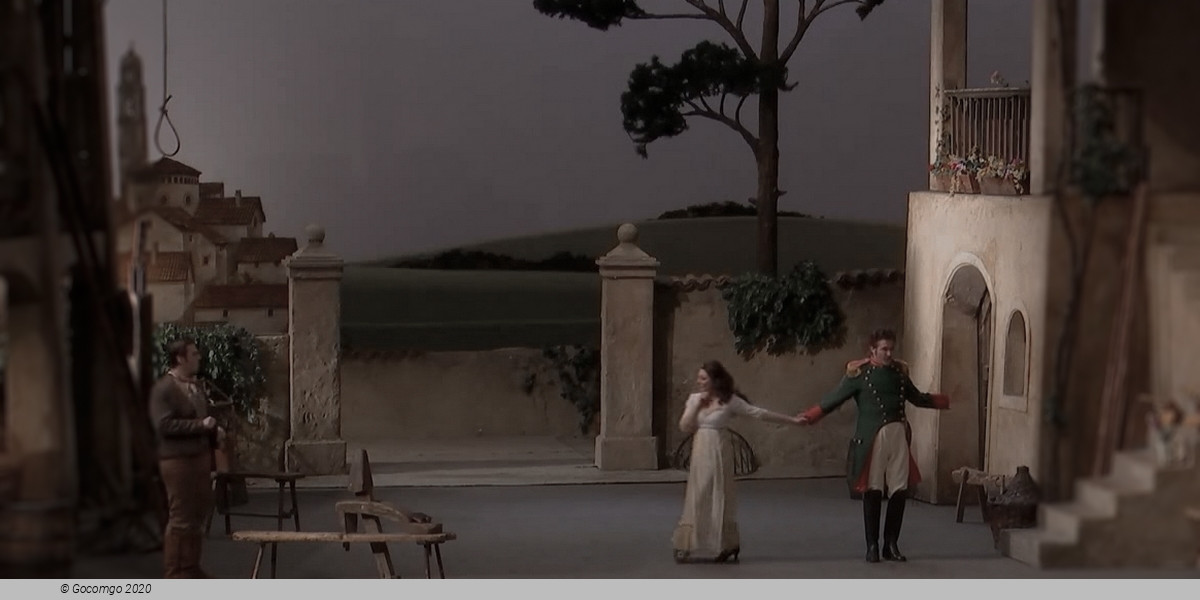
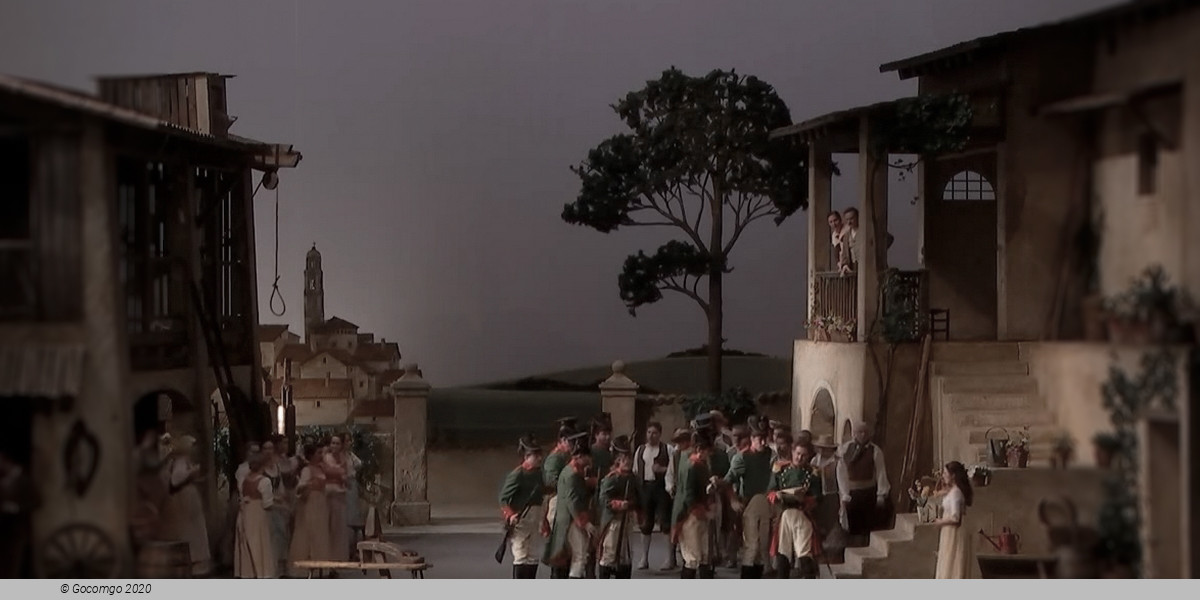
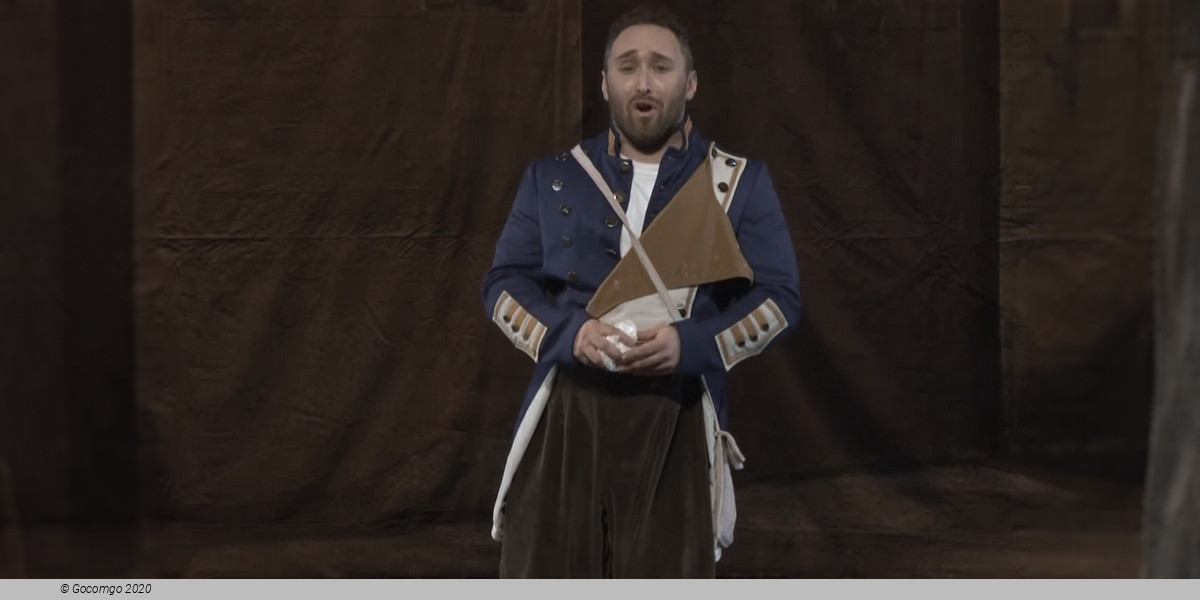
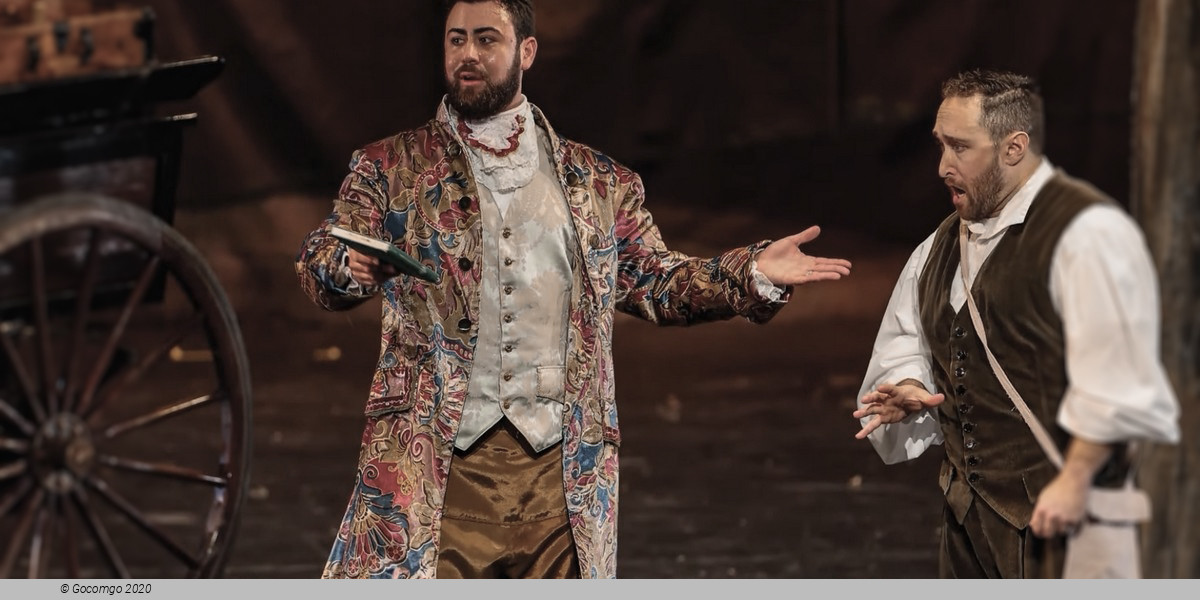
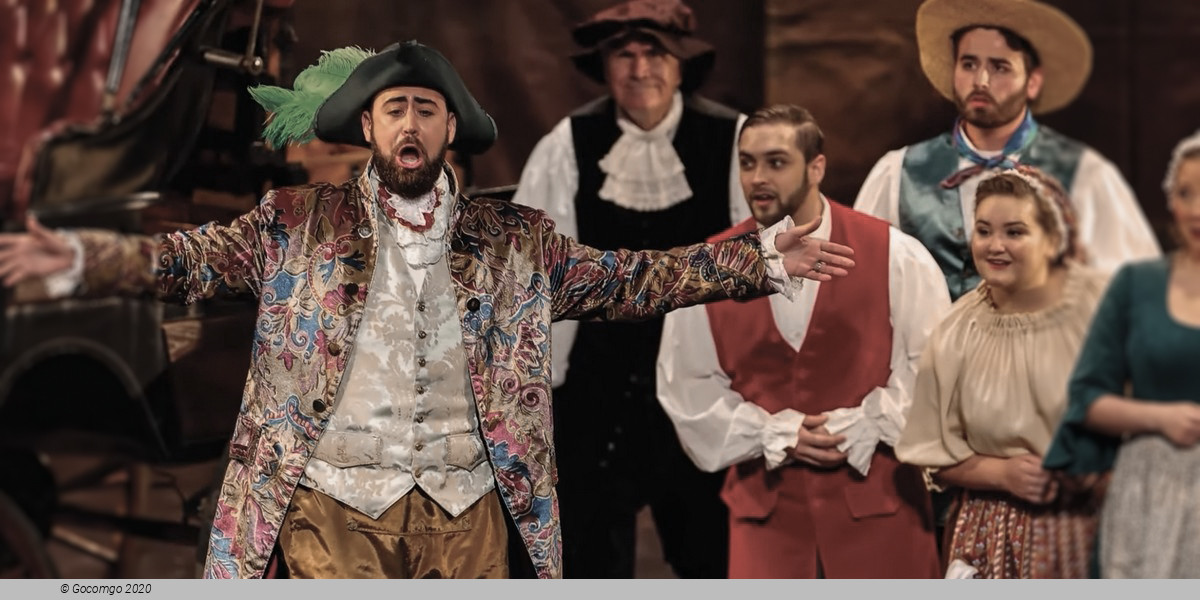
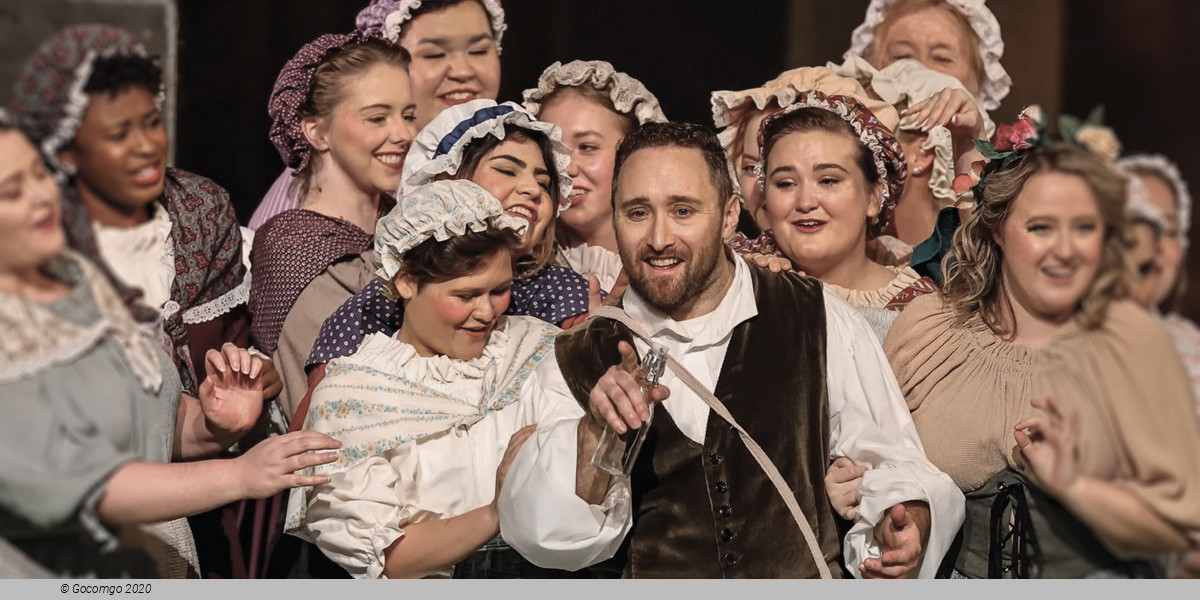
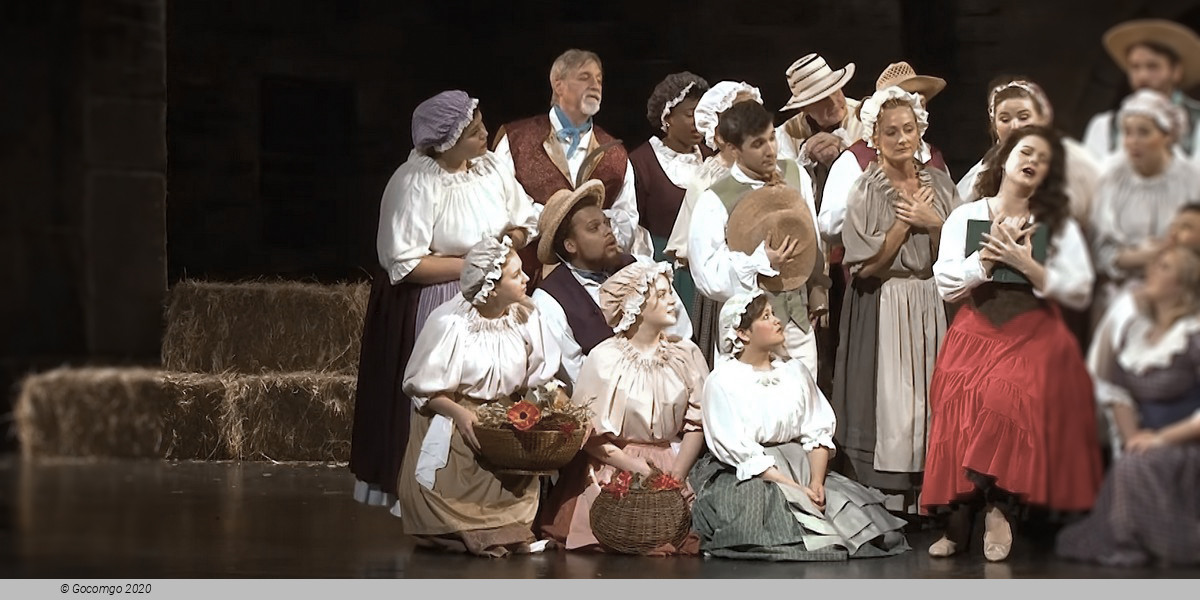
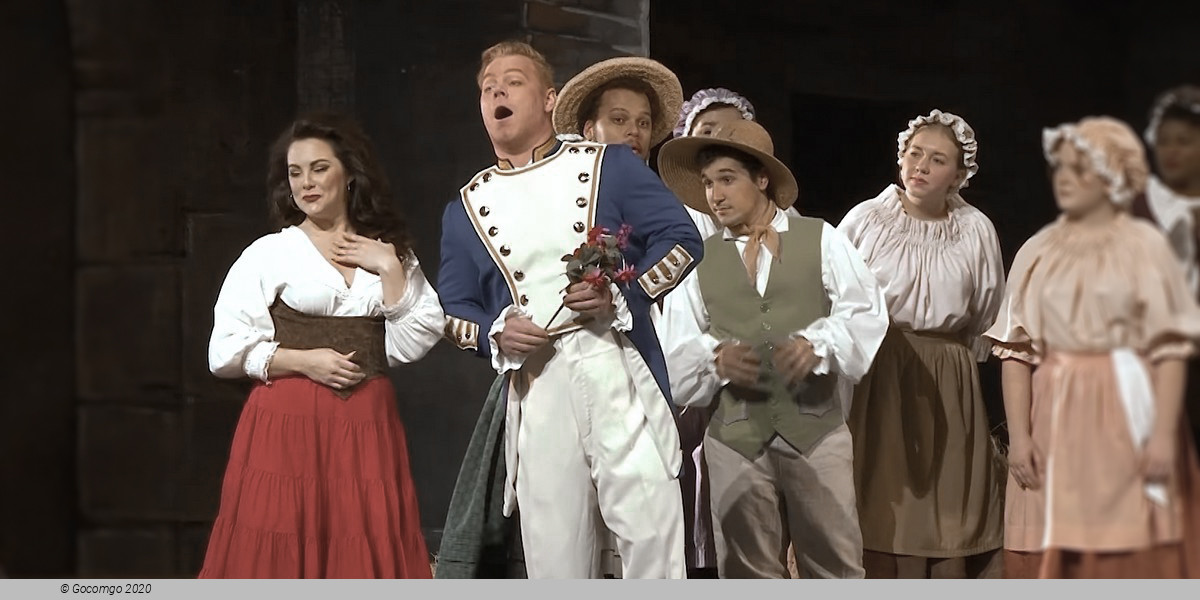
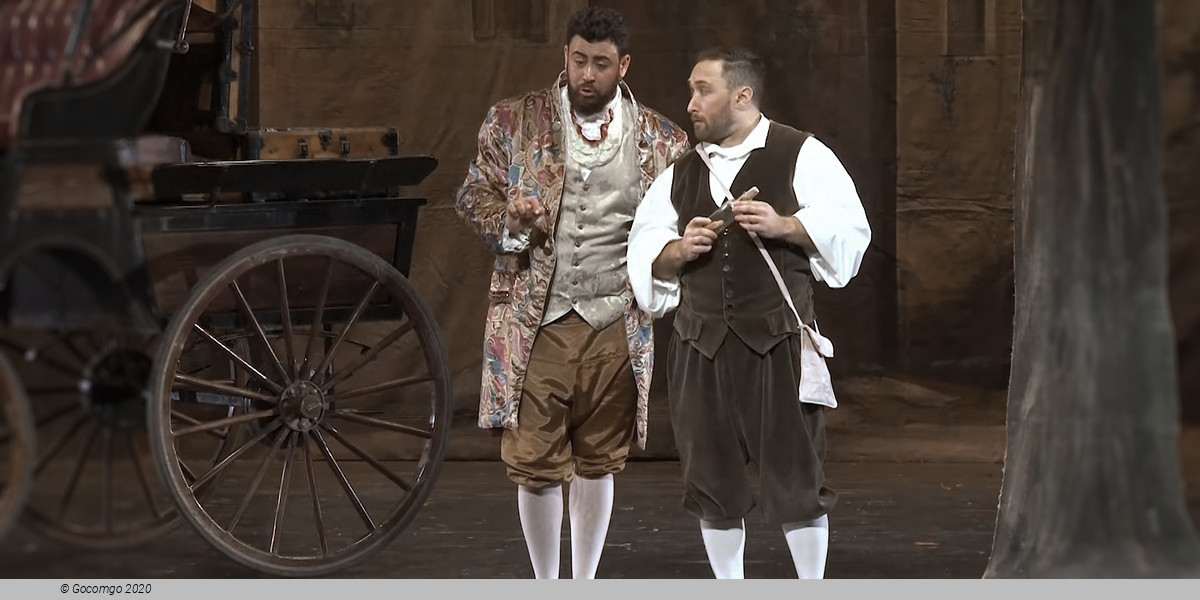
“I am obliged to set a libretto to music within fourteen days. I give you one week to prepare it for me. We shall see which of the two of us has the most courage.” Donizetti’s instructions to his librettist Romani signalled the beginning of the composition of L’Elisir d’amore, an opera that is, without a doubt, the Italian composer’s comic masterpiece. Laurent Pelly’s playful production transposes this melodramma giocoso into the Italy of the 1960s – complete with bales of hay and Vespas. The staging is a deft combination of fantasy and poetry, from the roaring arrival of Doctor Dulcamara to Nemorino’s legendary romance to Adina. This production of the quintessential bel canto opera has become a Paris Opera classic that cannot be missed.

Co-production with the Royal Opera House, Covent Garden, London

History
Premiere of this production: 12 May 1832, Teatro della Canobbiana, Milan

L'elisir d'amore (The Elixir of Love) is a comic opera (melodramma giocoso) in two acts by the Italian composer Gaetano Donizetti. Felice Romani wrote the Italian libretto, after Eugène Scribe's libretto for Daniel Auber's Le philtre (1831). The opera premiered on 12 May 1832 at the Teatro della Canobbiana in Milan.

Synopsis

ACT I

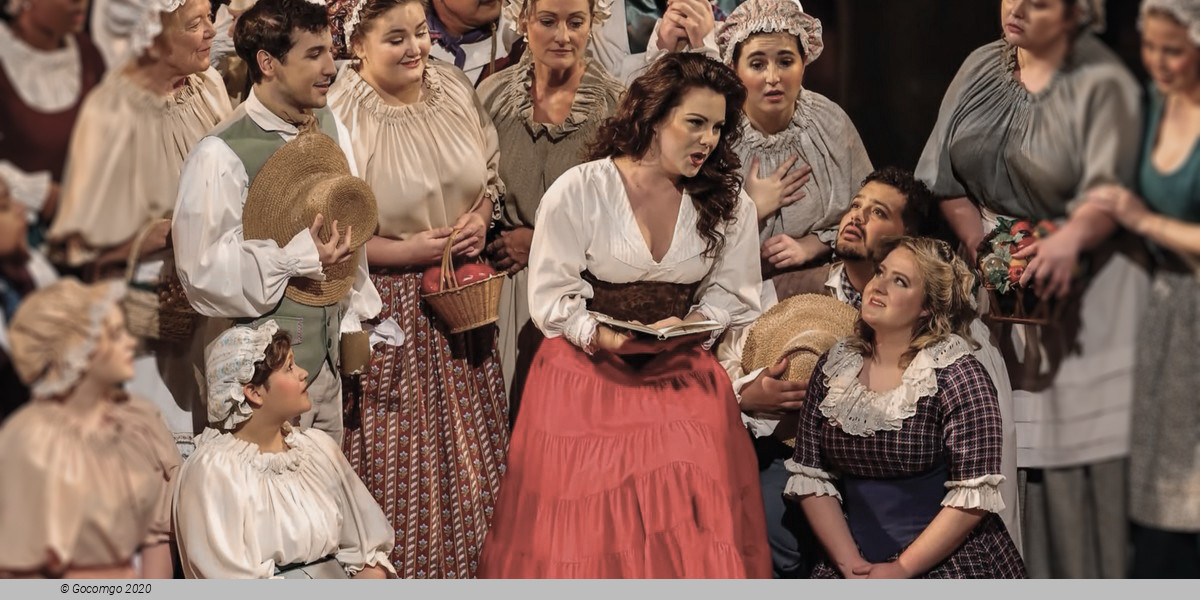
A village at harvest time. The villagers are enjoying a siesta. Nemorino admires from afar the beautiful Adina who takes an interest in the arts and is reading the legend of Tristan and Iseult and having a good laugh at the story of the love potion. She even reads the story to the peasants. Thereupon enters Sergeant Belcore at the head of his squadron. During a public seduction scene he proposes to Adina. The young woman asks him to wait a while and offers him refreshments. Nemorino, hurt, declares his love, and declares that he is willing to die for Adina. However she discourages him. She is fickle and does not want to love him. Doctor Dulcamara, a barker, arrives upon the scene. He sells a magic elixir that cures all ailments from wrinkles to diabetes and even paralysis. Nemorino has an idea: the peddler must surely possess Queen Iseult’s love potion. Dulcamara, delighted to come across such an idiot, confirms that he has it. He sells Nemorino a small bottle of Bordeaux and promises him that he will feel the effects within twenty-four hours. (Just the time he himself will need to leave the village.) An overjoyed Nemorino tests the potion and finishes the bottle. Convinced that he is feeling the first effects of the elixir and that Adina will soon fall in love with him, Nemorino feigns indifference. A furious Adina agrees to marry Belcore within six days. Nemorino remains unperturbed. The potion will take effect by the next day. However, unexpected complications oblige Belcore to leave for the war the next day. Adina decides to marry the soldier straight away. Nemorino, who has now sobered up, begs Adina to wait. However the latter, offended, invites the whole village to the wedding. Nemorino is grief-stricken.
 

ACT II

The wedding party is in full swing. The guests drink, joke and sing. Nemorino has stayed away and Adina is disappointed. Everyone steps outside for the signing of the wedding contract leaving Dulcamara alone at the buffet. Nemorino arrives, on the verge of suicide. Dulcamara advises him to take another dose of the potion. But Nemorino has no more money and resolves to join the ranks alongside Belcore to be able to afford another bottle of the magical Bordeaux. The village girls have heard that Nemorino’s uncle has died. He has inherited a fortune. All of a sudden they find Nemorino very handsome and become very friendly with him. “It’s the magic potion” thinks the peasant who has finished the second bottle. Adina, observing Nemorino’s success and discovering that he has joined up in order to win her love, at last decides to give him her love. Dulcamara offers her a little of the magic potion but Adina places all her trust in the power of her eyes. Nemorino, who has seen Adina’s distress, is delighted. Adina hands him his enlistment forms that she has bought back from Belcore and, at last, falls into his arms. Belcore consoles himself with the idea that there are plenty of other women in the world. The villagers fall over themselves to buy Dulcamara’s marvellous potion that brings love and riches.

Place: A small village in the Basque Country
Time: The end of the 18th century

Act 1
Nemorino, a poor peasant, is in love with Adina, a beautiful landowner, who torments him with her indifference. When Nemorino hears Adina reading to her workers the story of Tristan and Isolde, he is convinced that a magic potion will help him to gain Adina's love. The self-important Sergeant Belcore appears with his regiment and immediately sets about courting Adina in front of everyone. Nemorino becomes anxious (although, Adina meanwhile secretly derides Belcore's complacency) and, alone with Adina, reveals his love for her. Yet Adina rebuffs him, saying she wants a different lover every day and following her example would do Nemorino better. Nemorino declares that his feelings will never change. The travelling quack doctor, Dulcamara (the self-proclaimed Dr. Encyclopedia), arrives, selling his bottled cure-all to the townspeople. Nemorino innocently asks Dulcamara if he has any of Isolde's love potion. Despite failing to recognise the name "Isolde", Dulcamara's commercial talents nevertheless enable him to sell a bottle of the cure-all – in reality only cheap wine – to Nemorino, withdrawing all his savings.

To make a safe escape, Dulcamara tells Nemorino the potion needs 24 hours to take effect – by which time, the doctor will be long gone. Nemorino drinks the potion in a haste in order to watch the effect tomorrow. Emboldened by the "elixir" (in fact, drunk), Nemorino feigns indifference when he encounters Adina, as he expects that the elixir will facilitate his conquest of Adina the following day. She becomes increasingly annoyed; perhaps she has feelings for Nemorino after all? Belcore returns and proposes marriage to Adina. Still riled by Nemorino and wishing to give him a lesson, Adina falsely promises to marry Belcore in six days' time. Yet Nemorino only laughs in response: such confidence is sustained in the belief in the magic potion. However, when Belcore learns that his regiment must leave the next morning, Adina promises to marry him before his departure. This of course panics Nemorino, who cries out for Dr. Dulcamara to come to his aid. Adina, meanwhile, invites everyone to the wedding.

Act 2
Adina and Belcore's wedding party is in full swing. Dr. Dulcamara encourages Adina to sing a duet with him to entertain the guests. The notary arrives to make the marriage official. Adina is annoyed to see that Nemorino has not appeared, for the whole deal has been intended only to punish him. While everyone goes to witness the signing of the wedding contract, Dulcamara stays behind, helping himself to food and drink. Having seen the notary, Nemorino appears, depressed, as he believes that he has lost Adina. He sees Dulcamara and frantically begs him for a more powerful, faster-acting elixir. Although Dulcamara is proud to boast of his philanthropy, upon discovering that Nemorino now has no money he changes his tune and marches off, refusing to supply him anything. Belcore emerges, musing about why Adina has suddenly put off the wedding and signing of the contract. He spots Nemorino and asks his rival why he is depressed. When Nemorino says he needs cash, Belcore suggests joining the army, as he'll receive funds on the spot. Belcore tries to excite Nemorino with tales of military life, while Nemorino only thinks of getting the potion and thus winning Adina, if only for a day before departure. Belcore produces a contract, which Nemorino signs in return for the money. Nemorino privately vows to rush and buy more potion, while Belcore muses about how sending Nemorino off to war has so easily dispatched his rival.

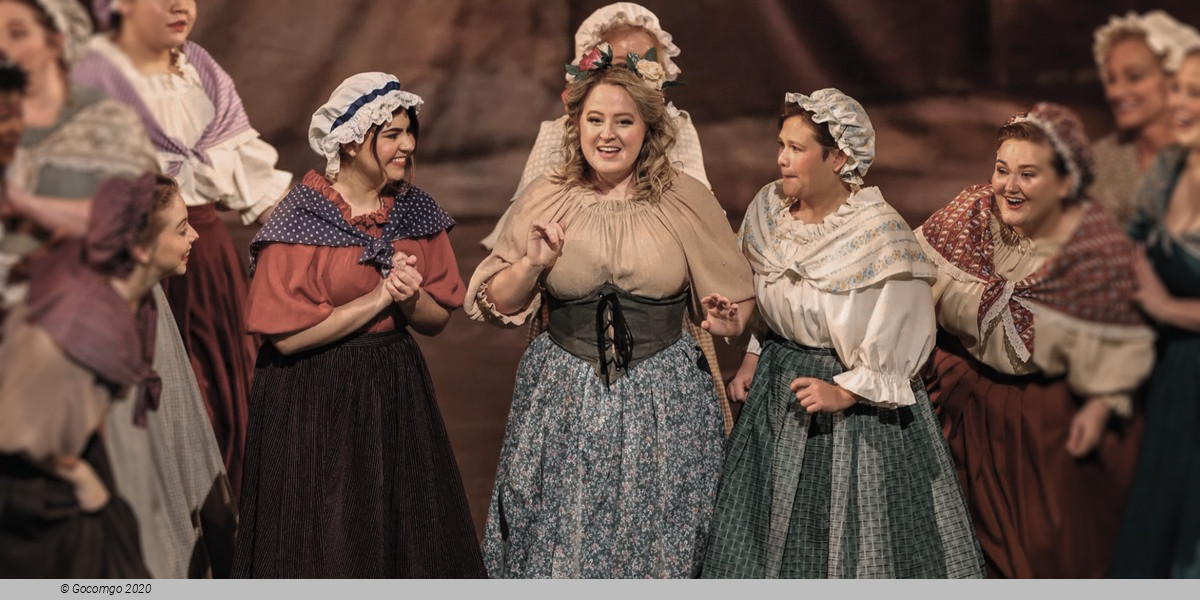
After the two men have left, Giannetta gossips with the women of the village. Swearing them all to secrecy, she reveals that Nemorino's uncle has just died and left his nephew a large fortune. However, neither Nemorino nor Adina is yet aware of this. Nemorino enters, having spent his military signing bonus on – and consumed – a large amount of the fake elixir from Dr. Dulcamara. Hoping to share his fortune, the women approach Nemorino with overly friendly greetings. So out of character is this that Nemorino takes it as proof of the elixir's efficacy. Adina sees Nemorino with the women, is rattled by his newfound popularity, and asks Dr. Dulcamara for an explanation. Unaware that Adina is the object of Nemorino's affection, Dulcamara explains that Nemorino spent his last penny on the elixir and joined the army for money to get more, so desperate was he to win the love of some unnamed cruel beauty. Adina immediately recognises Nemorino's sincerity, regrets her behaviour and realises that she has loved Nemorino all along. Although Dulcamara seizes the opportunity to try to sell her some of his potion to win back Nemorino, Adina declares that she has full confidence in her own powers of attraction.

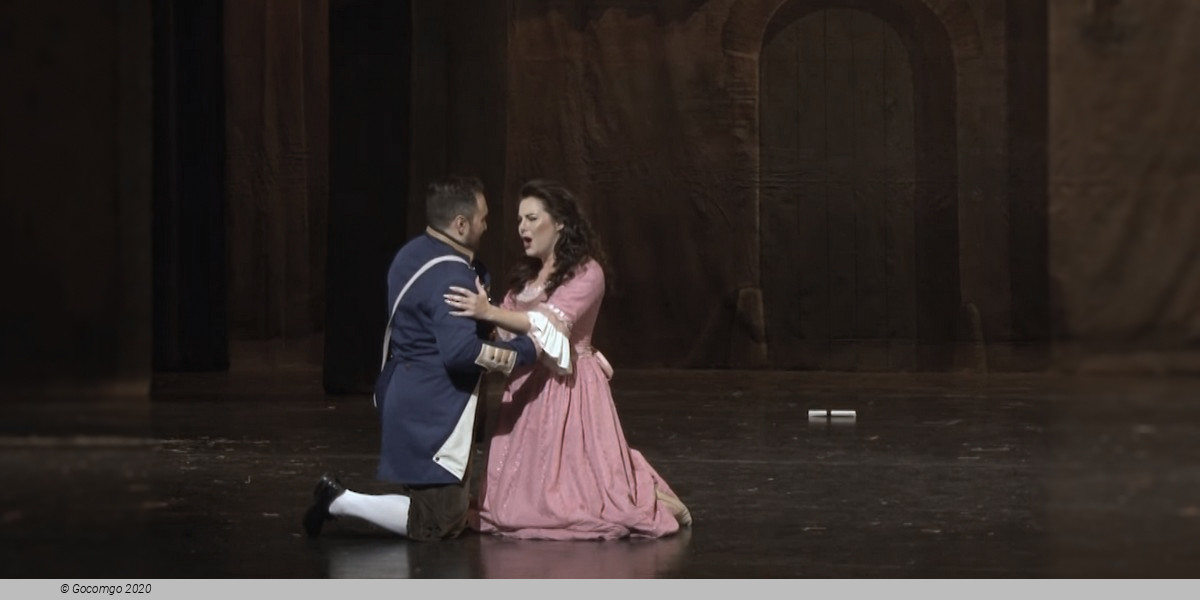
Nemorino appears alone, pensive, reflecting on a tear he saw in Adina's eye when he was ignoring her earlier. Solely based on that, he convinces himself that Adina loves him. She enters and asks why he has chosen to join the army and leave the village. When Nemorino explains that he was seeking a better life, Adina responds that he is loved and that she has purchased back his military contract from Sergeant Belcore. She offers the cancelled contract to Nemorino and reassures him that, if he stays, he will be happy. As he takes the contract, Adina turns to leave. Nemorino believes she is abandoning him and flies into a desperate fit, vowing that if he is not loved he might as well go off and die a soldier. Deeply moved by his fidelity, Adina finally declares that she will love Nemorino forever. Nemorino is ecstatic. Adina begs him to forgive her, which he does with a kiss. Belcore returns to see Nemorino and Adina in an embrace. When Adina explains that she loves Nemorino, the Sergeant takes the news in stride, noting that there are plenty of other women in the world. Adina and Nemorino learn about the inheritance from his uncle. Dulcamara returns and boasts of the success of his elixir: Nemorino is now not only loved but also rich. He exults in the boost this will bring to the sales of his product. As he prepares to leave, everyone queues up to buy the elixir and hails Dulcamara as a great physician.

Venue Info

Opera National de Paris - Paris
Location   Palais Garnier: Place de l’Opéra, 75009 Paris; Opéra Bastille: Place de la Bastille, 75012 Paris

The Paris Opera is the primary opera and ballet company of France. It was founded in 1669 by Louis XIV as the Académie d'Opéra, and shortly thereafter was placed under the leadership of Jean-Baptiste Lully and officially renamed the Académie Royale de Musique, but continued to be known more simply as the Opéra. Classical ballet as it is known today arose within the Paris Opera as the Paris Opera Ballet and has remained an integral and important part of the company. Currently called the Opéra National de Paris, it mainly produces operas at its modern 2700-seat theatre Opéra Bastille which opened in 1989, and ballets and some classical operas at the older 1970-seat Palais Garnier which opened in 1875. Small scale and contemporary works are also staged in the 500-seat Amphitheatre under the Opéra Bastille.

The company's annual budget is in the order of 200 million euros, of which 100 million come from the French state and 70 million from box office receipts. With this money, the company runs the two houses and supports a large permanent staff, which includes the orchestra of 170, a chorus of 110 and the corps de ballet of 150.

Each year, the Opéra presents about 380 performances of opera, ballet and other concerts, to a total audience of about 800,000 people (of whom 17% come from abroad), which is a very good average seat occupancy rate of 94%. In the 2012/13 season, the Opéra presented 18 opera titles (two in a double bill), 13 ballets, 5 symphonic concerts and two vocal recitals, plus 15 other programmes. The company's training bodies are also active, with 7 concerts from the Atelier Lyrique and 4 programmes from the École de Danse.

The Opera under Louis XIV
Pierre Perrin

The poet Pierre Perrin began thinking and writing about the possibility of French opera in 1655, more than a decade before the official founding of the Paris Opera as an institution. He believed that the prevailing opinion of the time that the French language was fundamentally unmusical was completely incorrect. Seventeenth-century France offered Perrin essentially two types of organization for realizing his vision: a royal academy or a public theater. In 1666 he proposed to the minister Colbert that "the king decree 'the establishment of an Academy of Poetry and Music' whose goal would be to synthesize the French language and French music into an entirely new lyric form."

Even though Perrin's original concept was of an academy devoted to discussions of French opera, the king's intention was in fact a unique hybrid of royal academy and public theatre, with an emphasis on the latter as an institution for performance. On 28 June 1669, Louis XIV signed the Privilège accordé au Sieur Perrin pour l'établissement d'une Académie d'Opéra en musique, & Vers François (Privilege granted to Sir Perrin for the establishment of an Academy of Opera in music, & French Verse). The wording of the privilège, based in part on Perrin's own writings, gave him the exclusive right for 12 years to found anywhere in France academies of opera dedicated to the performance of opera in French. He was free to select business partners of his choice and to set the price of tickets. No one was to have the right of free entry including members of the royal court, and no one else could set up a similar institution. Although it was to be a public theatre, it retained its status as royal academy in which the authority of the king as the primary stakeholder was decisive. The monopoly, originally intended to protect the enterprise from competition during its formative phase, was renewed for subsequent recipients of the privilege up to the early French Revolution. As Victoria Johnson points out, "the Opera was an organization by nature so luxurious and expensive in its productions that its very survival depended on financial protection and privilege."

Perrin converted the Bouteille tennis court, located on the Rue des Fossés de Nesles (now 42 Rue Mazarine), into a rectangular facility with provisions for stage machinery and scenery changes and a capacity of about 1200 spectators. His first opera Pomone with music by Robert Cambert opened on 3 March 1671 and ran for 146 performances. A second work, Les peines et les plaisirs de l'amour, with a libretto by Gabriel Gilbert and music by Cambert, was performed in 1672.

Jean-Baptiste Lully

Despite this early success, Cambert and two other associates did not hesitate to swindle Perrin, who was imprisoned for debt and forced to concede his privilege on 13 March 1672 to the surintendant of the king's music Jean-Baptiste Lully. The institution was renamed the Académie Royale de Musique and came to be known in France simply as the Opéra. Within one month Lully had convinced the king to expand the privilege by restricting the French and Italian comedians to using two singers rather than six, and six instrumentalists, rather than twelve. Because of legal difficulties Lully could not use the Salle de la Bouteille, and a new theatre was built by Carlo Vigarani at the Bel-Air tennis court on the Rue de Vaugirard.[9] Later, Lully and his successors bitterly negotiated the concession of the privilege, in whole or in part, from the entrepreneurs in the provinces: in 1684 Pierre Gautier bought the authorisation to open a music academy in Marseille, then the towns of Lyon, Rouen, Lille and Bordeaux followed suit in the following years. During Lully's tenure, the only works performed were his own. The first productions were the pastorale Les fêtes de l'Amour et de Bacchus (November 1672) and his first tragedie lyrique called Cadmus et Hermione (27 April 1673).

After Molière's death in 1673, his troupe merged with the players at the Théâtre du Marais to form the Théâtre Guénégaud (at the same theatre that had been used by the Académie d'Opéra), and no longer needed the theatre built by Richelieu at his residence the Palais-Royal, near the Louvre. (In 1680 the troupe at the Guénégaud merged again with the players from the Hôtel de Bourgogne forming the Comédie-Française.) Richelieu's theatre had been designed by Jacques Le Mercier and had opened in 1641, and unlike the huge theatre at the Tuileries Palace, which could accommodate 6,000 to 8,000 spectators, was of a size consistent with good acoustics. Lully greatly desired a better theatre and persuaded the king to let him use the one at the Palais-Royal free of charge. The Théâtre du Palais-Royal had been altered in 1660 and 1671, but Lully, with 3,000 livres received from the king, had further changes made by Vigarani in 1674.

The first production in the new theatre was Alceste on 19 January 1674. The opera was bitterly attacked by those enraged at the restrictions that Lully had caused to be placed on the French and Italian comedians. To mitigate the damage, Louis XIV arranged for new works to be premiered at the court, usually at the Chateau Vieux of the Château de Saint-Germain-en-Laye. This had the further advantage of subsidizing the cost of rehearsals, as well as most of the machinery, sets, and costumes, which were donated to the Opéra for use in Paris. During Lully's time at the Opéra, performances were given all year, except for three weeks at Easter. Regular performances were on Tuesdays, Fridays, and Sundays. The premieres presented at court were usually during Carnival and were moved to the Palais-Royal after Easter, where the openings were on Thursdays. About two to three new works were mounted each year. In all, thirteen of Lully's tragédie en musique were performed there (see the list of compositions by Jean-Baptiste Lully).

After Lully

After Lully died (in 1687), the number of new works per year almost doubled, since his successors (Pascal Collasse, Henri Desmarets, André Campra, André Cardinal Destouches, and Marin Marais) had greater difficulty sustaining the interest of the public. Revivals of Lully's works were common. French composers at the Opéra generally wrote music to new librettos, which had to be approved by the directors of the company. The Italian practice of preparing new settings of existing librettos was considered controversial and did not become the norm in Paris until around 1760. One of the most important of the new works during this period was an opéra-ballet by Campra called L'Europe galante presented in 1697.

Ballet
In 1661 Louis XIV, who was a dancer himself and one of the great architects of baroque ballet (the art form which would one day evolve into classical ballet), established the Académie Royale de Danse, intended to codify court and character dances and to certify dance teachers by examination. From 1680 until Lully's death, it was under the direction of the great dancing master Pierre Beauchamp, the man who codified the five positions of the feet. When Lully took over the Opéra in 1672, he and Beauchamp made theatrical ballet an important part of the company's productions. The ballet of that time was merely an extension of the opera, having yet to evolve into an independent form of theatrical art. As it became more important, however, the dance component of the company began to be referred to as the Paris Opera Ballet. In 1713 an associated ballet school was opened, today known as the Paris Opera Ballet School. The Académie Royale de Danse remained separate, and with the fall of the monarchy in 1789 it disappeared.

The company's names after the Revolution

With the French Revolution and the founding of the Republic, the company changed names several times, dropping its association with the royal family (see the List of official company names for details), and in 1794, moved into the Théâtre National de la rue de la Loi (capacity 2800) where it took the name Théâtre des Arts. In 1797, it was renamed the Théâtre de la République et des Arts.

Napoleon took control of the company in 1802 and with the declaration of the French Empire in 1804, renamed the company the Académie Impériale de Musique. With the Restoration in 1814, the company was renamed the Académie Royale de Musique. It became part of the Académie des Beaux-Arts in 1816. In 1821, the company moved to the Salle Le Peletier, which had a capacity of 1900 spectators and where it remained until the building was destroyed by fire in 1873.

In the second half of the 19th century, with the ascension of Napoleon III in 1851, the name Académie Impériale de Musique was reinstated and after 1870 with the formation of the Third Republic, was changed to Théâtre National de l'Opéra.

In 1875, the institution occupied a new home, the Palais Garnier. Between 1908 and 1914 Henri Benjamin Rabaud conducted at Palais Garnier. Rabaud also composed several works which first premiered at Opéra-Comique, but were later also performed at Palais Garnier.

In 1939, the Opéra was merged with the Opéra-Comique and the company name became Réunion des Théâtres Lyriques Nationaux. The Opéra-Comique was closed in 1972 with the appointment of Rolf Liebermann as general administrator of the Théâtre National de l'Opéra de Paris (1973–1980), but in 1976, the Opéra-Comique was restored.

In 1990 the Opéra moved its primary venue to the new Opéra-Bastille, becoming the Opéra de Paris, although it continued to mount productions, primarily ballet, at the Palais Garnier; and the Opéra-Comique regained its autonomy. In 1994 the Opéra de Paris became the Opéra National de Paris. Regardless of all the changes in its "official" name, the company and its theatres were commonly referred to as the Opéra.

Important Info
Type: Opera
City: Paris, France
Starts at: 19:30
Acts: 2
Intervals: 1
Duration: 2h 45min
Sung in: Italian
Top of page