Time: The years 1598 to 1605
Place: Moscow; the Lithuanian frontier; a castle in Sandomierz; Kromï
Part 1 / Prologue
Scene 1: The Courtyard of the Novodevichiy Monastery near Moscow (1598)
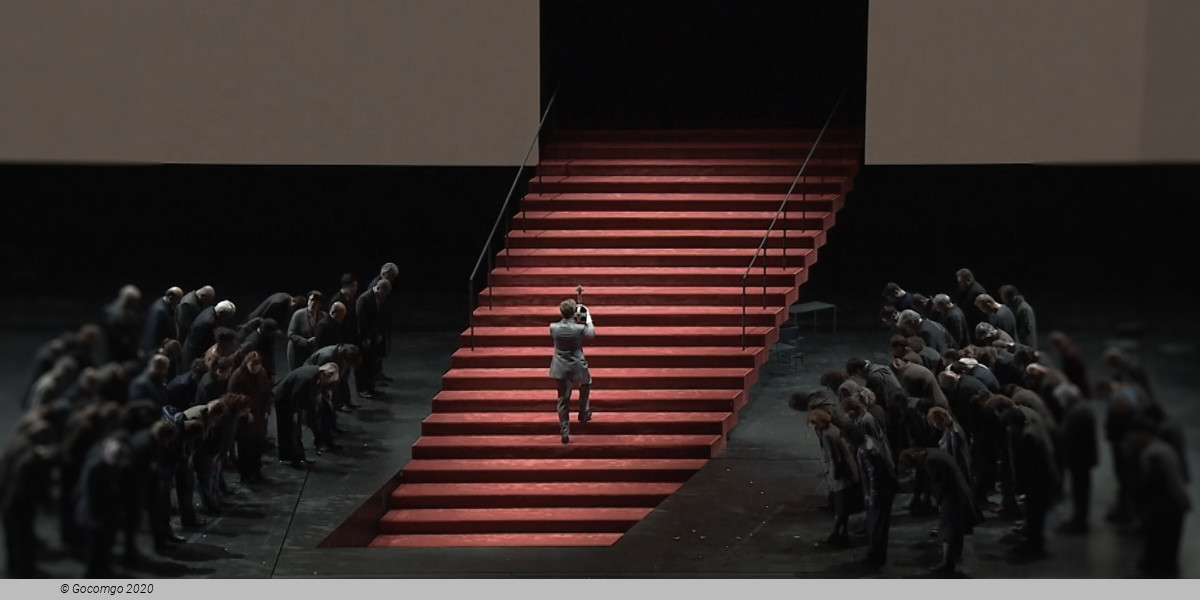
There is a brief introduction foreshadowing the 'Dmitriy Motif'. The curtain opens on a crowd in the courtyard of the monastery, where the weary regent Boris Godunov has temporarily retired. Nikitich the police officer orders the assembled people to kneel. He goads them to clamor for Boris to accept the throne. They sing a chorus of supplication ("To whom dost thou abandon us, our father?"). The people are bewildered about their purpose and soon fall to bickering with each other, resuming their entreaties only when the policeman threatens them with his club. Their chorus reaches a feverish climax. Andrey Shchelkalov, the Secretary of the Duma, appears from inside the convent, informs the people that Boris still refuses the throne of Russia ("Orthodox folk! The boyar is implacable!"), and requests that they pray that he will relent. An approaching procession of pilgrims sings a hymn ("Glory to Thee, Creator on high"), exhorting the people to crush the spirit of anarchy in the land, take up holy icons, and go to meet the Tsar. They disappear into the monastery.
[Original 1869 Version only: The people discuss the statements of the pilgrims. Many remain bewildered about the identity of this Tsar. The police officer interrupts their discussion, ordering them to appear the next day at the Moscow Kremlin. The people move on, stoically exclaiming "if we are to wail, we might as well wail at the Kremlin".]
Scene 2: [Cathedral] Square in the Moscow Kremlin (1598).
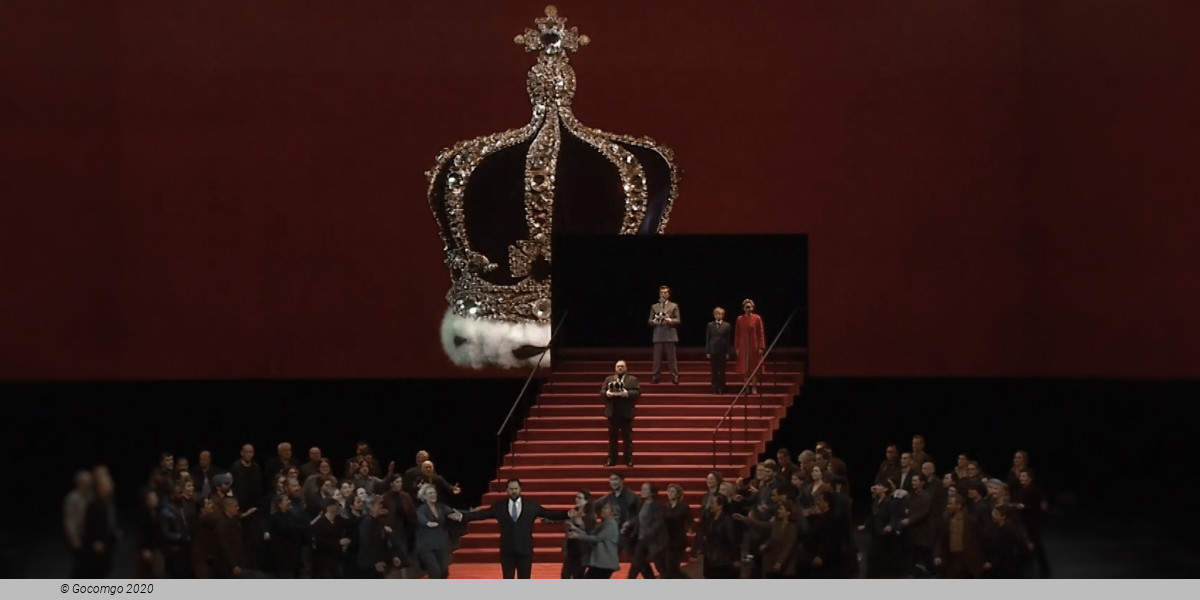
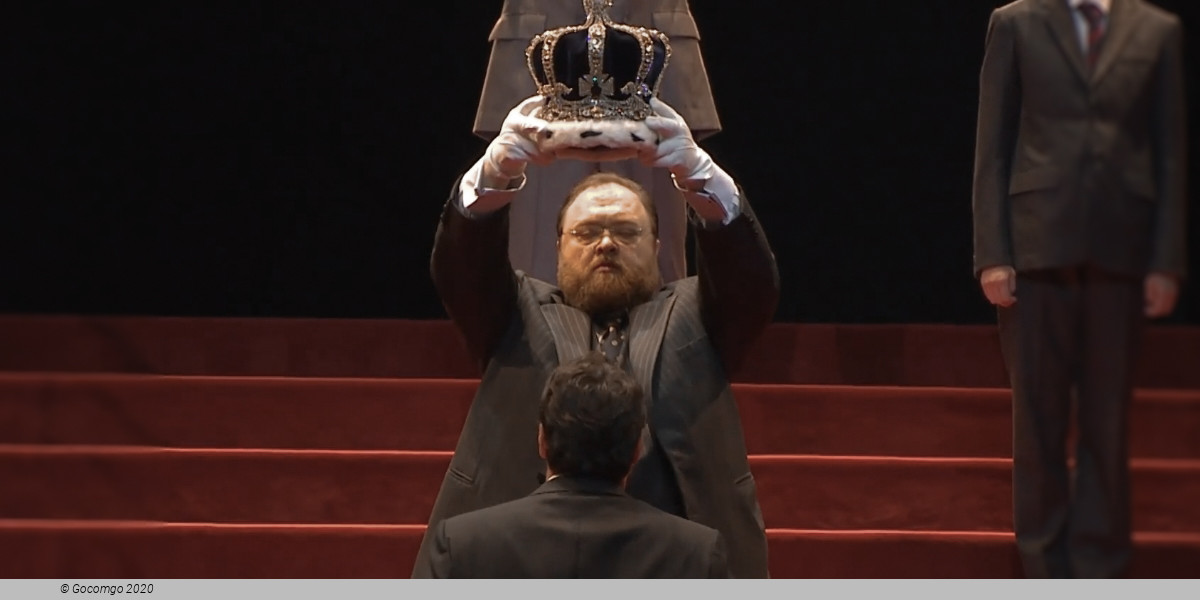
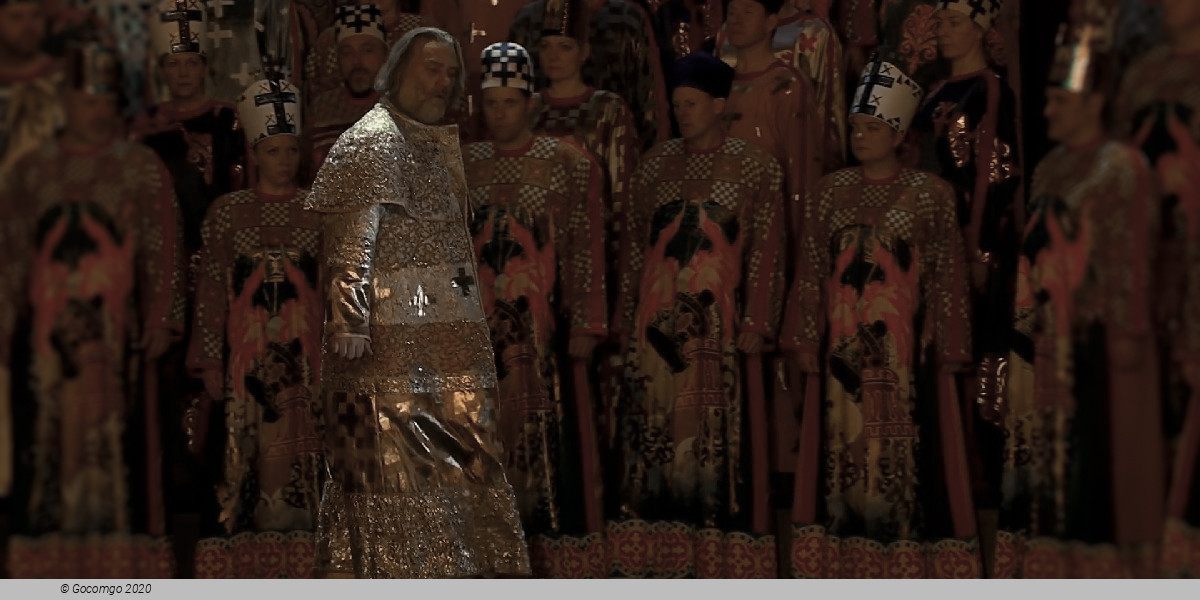
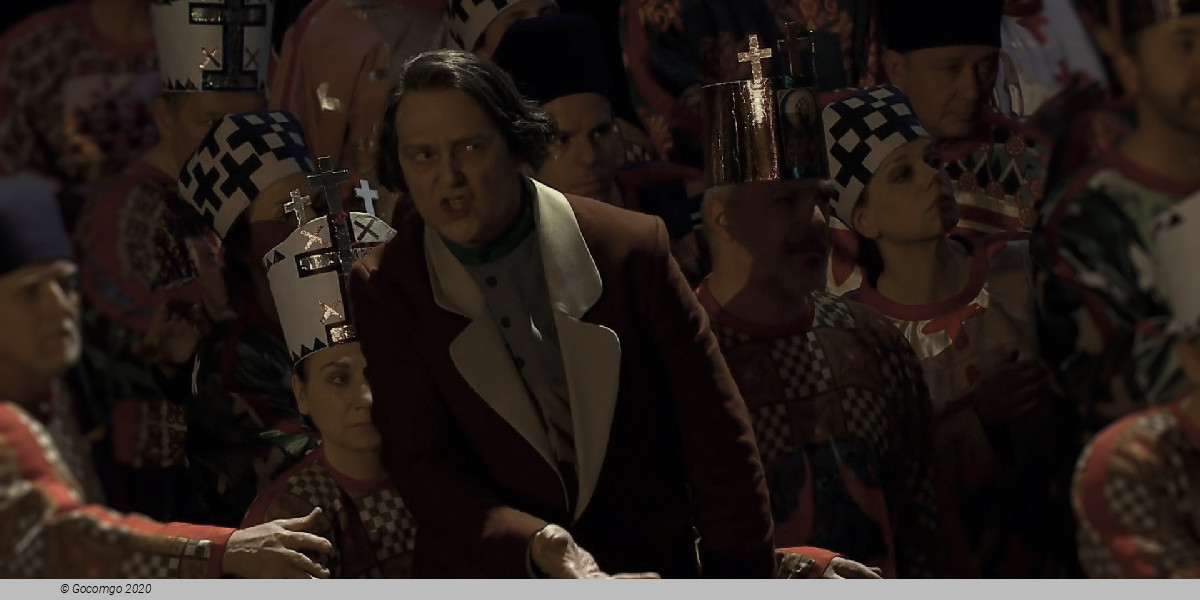
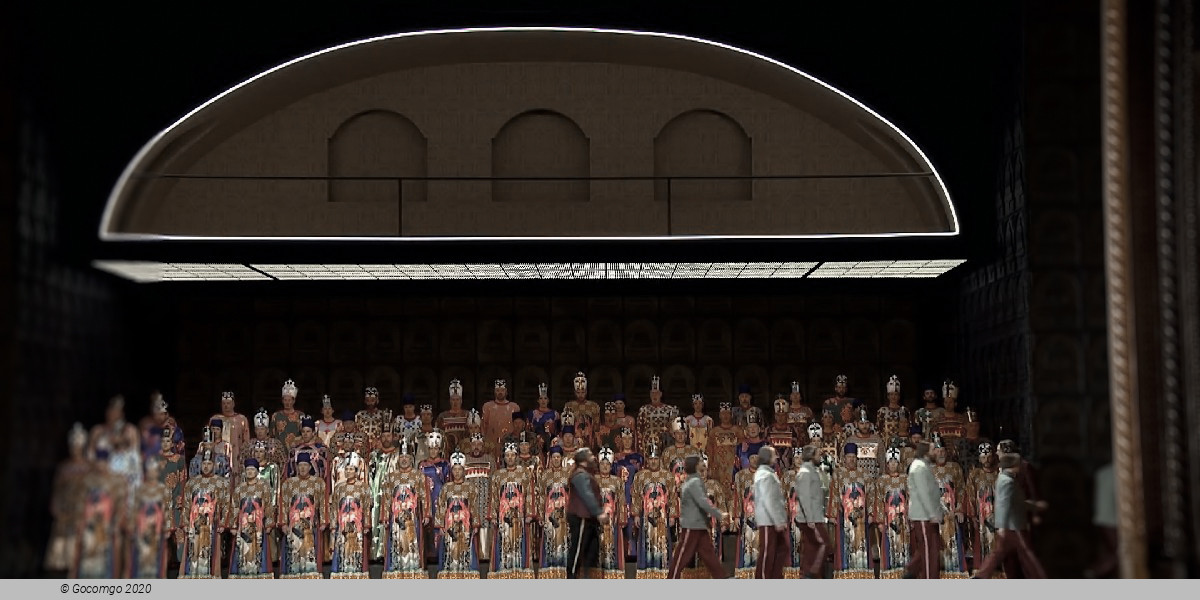
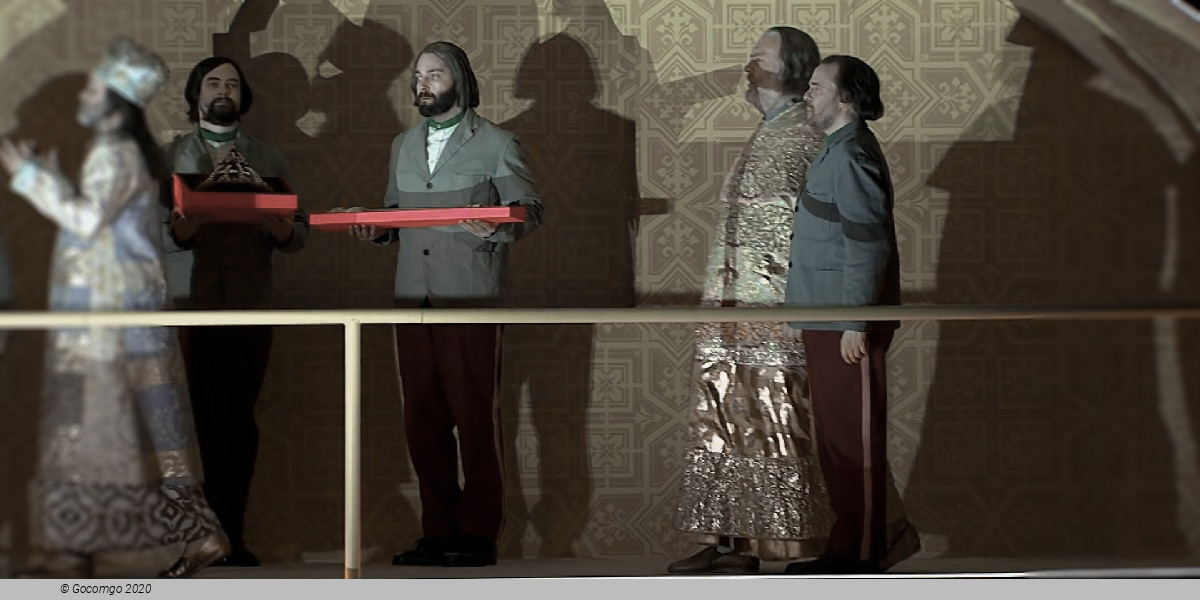
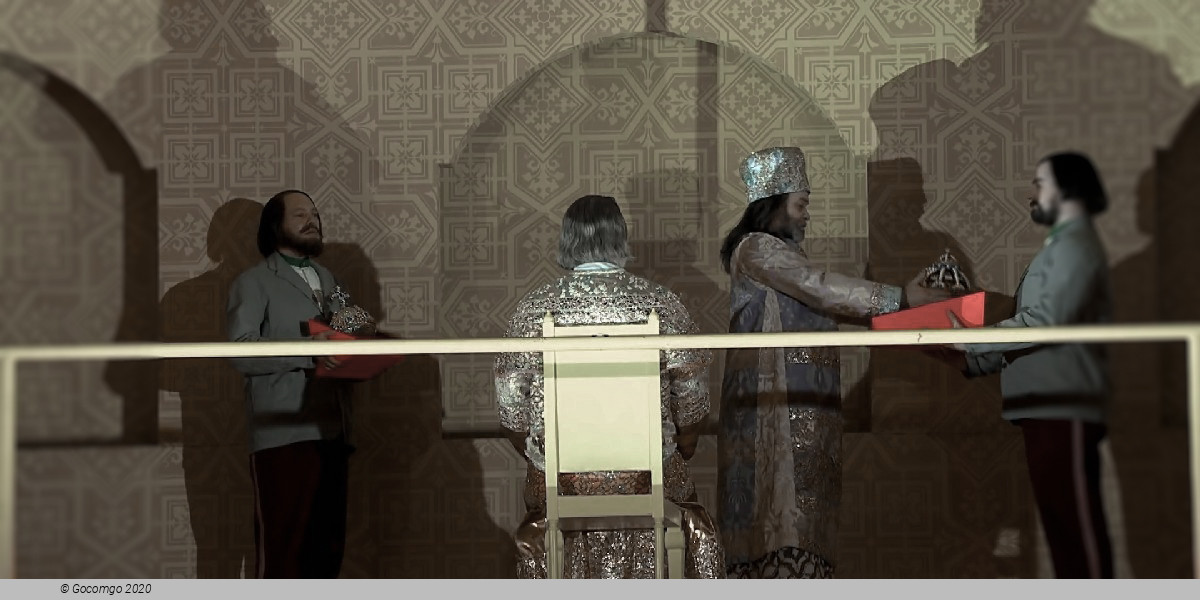
The orchestral introduction is based on bell motifs. From the porch of the Cathedral of the Dormition, Prince Shuysky exhorts the people to glorify Tsar Boris. As the people sing a great chorus of praise ("Like the beautiful sun in the sky, glory"), a solemn procession of boyars exits the cathedral. The people kneel. Boris appears on the porch of the cathedral. The shouts of "Glory!" reach a climax and subside. Boris delivers a brief monologue ("My soul grieves") betraying a feeling of ominous foreboding. He prays for God's blessing, and hopes to be a good and just ruler. He invites the people to a great feast, and then proceeds to the Cathedral of the Archangel to kneel at the tombs of Russia's past rulers. The people wish Boris a long life ("Glory! Glory! Glory!"). A crowd breaks toward the cathedral. The police officers struggle to maintain order. The people resume their shouts of "Glory!"
In this scene, Mussorgsky is hailed to be ahead of his time musically. His use of the whole tone scale, which uses only whole steps, made the Coronation scene stand out. This technique was replicated by impressionistic composers about 20 years later who noted his success. Mussorgsky also combined different two-beat and three-beat meters to create a unique sound for his composition called polymeters. These techniques were uncommon during this era and were believed to be almost too overwhelming for the public. This led to his rejection on two different occasions by the Imperial Opera before they decided to perform.
Part 2 / Act 1
Scene 1: Night. A Cell in the Chudov Monastery [within the Moscow Kremlin] (1603)
Pimen, a venerable monk, writes a chronicle ("Yet one last tale") of Russian history. The young novice Grigoriy awakes from a horrible (and prophetic) dream, which he relates to Pimen, in which he climbed a high tower, was mocked by the people of Moscow, and fell. Pimen advises him to fast and pray. Grigoriy regrets that he retired so soon from worldly affairs to become a monk. He envies Pimen's early life of adventure. Pimen speaks approvingly of Ivan the Terrible and his son Fyodor, who both exhibited great spiritual devotion, and draws a contrast with Boris, a regicide.
[Original 1869 Version only: At Grigoriy's request, Pimen tells the vivid details of the scene of the murder of Dmitriy Ivanovich, which he witnessed in Uglich.]
Upon discovering the similarity in age between himself and the murdered Tsarevich, Grigoriy conceives the idea of posing as the Pretender. As Pimen departs for Matins, Grigoriy declares that Boris shall escape neither the judgment of the people, nor that of God.
Scene 2: An Inn on the Lithuanian Border (1603)
There is a brief orchestral introduction based on three prominent themes from this scene.
[Revised 1872 Version only: The Hostess enters and sings the 'Song of the Drake' ("I have caught a gray drake"). It is interrupted towards the end by approaching voices].
The vagrants Varlaam and Misail, who are dressed as monks and are begging for alms, and their companion Grigoriy, who is in secular garb, arrive and enter. After exchanging greetings, Varlaam requests some wine. When the Hostess returns with a bottle, he drinks and launches into a ferocious song ("So it was in the city of Kazan") of Ivan the Terrible's siege of Kazan. The two monks quickly become tipsy, and soon begin to doze. Grigoriy quietly asks the Hostess for directions to the Lithuanian border. The Hostess mentions that the police are watching the ordinary roads, but they are wasting their time, because there is an alternative, less well-known way to get to the border. Policemen appear in search of a fugitive heretic monk (Grigoriy) who has run off from the Chudov Monastery declaring that he will become Tsar in Moscow. Noticing Varlaam's suspicious appearance and behavior, the lead policeman thinks he has found his man. He cannot read the ukaz (edict) he is carrying, however, so Grigoriy volunteers to read it. He does so, but, eyeing Varlaam carefully, he substitutes Varlaam's description for his own. The policemen quickly seize Varlaam, who protests his innocence and asks to read the ukaz. Varlaam is only barely literate, but he manages to haltingly read the description of the suspect, which of course matches Grigoriy. Grigoriy brandishes a dagger, and leaps out of the window. The men set off in pursuit.
Part 3 / Act 2
The Interior of the Tsar's Terem in the Moscow Kremlin (1605)
Kseniya (or Xenia), clutching a portrait of "Prince Ivan", her betrothed who has died, sings a brief mournful aria ("Where are you, my bridegroom?"). Fyodor studies a great map of the Tsardom of Russia.
[Revised 1872 Version only: Fyodor tries to console Kseniya and shows her the magic of the clock, once it starts chiming].
Kseniya's nurse assures her that she will soon forget about "Prince Ivan".
[1872: The nurse and Fyodor attempt to cheer Kseniya up with some songs ("A gnat was chopping wood" and "A little tale of this and that").]
Boris abruptly enters, briefly consoles Kseniya, and then sends her and her nurse to their own quarters. Fyodor shows Boris the map of Russia. After encouraging his son to resume his studies, Boris delivers a long and fine soliloquy ("I have attained supreme power").
[1872: At the end of this arioso he reveals that he has been disturbed by a vision of a bloody child begging for mercy. A commotion breaks out in his children's quarters. Boris sends Fyodor to investigate.]
The boyar-in-attendance brings word of the arrival of Prince Shuysky, and reports a denunciation against him for his intrigues.
[1872: Fyodor returns to relate a whimsical tale ("Our little parrot was sitting") involving a pet parrot. Boris takes comfort in his son's imagination and advises Fyodor, when he becomes Tsar, to beware of evil and cunning advisors such as Shuysky.]
Prince Shuysky now enters. Boris insults him, accusing him of conspiring with Pushkin, an ancestor of the poet. However, the prince brings grave tidings. A Pretender has appeared in Lithuania. Boris angrily demands to know his identity. Shuysky fears the Pretender might attract a following bearing the name of Tsarevich Dmitriy. Shaken by this revelation, Boris dismisses Fyodor. He orders Shuysky to seal the border with Lithuania, and, clearly on the edge of madness, asks Shuysky whether he has ever heard of dead children rising from their graves to question Tsars. Boris seeks assurance that the dead child the prince had seen in Uglich was really Dmitriy. He threatens Shuysky, if he dissembles, with a gruesome execution. The Prince describes the ghastly scene of Dmitriy's murder in a brief and beautiful aria ("In Uglich, in the cathedral"). But he gives hints that a miracle (incorruptibility) has occurred. Boris begins choking with guilt and remorse, and gives a sign for Shuysky to depart.
[1872: The chiming clock again begins working.]
Boris hallucinates (Hallucination or 'Clock' Scene). The spectre of the dead Dmitriy reaches out to him. Addressing the apparition, he denies his responsibility for the crime: "Begone, begone child! I am not thy murderer... the will of the people!" He collapses, praying that God will have mercy on his guilty soul.
Act 3 (The 'Polish' Act) (1872 Version only)
Scene 1: The Boudoir of Marina Mniszech in Sandomierz [Poland] (1604)
Maidens sing a delicate, sentimental song ("On the blue Vistula") to entertain Marina as her chambermaid dresses her hair. Marina declares her preference for heroic songs of chivalry. She dismisses everyone. Alone, she sings of her boredom ("How tediously and sluggishly"), of Dmitriy, and of her thirst for adventure, power, and glory. The Jesuit Rangoni enters, bemoans the wretched state of the church, attempts to obtain Marina's promise that when she becomes Tsaritsa she will convert the heretics of Moscow (Russian Orthodox Church) to the true faith (Roman Catholicism), and encourages her to bewitch the Pretender. When Marina wonders why she should do this, Rangoni angrily insists that she stop short of nothing, including sacrificing her honor, to obey the dictates of the church. Marina expresses contempt of his hypocritical insinuations and demands he leave. As Rangoni ominously tells her she is in the thrall of infernal forces, Marina collapses in dread. Rangoni demands her obedience.
Scene 2: Mniszech's Castle in Sandomierz. A Garden. A Fountain. A Moonlit Night (1604)
Woodwind and harp accompany a pensive version of the 'Dmitriy Motif'. The Pretender dreams of an assignation with Marina in the garden of her father's castle. However, to his annoyance, Rangoni finds him. He brings news that Marina longs for him and wishes to speak with him. The Pretender resolves to throw himself at Marina's feet, begging her to be his wife and Tsaritsa. He entreats Rangoni to lead him to Marina. Rangoni, however, first begs the Pretender to consider him a father, allowing him to follow his every step and thought. Despite his mistrust of Rangoni, the Pretender agrees not to part from him if he will only let him see Marina. Rangoni convinces the Pretender to hide as the Polish nobles emerge from the castle dancing a polonaise (Polonaise). Marina flirts, dancing with an older man. The Poles sing of taking the Muscovite throne, defeating the army of Boris, and capturing him. They return to the castle. The Pretender comes out of hiding, cursing Rangoni. He resolves to abandon wooing Marina and begin his march on Moscow. But then Marina appears and calls to him. He is lovesick. She, however, only wants to know when he will be Tsar, and declares she can only be seduced by a throne and a crown. The Pretender kneels at her feet. She rejects his advances, and, attempting to spur him to action, dismisses him, calling him a lackey. Having reached his limit, he tells her he will depart the next day to lead his army to Moscow and to his father's throne. Furthermore, as Tsar he will take pleasure in watching her come crawling back looking for her own lost throne, and will command everyone to laugh at her. She quickly reverses course, tells him she adores him, and they sing a duet ("O Tsarevich, I implore you"). Rangoni observes the amorous couple from afar, and, joining them in a brief trio, cynically rejoices in his victory.
Part 4 / Act 4
Scene 1 [1869 Version only]: The Square before the Cathedral of Vasiliy the Blessed in Moscow (1605)
A crowd mills about before the Cathedral of the Intercession (the Temple of Vasiliy the Blessed) in Red Square. Many are beggars, and policemen occasionally appear. A group of men enters, discussing the anathema the deacon had declared on Grishka (Grigoriy) Otrepyev in the mass. They identify Grishka as the Tsarevich. With growing excitement they sing of the advance of his forces to Kromï, of his intent to retake his father's throne, and of the defeat he will deal to the Godunovs. A yuródivïy enters, pursued by urchins. He sings a nonsensical song ("The moon is flying, the kitten is crying"). The urchins greet him and rap on his metal hat. The yuródivïy has a kopek, which the urchins promptly steal. He whines pathetically. Boris and his retinue exit the Cathedral. The boyars distribute alms. In a powerful chorus ("Benefactor father... Give us bread!"), the hungry people beg for bread. As the chorus subsides, the yuródivïy's cries are heard. Boris asks why he cries. The yuródivïy reports the theft of his kopek and asks Boris to order the boys' slaughter, just as he did in the case of the Tsarevich. Shuysky wants the yuródivïy seized, but Boris instead asks for the holy man's prayers. As Boris exits, the yuródivïy declares that the Mother of God will not allow him to pray for Tsar Herod (see Massacre of the Innocents). The yuródivïy then sings his lament ("Flow, flow, bitter tears!") about the fate of Russia.
Scene 2 [1869 Version] / Scene 1 [1872 version]: The Faceted Palace in the Moscow Kremlin (1605)
A session of the Duma is in progress.
[Original 1869 Version only: The assembled boyars listen as Shchelkalov, reading the Tsar's ukaz (edict), informs them of the Pretender's claim to the throne of Russia, and requests they pass judgment on him.]
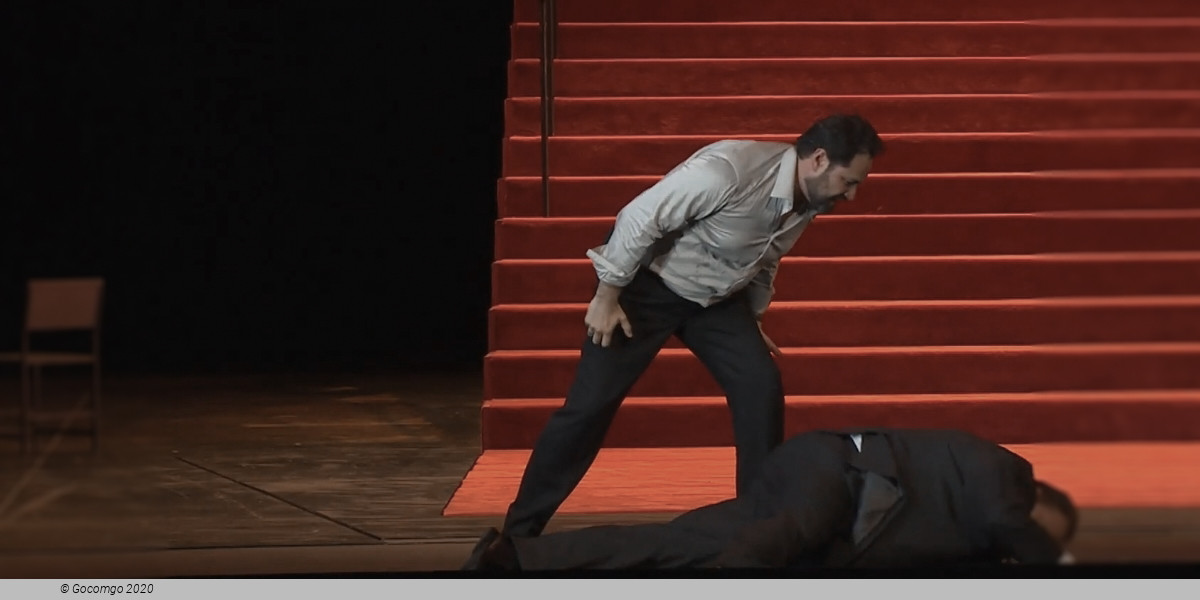
After some arguments, the boyars agree ("Well, let's put it to a vote, boyars"), in a powerful chorus, that the Pretender and his sympathizers should be executed. Shuysky, whom they distrust, arrives with an interesting story. Upon leaving the Tsar's presence, he observed Boris attempting to drive away the ghost of the dead Tsarevich, exclaiming: "Begone, begone child!" The boyars accuse Shuysky of spreading lies. However, a dishevelled Boris now enters, echoing Shuysky: "Begone child!" The boyars are horrified. After Boris comes to his senses, Shuysky informs him that a humble old man craves an audience. Pimen enters and tells the story ("One day, at the evening hour") of a blind man who heard the voice of the Tsarevich in a dream. Dmitry instructed him to go to Uglich and pray at his grave, for he has become a miracle worker in heaven. The man did as instructed and regained his sight. This story is the final blow for Boris. He calls for his son, declares he is dying ("Farewell, my son, I am dying"), gives Fyodor final counsel, and prays for God's blessing on his children. In a very dramatic scene ("The bell! The funeral bell!"), he dies.
Scene 2 [1872 Version only]: A Forest Glade near Kromï (1605)
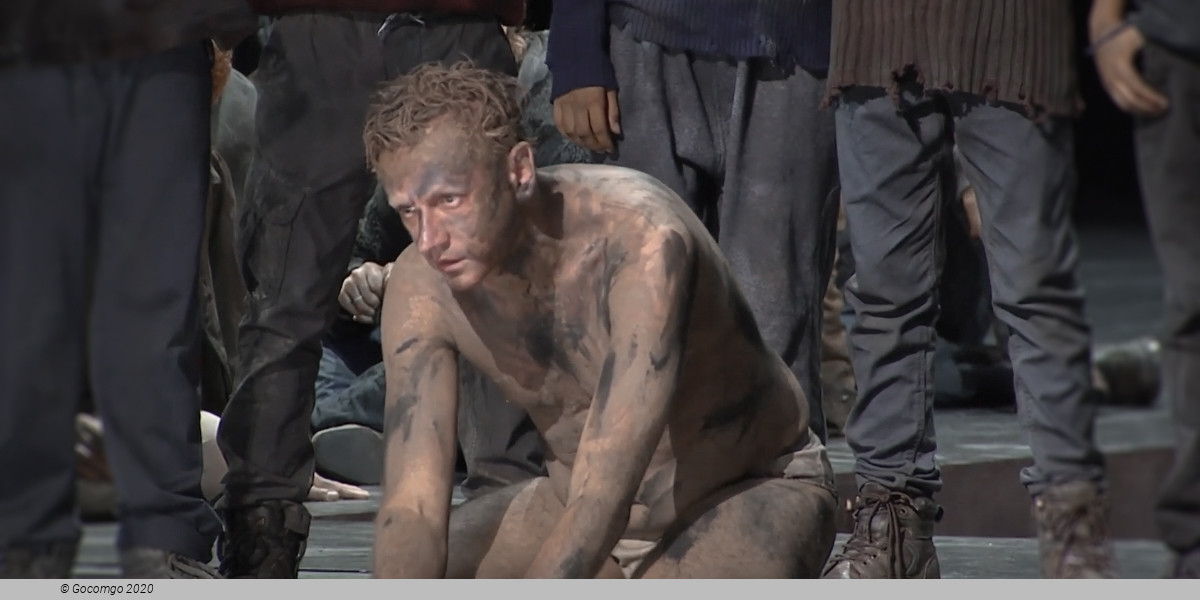
Tempestuous music accompanies the entry of a crowd of vagabonds who have captured the boyar Khrushchov. The crowd taunts him, then bows in mock homage ("Not a falcon flying in the heavens"). The yuródivïy enters, pursued by urchins. He sings a nonsensical song ("The moon is flying, the kitten is crying"). The urchins greet him and rap on his metal hat. The yuródivïy has a kopek, which the urchins promptly steal. He whines pathetically. Varlaam and Misail are heard in the distance singing of the crimes of Boris and his henchmen ("The sun and moon have gone dark"). They enter. The crowd gets worked up to a frenzy ("Our bold daring has broken free, gone on a rampage") denouncing Boris. Two Jesuits are heard in the distance chanting in Latin ("Domine, Domine, salvum fac"), praying that God will save Dmitriy. They enter. At the instigation of Varlaam and Misail, the vagabonds prepare to hang the Jesuits, who appeal to the Holy Virgin for aid. Processional music heralds the arrival of Dmitriy and his forces. Varlaam and Misail glorify him ("Glory to thee, Tsarevich!") along with the crowd. The Pretender calls those persecuted by Godunov to his side. He frees Khrushchov, and calls on all to march on Moscow. All exeunt except the yuródivïy, who sings a plaintive song ("Flow, flow, bitter tears!") of the arrival of the enemy and of woe to Russia.
Time: The years 1598 to 1605
Place: Moscow; the Lithuanian frontier; a castle in Sandomierz; Kromï
Part 1 / Prologue
Scene 1: The Courtyard of the Novodevichiy Monastery near Moscow (1598)
There is a brief introduction foreshadowing the 'Dmitriy Motif'. The curtain opens on a crowd in the courtyard of the monastery, where the weary regent Boris Godunov has temporarily retired. Nikitich the police officer orders the assembled people to kneel. He goads them to clamor for Boris to accept the throne. They sing a chorus of supplication ("To whom dost thou abandon us, our father?"). The people are bewildered about their purpose and soon fall to bickering with each other, resuming their entreaties only when the policeman threatens them with his club. Their chorus reaches a feverish climax. Andrey Shchelkalov, the Secretary of the Duma, appears from inside the convent, informs the people that Boris still refuses the throne of Russia ("Orthodox folk! The boyar is implacable!"), and requests that they pray that he will relent. An approaching procession of pilgrims sings a hymn ("Glory to Thee, Creator on high"), exhorting the people to crush the spirit of anarchy in the land, take up holy icons, and go to meet the Tsar. They disappear into the monastery.
[Original 1869 Version only: The people discuss the statements of the pilgrims. Many remain bewildered about the identity of this Tsar. The police officer interrupts their discussion, ordering them to appear the next day at the Moscow Kremlin. The people move on, stoically exclaiming "if we are to wail, we might as well wail at the Kremlin".]
Scene 2: [Cathedral] Square in the Moscow Kremlin (1598).
The orchestral introduction is based on bell motifs. From the porch of the Cathedral of the Dormition, Prince Shuysky exhorts the people to glorify Tsar Boris. As the people sing a great chorus of praise ("Like the beautiful sun in the sky, glory"), a solemn procession of boyars exits the cathedral. The people kneel. Boris appears on the porch of the cathedral. The shouts of "Glory!" reach a climax and subside. Boris delivers a brief monologue ("My soul grieves") betraying a feeling of ominous foreboding. He prays for God's blessing, and hopes to be a good and just ruler. He invites the people to a great feast, and then proceeds to the Cathedral of the Archangel to kneel at the tombs of Russia's past rulers. The people wish Boris a long life ("Glory! Glory! Glory!"). A crowd breaks toward the cathedral. The police officers struggle to maintain order. The people resume their shouts of "Glory!"
In this scene, Mussorgsky is hailed to be ahead of his time musically. His use of the whole tone scale, which uses only whole steps, made the Coronation scene stand out. This technique was replicated by impressionistic composers about 20 years later who noted his success. Mussorgsky also combined different two-beat and three-beat meters to create a unique sound for his composition called polymeters. These techniques were uncommon during this era and were believed to be almost too overwhelming for the public. This led to his rejection on two different occasions by the Imperial Opera before they decided to perform.
Part 2 / Act 1
Scene 1: Night. A Cell in the Chudov Monastery [within the Moscow Kremlin] (1603)
Pimen, a venerable monk, writes a chronicle ("Yet one last tale") of Russian history. The young novice Grigoriy awakes from a horrible (and prophetic) dream, which he relates to Pimen, in which he climbed a high tower, was mocked by the people of Moscow, and fell. Pimen advises him to fast and pray. Grigoriy regrets that he retired so soon from worldly affairs to become a monk. He envies Pimen's early life of adventure. Pimen speaks approvingly of Ivan the Terrible and his son Fyodor, who both exhibited great spiritual devotion, and draws a contrast with Boris, a regicide.
[Original 1869 Version only: At Grigoriy's request, Pimen tells the vivid details of the scene of the murder of Dmitriy Ivanovich, which he witnessed in Uglich.]
Upon discovering the similarity in age between himself and the murdered Tsarevich, Grigoriy conceives the idea of posing as the Pretender. As Pimen departs for Matins, Grigoriy declares that Boris shall escape neither the judgment of the people, nor that of God.
Scene 2: An Inn on the Lithuanian Border (1603)
There is a brief orchestral introduction based on three prominent themes from this scene.
[Revised 1872 Version only: The Hostess enters and sings the 'Song of the Drake' ("I have caught a gray drake"). It is interrupted towards the end by approaching voices].
The vagrants Varlaam and Misail, who are dressed as monks and are begging for alms, and their companion Grigoriy, who is in secular garb, arrive and enter. After exchanging greetings, Varlaam requests some wine. When the Hostess returns with a bottle, he drinks and launches into a ferocious song ("So it was in the city of Kazan") of Ivan the Terrible's siege of Kazan. The two monks quickly become tipsy, and soon begin to doze. Grigoriy quietly asks the Hostess for directions to the Lithuanian border. The Hostess mentions that the police are watching the ordinary roads, but they are wasting their time, because there is an alternative, less well-known way to get to the border. Policemen appear in search of a fugitive heretic monk (Grigoriy) who has run off from the Chudov Monastery declaring that he will become Tsar in Moscow. Noticing Varlaam's suspicious appearance and behavior, the lead policeman thinks he has found his man. He cannot read the ukaz (edict) he is carrying, however, so Grigoriy volunteers to read it. He does so, but, eyeing Varlaam carefully, he substitutes Varlaam's description for his own. The policemen quickly seize Varlaam, who protests his innocence and asks to read the ukaz. Varlaam is only barely literate, but he manages to haltingly read the description of the suspect, which of course matches Grigoriy. Grigoriy brandishes a dagger, and leaps out of the window. The men set off in pursuit.
Part 3 / Act 2
The Interior of the Tsar's Terem in the Moscow Kremlin (1605)
Kseniya (or Xenia), clutching a portrait of "Prince Ivan", her betrothed who has died, sings a brief mournful aria ("Where are you, my bridegroom?"). Fyodor studies a great map of the Tsardom of Russia.
[Revised 1872 Version only: Fyodor tries to console Kseniya and shows her the magic of the clock, once it starts chiming].
Kseniya's nurse assures her that she will soon forget about "Prince Ivan".
[1872: The nurse and Fyodor attempt to cheer Kseniya up with some songs ("A gnat was chopping wood" and "A little tale of this and that").]
Boris abruptly enters, briefly consoles Kseniya, and then sends her and her nurse to their own quarters. Fyodor shows Boris the map of Russia. After encouraging his son to resume his studies, Boris delivers a long and fine soliloquy ("I have attained supreme power").
[1872: At the end of this arioso he reveals that he has been disturbed by a vision of a bloody child begging for mercy. A commotion breaks out in his children's quarters. Boris sends Fyodor to investigate.]
The boyar-in-attendance brings word of the arrival of Prince Shuysky, and reports a denunciation against him for his intrigues.
[1872: Fyodor returns to relate a whimsical tale ("Our little parrot was sitting") involving a pet parrot. Boris takes comfort in his son's imagination and advises Fyodor, when he becomes Tsar, to beware of evil and cunning advisors such as Shuysky.]
Prince Shuysky now enters. Boris insults him, accusing him of conspiring with Pushkin, an ancestor of the poet. However, the prince brings grave tidings. A Pretender has appeared in Lithuania. Boris angrily demands to know his identity. Shuysky fears the Pretender might attract a following bearing the name of Tsarevich Dmitriy. Shaken by this revelation, Boris dismisses Fyodor. He orders Shuysky to seal the border with Lithuania, and, clearly on the edge of madness, asks Shuysky whether he has ever heard of dead children rising from their graves to question Tsars. Boris seeks assurance that the dead child the prince had seen in Uglich was really Dmitriy. He threatens Shuysky, if he dissembles, with a gruesome execution. The Prince describes the ghastly scene of Dmitriy's murder in a brief and beautiful aria ("In Uglich, in the cathedral"). But he gives hints that a miracle (incorruptibility) has occurred. Boris begins choking with guilt and remorse, and gives a sign for Shuysky to depart.
[1872: The chiming clock again begins working.]
Boris hallucinates (Hallucination or 'Clock' Scene). The spectre of the dead Dmitriy reaches out to him. Addressing the apparition, he denies his responsibility for the crime: "Begone, begone child! I am not thy murderer... the will of the people!" He collapses, praying that God will have mercy on his guilty soul.
Act 3 (The 'Polish' Act) (1872 Version only)
Scene 1: The Boudoir of Marina Mniszech in Sandomierz [Poland] (1604)
Maidens sing a delicate, sentimental song ("On the blue Vistula") to entertain Marina as her chambermaid dresses her hair. Marina declares her preference for heroic songs of chivalry. She dismisses everyone. Alone, she sings of her boredom ("How tediously and sluggishly"), of Dmitriy, and of her thirst for adventure, power, and glory. The Jesuit Rangoni enters, bemoans the wretched state of the church, attempts to obtain Marina's promise that when she becomes Tsaritsa she will convert the heretics of Moscow (Russian Orthodox Church) to the true faith (Roman Catholicism), and encourages her to bewitch the Pretender. When Marina wonders why she should do this, Rangoni angrily insists that she stop short of nothing, including sacrificing her honor, to obey the dictates of the church. Marina expresses contempt of his hypocritical insinuations and demands he leave. As Rangoni ominously tells her she is in the thrall of infernal forces, Marina collapses in dread. Rangoni demands her obedience.
Scene 2: Mniszech's Castle in Sandomierz. A Garden. A Fountain. A Moonlit Night (1604)
Woodwind and harp accompany a pensive version of the 'Dmitriy Motif'. The Pretender dreams of an assignation with Marina in the garden of her father's castle. However, to his annoyance, Rangoni finds him. He brings news that Marina longs for him and wishes to speak with him. The Pretender resolves to throw himself at Marina's feet, begging her to be his wife and Tsaritsa. He entreats Rangoni to lead him to Marina. Rangoni, however, first begs the Pretender to consider him a father, allowing him to follow his every step and thought. Despite his mistrust of Rangoni, the Pretender agrees not to part from him if he will only let him see Marina. Rangoni convinces the Pretender to hide as the Polish nobles emerge from the castle dancing a polonaise (Polonaise). Marina flirts, dancing with an older man. The Poles sing of taking the Muscovite throne, defeating the army of Boris, and capturing him. They return to the castle. The Pretender comes out of hiding, cursing Rangoni. He resolves to abandon wooing Marina and begin his march on Moscow. But then Marina appears and calls to him. He is lovesick. She, however, only wants to know when he will be Tsar, and declares she can only be seduced by a throne and a crown. The Pretender kneels at her feet. She rejects his advances, and, attempting to spur him to action, dismisses him, calling him a lackey. Having reached his limit, he tells her he will depart the next day to lead his army to Moscow and to his father's throne. Furthermore, as Tsar he will take pleasure in watching her come crawling back looking for her own lost throne, and will command everyone to laugh at her. She quickly reverses course, tells him she adores him, and they sing a duet ("O Tsarevich, I implore you"). Rangoni observes the amorous couple from afar, and, joining them in a brief trio, cynically rejoices in his victory.
Part 4 / Act 4
Scene 1 [1869 Version only]: The Square before the Cathedral of Vasiliy the Blessed in Moscow (1605)
A crowd mills about before the Cathedral of the Intercession (the Temple of Vasiliy the Blessed) in Red Square. Many are beggars, and policemen occasionally appear. A group of men enters, discussing the anathema the deacon had declared on Grishka (Grigoriy) Otrepyev in the mass. They identify Grishka as the Tsarevich. With growing excitement they sing of the advance of his forces to Kromï, of his intent to retake his father's throne, and of the defeat he will deal to the Godunovs. A yuródivïy enters, pursued by urchins. He sings a nonsensical song ("The moon is flying, the kitten is crying"). The urchins greet him and rap on his metal hat. The yuródivïy has a kopek, which the urchins promptly steal. He whines pathetically. Boris and his retinue exit the Cathedral. The boyars distribute alms. In a powerful chorus ("Benefactor father... Give us bread!"), the hungry people beg for bread. As the chorus subsides, the yuródivïy's cries are heard. Boris asks why he cries. The yuródivïy reports the theft of his kopek and asks Boris to order the boys' slaughter, just as he did in the case of the Tsarevich. Shuysky wants the yuródivïy seized, but Boris instead asks for the holy man's prayers. As Boris exits, the yuródivïy declares that the Mother of God will not allow him to pray for Tsar Herod (see Massacre of the Innocents). The yuródivïy then sings his lament ("Flow, flow, bitter tears!") about the fate of Russia.
Scene 2 [1869 Version] / Scene 1 [1872 version]: The Faceted Palace in the Moscow Kremlin (1605)
A session of the Duma is in progress.
[Original 1869 Version only: The assembled boyars listen as Shchelkalov, reading the Tsar's ukaz (edict), informs them of the Pretender's claim to the throne of Russia, and requests they pass judgment on him.]
After some arguments, the boyars agree ("Well, let's put it to a vote, boyars"), in a powerful chorus, that the Pretender and his sympathizers should be executed. Shuysky, whom they distrust, arrives with an interesting story. Upon leaving the Tsar's presence, he observed Boris attempting to drive away the ghost of the dead Tsarevich, exclaiming: "Begone, begone child!" The boyars accuse Shuysky of spreading lies. However, a dishevelled Boris now enters, echoing Shuysky: "Begone child!" The boyars are horrified. After Boris comes to his senses, Shuysky informs him that a humble old man craves an audience. Pimen enters and tells the story ("One day, at the evening hour") of a blind man who heard the voice of the Tsarevich in a dream. Dmitry instructed him to go to Uglich and pray at his grave, for he has become a miracle worker in heaven. The man did as instructed and regained his sight. This story is the final blow for Boris. He calls for his son, declares he is dying ("Farewell, my son, I am dying"), gives Fyodor final counsel, and prays for God's blessing on his children. In a very dramatic scene ("The bell! The funeral bell!"), he dies.
Scene 2 [1872 Version only]: A Forest Glade near Kromï (1605)
Tempestuous music accompanies the entry of a crowd of vagabonds who have captured the boyar Khrushchov. The crowd taunts him, then bows in mock homage ("Not a falcon flying in the heavens"). The yuródivïy enters, pursued by urchins. He sings a nonsensical song ("The moon is flying, the kitten is crying"). The urchins greet him and rap on his metal hat. The yuródivïy has a kopek, which the urchins promptly steal. He whines pathetically. Varlaam and Misail are heard in the distance singing of the crimes of Boris and his henchmen ("The sun and moon have gone dark"). They enter. The crowd gets worked up to a frenzy ("Our bold daring has broken free, gone on a rampage") denouncing Boris. Two Jesuits are heard in the distance chanting in Latin ("Domine, Domine, salvum fac"), praying that God will save Dmitriy. They enter. At the instigation of Varlaam and Misail, the vagabonds prepare to hang the Jesuits, who appeal to the Holy Virgin for aid. Processional music heralds the arrival of Dmitriy and his forces. Varlaam and Misail glorify him ("Glory to thee, Tsarevich!") along with the crowd. The Pretender calls those persecuted by Godunov to his side. He frees Khrushchov, and calls on all to march on Moscow. All exeunt except the yuródivïy, who sings a plaintive song ("Flow, flow, bitter tears!") of the arrival of the enemy and of woe to Russia.



 Palais Garnier: Place de l’Opéra, 75009 Paris; Opéra Bastille: Place de la Bastille, 75012 Paris