
Oper Frankfurt 18 May 2023 - Hercules | GoComGo.com

Hercules

Oper Frankfurt, Opera House, Frankfurt am Main, Germany
All photos (2)
Select date and time
6 PM

E-tickets: Print at home or at the box office of the event if so specified. You will find more information in your booking confirmation email.

You can only select the category, and not the exact seats.
If you order 2 or 3 tickets: your seats will be next to each other.
If you order 4 or more tickets: your seats will be next to each other, or, if this is not possible, we will provide a combination of groups of seats (at least in pairs, for example 2+2 or 2+3).

Important Info
Type: Opera
City: Frankfurt am Main, Germany
Starts at: 18:00
Acts: 3
Intervals: 1
Duration: 3h 45min
Sung in: English
Titles in: German,English

E-tickets: Print at home or at the box office of the event if so specified. You will find more information in your booking confirmation email.

You can only select the category, and not the exact seats.
If you order 2 or 3 tickets: your seats will be next to each other.
If you order 4 or more tickets: your seats will be next to each other, or, if this is not possible, we will provide a combination of groups of seats (at least in pairs, for example 2+2 or 2+3).

Overview

She’s waiting for her husband to come back from war. When he does, her jealousy ruins everything.

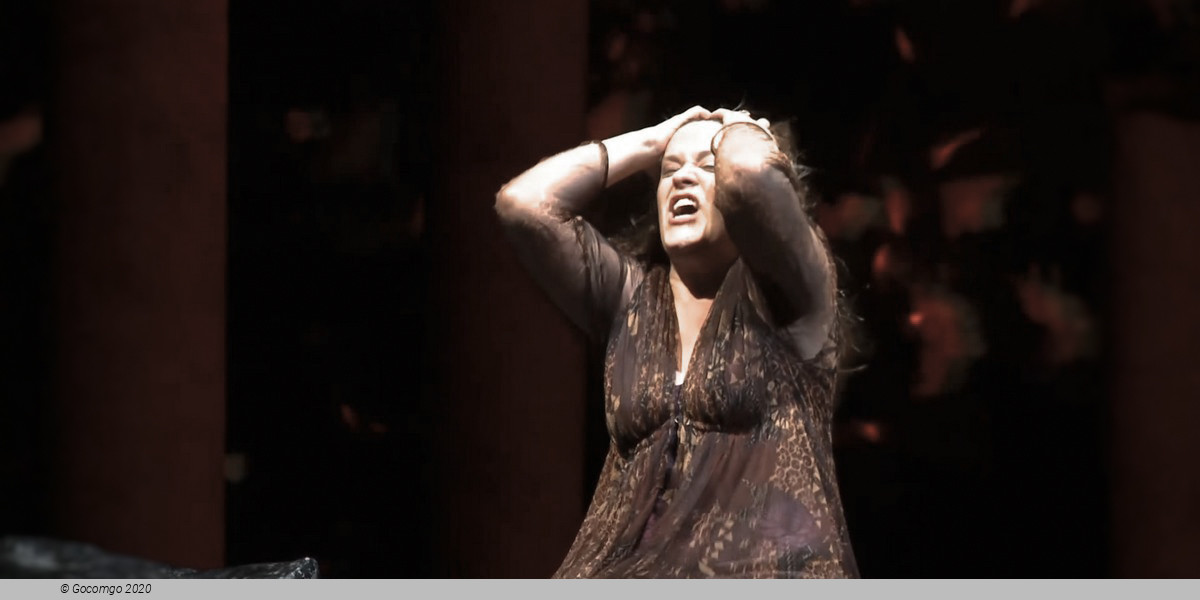
As so often in Handel’s dramatic works the central character here is a woman, Dejanira, who’s plagued by pathological jealousy. She’s terrified that her husband Hercules won’t come back from war. Her joy of life returns when he does, but doesn’t last long because Princess Iole, whose father was killed by Hercules, is a member of his retinue. Dejanira projects all her fears onto Iole. Her unfounded jealousy and self-destructive determination grow. She has a cloak, said to possess magical powers, taken to her husband to rekindle their supposedly lost love. But things go badly wrong: the cloak, which bursts into flames, turns out to be poisoned, and Hercules burns alive. Dejanira knows she did wrong. Handel created a closing mad scene for her, the largest in scale in the history of music, and an expressively drawn portrait of a modern woman.

Librettist Thomas Broughton drew on ideas from several poems about Hercules’ death while drawing up his own version, bringing the innocence of those involved and the terrible consequences of their entanglements to the fore. Although published as an oratorio, the work defies classification. It’s more like a piece of music theatre which, unable to compete with spectacular operatic effects on stage or the religious pretensions of oratorio, was not very well received. So Hercules marked a climax in Handel’s dramatic output and a low in his career as an impresario.

History
Premiere of this production: 05 January 1745, King's Theatre, London

Hercules is a Musical Drama in three acts by George Frideric Handel, composed in July and August 1744. The English language libretto was by the Reverend Thomas Broughton, based on Sophocles's Women of Trachis and the ninth book of Ovid's Metamorphoses.

Synopsis

Précis: When the great hero Hercules returns to his wife Dejanira after a long absence, bringing with him as a captive the beautiful Princess Iole, Dejanira becomes consumed with jealousy. In a misguided attempt to secure her husband's fidelity, she inadvertently causes his death and goes mad.

Scene: Greece, in legendary antiquity

Years before the action of the piece, Hercules killed the centaur Nessus as he tried to rape Hercules' wife Dejanira. As he died, Nessus gave Dejanira a cloak soaked with his blood, telling her she should give it to Hercules if she ever doubted his fidelity because if Hercules donned the cloak he would never look at another woman again.

Act I
A royal apartment

Lichas, a royal herald, notices the inconsolable grief of Dejanira, (Accompanied recitative: See, with what sad dejection in her looks) and sympathises (Air: No longer, fate, relentless frown). Dejanira is convinced that her husband, Hercules, has been killed whilst on a military expedition that has kept him apart from her for more than a year (Accompanied recitative:O, Hercules, why art thou absent from me? and Air: The world, when day's career is run). Hyllus, son of Dejanira and Hercules, enters and reports that an oracle has been consulted and indicated that the hero is dead and the summits of Mount Oeta are ablaze with fire (Arioso:I feel, I feel the god, he swells my breast). The prophecy confirms Dejanira's fears and she longs to join her husband in death (Air:There in myrtle shades reclin'd); however Hyllus refuses to give up hope and vows to search for his father to the ends of the earth.(Air: Where congeal'd the northern streams) . The chorus comment on the devotion of Hercules' son and wife (Chorus: O filial piety, O gen'rous love!). Lichas arrives and announces that Hercules has returned alive after conquering Oechalia, much to the relief of Dejanira (Air:Begone, my fears). Lichas is glad that despair has so quickly turned to joy (Air:The smiling hours of joyful train) and the chorus reflect that one should never give up hope (Chorus:Let none despair).

A square before the Palace. Iole and Oechalian virgins, led captive

Among the captives is the princess Iole of legendary beauty. She laments the loss of her freedom (Air:Daughter of gods, bright liberty). Her predicament leaves Hyllus deeply moved. Hercules enters to a march in the orchestra. Despite having ravaged her country and sacrificed her father, Hercules reassures Iole that even though in exile, she may consider herself free. Iole cannot forget her father's death, which she witnessed, and prays that he may rest in peace (Air:My father! Ah, methinks I see). Hercules looks forward to enjoying domestic life after long martial activity (Air: The God of battle quits the bloody field). The chorus celebrate Hercules' glorious accomplishments (Chorus: Crown with festal pomp the day).

Act II
An apartment

Iole desires a simple form of happiness far removed from the machinations of power (Air: How blest the maid). Meanwhile, Dejanira, convinced that Hercules has been unfaithful to her, believes Iole's beauty proves his betrayal (Air: When beauty sorrow's livery wears), even though her suspicions are resolutely refuted by Iole (Air: Ah, think what ills the jealous prove!). Lichas observes how Dejanira's jealousy increases (Air: As stars, that rise and disappear). The chorus reflect on the corrosive effects of jealousy (Chorus: Jealousy! Infernal pest). Hyllus, having declared his love to the captive princess, is rejected by her (Air: Banish love from thy breast), which distresses him (Air: From celestial seats descending). The chorus reflect on the power of love (Chorus:Wanton god of am'rous fires).

Another apartment

Dejanira accuses her husband of tainting his reputation, an accusation he rejects (Air: Alcides' name in latest story). She insists he has disgraced himself by becoming besotted with Iole (Air: Resign thy club and lion's spoils). Hercules advises his wife to put aside these unjust suspicions, but Dejanira is consumed with jealousy (Air: Cease, ruler of the day, to rise). When Hercules is summoned to celebrate the rites of his victory, Dejanira gives Lichas a garment for her husband as a token of reconciliation. Lichas is pleased by this apparent sign of marital harmony (Air: Constant lovers, never roving). The blood-soaked cloak, entrusted to her by the centaur Nessus as he lay dying, appears to possess the power to lead a heart back to faithfulness. Meanwhile, Dejanira takes great pains to convince Iole that she regrets her accusations (Duet: Joys of freedom, joys of pow'r). The chorus hope that the marriage of Hercules and Dejanira will be a happy one once more (Chorus: Love and Hymen, hand in hand).

Act III

Lichas recounts how Hercules received Dejanira's gift and how the cloak was impregnated with a deadly poison which burnt and melted the flesh from his bones (Air: O scene of unexampl'd woe). The chorus lament the terrible news (Chorus: Tyrants now no more shall dread).

The Temple of Jupiter

As his son watches, Hercules dies in appalling suffering and cursing Dejanira's vengeance (Accompanied recitative: O Jove, what land is this). His last wish, that he be carried to the summit of Mount Oeta and set upon a funeral pyre, clarifies the oracle pronouncement in the first act. Hyllus hopes his father's ignominious death will not be widely known (Air: Let not fame the tidings spread).

The Palace

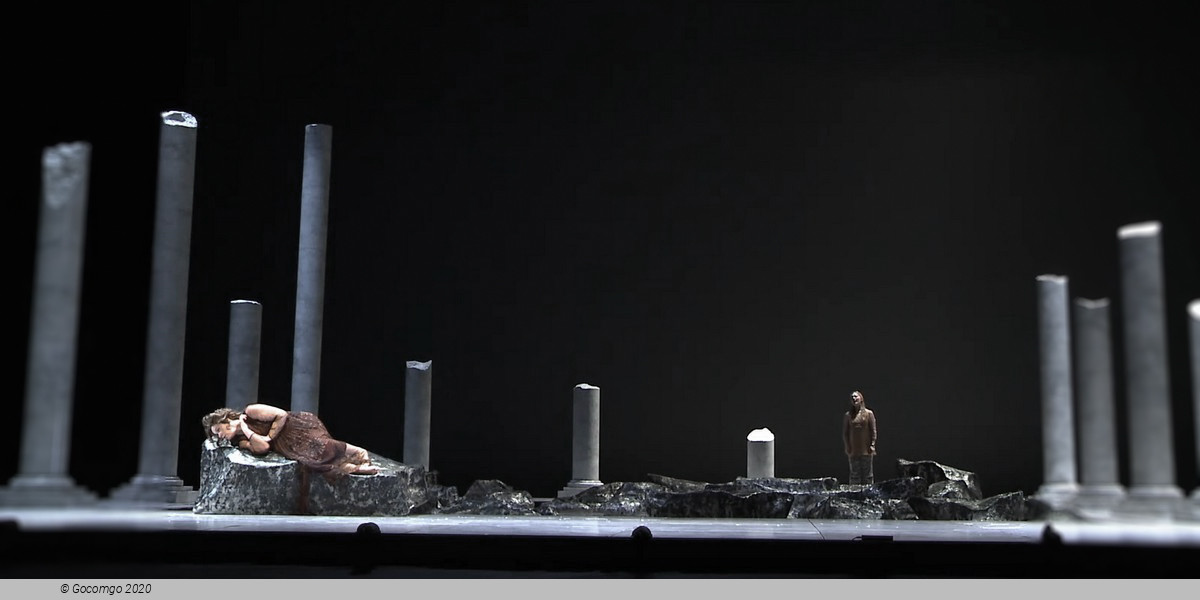
Dejanira, hearing of Hercules' agonising end, realises she should not have trusted the dying words of Nessus. Discovering that she has been the instrument of her beloved husband's death, she sinks into madness. (Accompanied recitative: Where shall I fly? Where hide this guilty head?) Such misfortune arouses the pity of Iole (Air: My breast with tender pity swells). A priest of Jupiter announces that Hercules has been lifted up to Olympus to join the gods there for all eternity. Hyllus pays tribute to his father's ascension to heaven (Air:He, who for Atlas propp'd the sky). Jove ordains the marriage of Hyllus and Iole, a decree that is received with joy by Hyllus and obedience by Iole (Duet: O prince, whose virtues all admire). The chorus praise the king of the gods (Chorus: To him your grateful notes of praise belong).

Venue Info

Oper Frankfurt - Frankfurt am Main
Location   Untermainanlage 11

The Oper Frankfurt (Frankfurt Opera) is one of the leading opera companies in Europe, and voted best "Opera house of the year" several times since 1996.

Opera in Frankfurt am Main has a long tradition, with many world premieres such as Franz Schreker's Der ferne Klang in 1912, Fennimore und Gerda by Frederick Delius in 1919, and Carl Orff's Carmina Burana in 1937. Frankfurt's international recognition began in the Gielen Era, 1977 to 1987, when Michael Gielen and stage directors such as Ruth Berghaus collaborated.

A historic opera house from 1880 was destroyed in World War II, and reconstructed as a concert hall, Alte Oper. The present opera house, built in 1963, is under one roof with the stage for drama. The opera orchestra is called Frankfurter Opern- und Museumsorchester. Today's venue for Baroque and contemporary opera is the Bockenheimer Depot, a former tram depot.

Oper Frankfurt is part of the Städtische Bühnen Frankfurt.

Frankfurt's first opera was Johann Theile's Adam und Eva, performed in 1698 by Johann Velten's touring company. The young Goethe's first operas in his home town of Frankfurt were productions by Theobald Marchand's company.

1782 – 1880
Opened in 1782, the Comoedienhaus was the first permanent venue of the Frankfurt Theater (drama and opera). In 1878 German violinist Willy Hess took up the leadership of the Oper Frankfurt. He resigned from that post in 1886 to take up a professorship in the Rotterdam Conservatorium voor Muziek.

1880 – 1944
The first representative opera house of the city was inaugurated in Frankfurt in 1880 at Opernplatz. Under the direction of the first Intendant Emil Claar and the first Kapellmeister Felix Otto Dessoff, the house was opened with Mozart's opera Don Giovanni.

During the 1920s, the opera in Frankfurt had more prominent Jewish singers than any other company in Germany, including the tenor Hermann Schramm, bass Hans Erl (the first King in Schreker's Der Schatzgräber), baritone Richard Breitenfeld and contralto Magda Spiegel, who also toured with Frankfurt Opera performing Wagner in the Netherlands. These singers were forced to leave the opera in June 1933. Orff's Carmina Burana was premiered at Oper Frankfurt in 1937. Jewish members of the opera company among those rounded up at 9 November 1938 at the Festhalle Frankfurt, where Erl sang In diesen Heilgen Hallen, from the Magic Flute for the deportees. Members of Frankfurt Opera were sent to Auschwitz and other camps where they perished.

1945 – 1970s
The opera house was damaged in an air raid in January 1944, and then almost completely destroyed in March. A new house for opera and play was built, completed in 1963 at the Theaterplatz (now Willy-Brandt-Platz). In 1952, Georg Solti became Generalmusikdirektor (GMD) and Intendant of the Oper Frankfurt, where he remained in charge for nine years.

The Gielen Era
From 1977 to 1987, Frankfurt Opera was led by Michael Gielen. This decade became known as the "Gielen Era", notable for the music of a conductor who was also a composer, and directors including Ruth Berghaus and Hans Neuenfels, whose productions of standard works such as Verdi's Aida and Wagner's Ring Cycle were thought-provoking. Operas which received their world premieres at the house were also performed again, including Franz Schreker's Die Gezeichneten.

1987 – present
The stage of the opera house was destroyed by a fire in November 1987. The opera house was rebuilt and opened in April 1991. Many famous singers started their career with the company, including Franz Völker, Edda Moser, Cheryl Studer and Diana Damrau, and many established artists have been engaged there in recent seasons including Christian Gerhaher, whose roles here have included Monteverdi's L'Orfeo and his first Wolfram in Wagner's Tannhäuser, Piotr Beczała in Massenet's Werther and Jan-Hendrik Rootering in Wagner's Parsifal.

Since 2002, Bernd Loebe has served as Intendant of the company. The company's current GMD is Sebastian Weigle, since 2008. Weigle has made commercial recordings of opera with the company for the OEHMS Classics label. He is scheduled to stand down as GMD of Oper Frankfurt at the close of the 2022–2023 season. In October 2021, the company announced the appointment of Thomas Guggeis as the next GMD of the company, effective with the 2023–2024 season, with an initial contract of 5 years.

Oper Frankfurt was voted 1996, 2003, 2015, 2018 and 2020 "Opera House of the Year" by the magazine Opernwelt.

Important Info
Type: Opera
City: Frankfurt am Main, Germany
Starts at: 18:00
Acts: 3
Intervals: 1
Duration: 3h 45min
Sung in: English
Titles in: German,English
Top of page