National Opera and Ballet of Bulgaria 11 June 2022 - Norma | GoComGo.com

Norma

National Opera and Ballet of Bulgaria, Main Hall, Sofia, Bulgaria
All photos (5)
Select date and time
7 PM
Request for Tickets
Important Info
Type: Opera
City: Sofia, Bulgaria
Starts at: 19:00
Intervals: 1
Duration: 3h
Sung in: Italian
Titles in: Bulgarian,English

E-tickets: Print at home or at the box office of the event if so specified. You will find more information in your booking confirmation email.

You can only select the category, and not the exact seats.
If you order 2 or 3 tickets: your seats will be next to each other.
If you order 4 or more tickets: your seats will be next to each other, or, if this is not possible, we will provide a combination of groups of seats (at least in pairs, for example 2+2 or 2+3).

Overview

The popular view of Vincenzo Bellini's Norma is that the title role is so outrageously difficult to sing that the opera has only survived, in the years since its première in 1831, as a vehicle for a few particularly endowed prime donne: Giuditta Pasta, Maria Malibran, Giulia Grisi (all three of whom Bellini heard before he died at thirty-three), Lilli Lehmann, Rosa Ponselle, and Maria Callas.

God knows it isn’t an easy part to sing, with its demanding mixture of vocal and emotional textures, its C’s above (some go for D’s) and B-flats below the staff, its long-breathed lines and octave drops and showpiece trills. One must be able to sing a strong, natural-sounding contralto and some of the highest coloratura ever written. The role of Norma calls for an authentic bel canto soprano voice, one that can be both mercurial-birdlike and witchy-dramatic.

Moreover, the dramatic challenge of this deep and complex part is at least as great as the musical. There is written into the role of Norma, Druid priestess and woman scorned, as much potential for dramatic excitement as into the roles of any of the great tragedy queens of Racine. It may well be that only the six sopranos I have just named have met both challenges at once, and have achieved something near to the full potential of this role.

In comparing critical descriptions made of all six of these Normas, what I found striking was the constant use, over a century and a quarter, of the same terms. Harold Rosenthal wrote, “The great Normas of operatic history have all been great singing actresses: mistresses of dramatic declamation and outstanding personalities—Lilli Lehmann, Rosa Ponselle, Maria Callas.”

“The singer,” remarked another critic, “must translate into musical phrase and cadence the emotions of a character under stress, as Pasta and Malibran did—and as Callas has done.”

Listening to Callas in Florence in 1952, a third critic wrote, “I realized what Stendhal and other chroniclers of the nineteenth century meant when they spoke of Malibran and Pasta.”

“We can well believe,” comments John Ardoin in The Callas Legacy , “that her balance between drama and agility came the closest in modern terms to those qualities of Giuditta Pasta.”

Of every one of the six (except perhaps Ponselle), it was acknowledged that the vocal instrument itself could be impure, even unbeautiful, but that the singer converted this sometimes steely edge into operatic gold by her range, control, and agility; by musical intelligence, accuracy, and style; and by theatrical presence and histrionic skill.

In 1856, Paul Scudo said, “Beautiful, intelligent, and passionate, Pasta made up for the imperfections of her vocal organ by means of incessant work, and a noble, tender, knowing style. An actress of the first rank, she submitted each breath to the control of an impeccable taste, and never left a single note to chance.”

Stendhal, a passionate admirer (and personal friend) of Giuditta Pasta, admitted that she had a voice made up of three distinct ranges—“not all molded from the same metal, as they say in Italy; but the fundamental variety of tone produced by a single voice affords one of the richest veins of musical expression which the artistry of a great soprano is able to exploit.”

“From the start,” concludes Sergio Segalini, “her limitations were obvious; but by dint of sheer effort, Giuditta Pasta forged all extremely accomplished technique that allowed her to become the ideal interpreter for Bellini. She was never able to give to her voice the exquisite beauty of a Maria Malibran, but she learned how to bring an infinite variety of vocal colors to her interpretations.”

Most of the great Normas began as mezzos, or even Wagnerians, and then channeled that power into bel canto. Lilli Lehmann and Maria Callas were perhaps the only two sopranos in history who could sing well both Norma and Brünnhilde, sometimes two or three nights apart—a feat comparable, someone once wrote, to winning gold medals in both weightlifting and the hundred-yard dash. (Lehmann insisted that she would rather sing three Brünnhildes than a single Norma.)

All six worked at their craft with demon-driven intensity. Lehmann would sing each phrase through hundreds of times in practice, go through an act three or four times running. Callas did the whole “Casta diva” nine times in one rehearsal for her American première. Each of the six applied extraordinary intelligence to her analysis and creation of the role. “It should be sung and acted with fanatical consecration,” declared Lehmann. Each was able to electrify audiences by her mere presence on a stage.

Each of these Normas is called “hypnotic,” “riveting,” “electrifying,” “unforgettable”; each is described as having exact pitch and control; each is praised for recitatives and fioriture sung expressively; each is called a genius of dramatic gesture and timing.

Time’s critic wrote after Callas’s 1954 Norma in Chicago: “She may not have the most beautiful voice in the world, but she certainly is the most exciting singer.” “I am enthralled,” wrote Harold Rosenthal of Callas’s 1957 London Norma, “when she is onstage. Opera is more than singing; it is music drama; and Callas' Norma is a dramatic creation of the highest order. . . . We will tell our children and grandchildren about it."

This role has never died out in Italy. There, the provincial and major houses have kept Norma in the repertory since its early nineteenth-century première: one Italian critic has listed twenty-three Normas worthy of note between Pasta and Callas.

More than ten years ago, Andrew Porter unearthed forty-seven different recordings of “Casta diva,” Norma’s famous first-act prayer: two verses of heartbreakingly beautiful melody over simple string arpeggios and a solo flute, which soar weightlessly in long curves around the key of F, then spill over into wild, repeated trills.

The cavatina climaxes in two series of fortissimo high A’s, leaping up to B-flat and then trickling rapidly down. It is gorgeous, it is touching, it is fiendishly demanding. It can be made to correspond precisely to the secret inner pain and confusion of the traitor/priestess, poignantly pleading with the moon-goddess to temper the audacious zeal and ardent hearts of her people.

And it seems that every soprano in sight wanted to prove that she could sing it. The most noteworthy of the present generation have been three divas gifted at coloratura, if not at compelling dramatic recreations: Joan Sutherland, Beverly Sills and Montserrat Caballé, the most nearly satisfactory of the three.

As for the orchestration, I think Bellini was more knowing and dramatically skillful than Verdi gave him credit for. Things most operagoers feel rather than recognize, such as tonal shifts, silences, and suspensions, were worked out as carefully as the more obviously expressive gestures—violins allegro agitato or creepy-crawly low strings to hint of danger; repeated notes to signify inner agitation; tender love lyrics easing out of crashing chords; a full palette of woodwind colors. Some of the orchestral interludes (listen to the poignant, three-theme D-minor prelude to Act II) are seductive and appropriate, and the singers’ line is usually deftly underscored by the musicians’.

“Casta diva”, best remembered for its long-breathed, floating, rising-and-falling legato, would lose half its meaning without the coloratura outburst with which it concludes. Of Norma’s violent attack on Pollione (“Ah, non tremare”), Brunel comments, “Norma’s extreme vehemence, transformed into sheer fury, expresses itself by means of her fioriture”. The three diabolically difficult low trills—E-flat, G-flat, B-flat—that Norma has to sing in Act II (con furore) on the accented dotted quarter notes of “A-dal-gi -sa fia punita” (Adalgisa will be punished) are the physical manifestation of her unbearable internal rage. The unaccented syllables here are sung to doubled sixteenth notes; after a fourth trill on the tonic B-flat, she leaps to a rapid run (up to A) above and down the staff to complete the dire and vengeful sentence: “Nel -le fiamme perirà”, (She will perish in the flames).

Even Wagner recognized this quality in Bellini. “They think me an ogre in all that concerns the musical school of Italy”, he wrote in 1837, “and they set me up in especial opposition to Bellini. No, no, a thousand times no! Bellini is one of my favorites, because his music is all heart, deeply felt, closely and intimately bound up with the words”.

Wagner had conducted Norma at Magdeburg in 1835, and at Riga in 1837, making additions to and changes in the orchestration. At Paris in 1839, he wrote a new aria (never used) for Oroveso to sing. In 1880, the conductor Anton Seidl wrote that after playing him some melodies from Norma on the piano, Wagner had remarked, “There is real passion and feeling here. It only needs to be sung by the right singer to make a deeply moving effect”.

In addition to being the most vocally demanding and physically strenuous female role in Italian opera (“the Isolde of La Scala”), the character of Norma encompasses a psychological encyclopedia of emotions. Our singer-actress must make credible a virtually unbroken gamut of violent emotional changes, until the moment when she beats the sacred shield, announces her own guilt, and, shrouded in black, marches into her own funeral pyre. Surely she is, as Pollione at last comes to realize, a sublime donna.

In Opera, or the Undoing of Women, Catherine Clément argues that this spellbinding vocal phenomenon—the human voice at its most beautiful, its potentially most expressive—has too often been “wasted” on weak, pliable, long-suffering heroines. Most of the female characters in opera are seen by her as the creatures of crude and cruel male librettists and composers who were simply converting their or their cultures’ male-chauvinist fantasies into operas. According to Hélène Seydoux’s view, male artists, secretly frustrated by their cultural obligation to “act like men” – when what they really wanted to do was cry – express their female inner selves, through their suffering heroines.

But can one honestly say that of Norma? Catherine Clément’s analysis does seem to grant the Druid priestess a large measure of independence, of pre-Christian, pre-Roman female strength: the strength of a witch or sorceress, even more than that of a lover and mother.

Between Medea, all charged with manic laughter—in which laughter we recognize her divinity—and the human priestess who has in fact had children by the Roman officer, the grandiose power of myth has declined. Romanticism cares more for tenderness… It cannot cope with the epic style. Its heroines are no longer goddesses, but divided women, in which the divine spark shines only in sudden flashes. Norma’s full strength is expressed in these moments when her rage is aborted, and transformed into abnegation.

Norma does not find tenderness in the chaste, cold moon. She does not find it in the faithless Roman Pollione. She finds it only in Adalgisa. Tender Adalgisa. . . and tender Norma, who would rather die than condemn her younger rival.

Norma’s mysterious dominion over i druidi —and, ultimately, over the Roman as well—goes beyond mere political power, the occasional and anomalous power of a Semiramis or a Cleopatra or an Elizabeth I. Norma rules them, as she rules us, by her voice. It is far and away the strongest thing in the world this particular opera creates. In fact, it seems to me, there is almost no innately, profoundly female emotion that Norma’s music does not contain. In this most powerful of female operatic roles (Isolde is all love; Brünnhilde goes out of her mind), the soprano voice is capable of expressing the supreme and independent difference of the gender it represents.

(1975, revised 1991)

David Littlejohn

History
Premiere of this production: 26 December 1831, Teatro alla Scala, Milan

Norma by Alexandre Soumet. It was first produced at La Scala in Milan on 26 December 1831. The opera is regarded as a leading example of the bel canto genre, and the soprano prayer "Casta diva" in act 1 is a famous piece.

Synopsis

Place: Gaul
Time: c. 100-50 BCE (Roman occupation)

Act 1
Sinfonia
Scene 1: The grove of the druids

Oroveso leads the druids in a procession in the forest to pray for victory against the invading Romans: (Oroveso and druids: "Ite sul colle, o Druidi" / "Go up on the hill, O druids"). The druids pray that Norma will come and have the courage to broker peace with the Romans: (Druids and Oroveso: "Dell'aura tua profetica" / "With thy prophetic aura, imbue her, O terrible God".) All leave to go to the temple.

Pollione and Flavio enter. Although Norma has secretly broken her vows in order to love him and has borne him two children, Pollione tells Flavio that he no longer loves her, having fallen in love with the priestess Adalgisa. But he expresses some remorse, describing his dream in which Adalgisa was beside him at the altar of Venus and a huge storm arose: (Pollione, aria: "Meco all'altar di Venere" / "With me at the altar in Rome was Adalgisa dressed in white, veiled all in white.") The storm presaged disaster for them both: "Thus does Norma punish her faithless lover," he declares. They hear the trumpets sounding to announce Norma's arrival. Flavio urges his friend to leave, but Pollione stands firm, proclaiming that he will confront them with a superior power and overthrow their altars: (Cabaletta: "Me protegge, me difende" / "I am protected and defended")

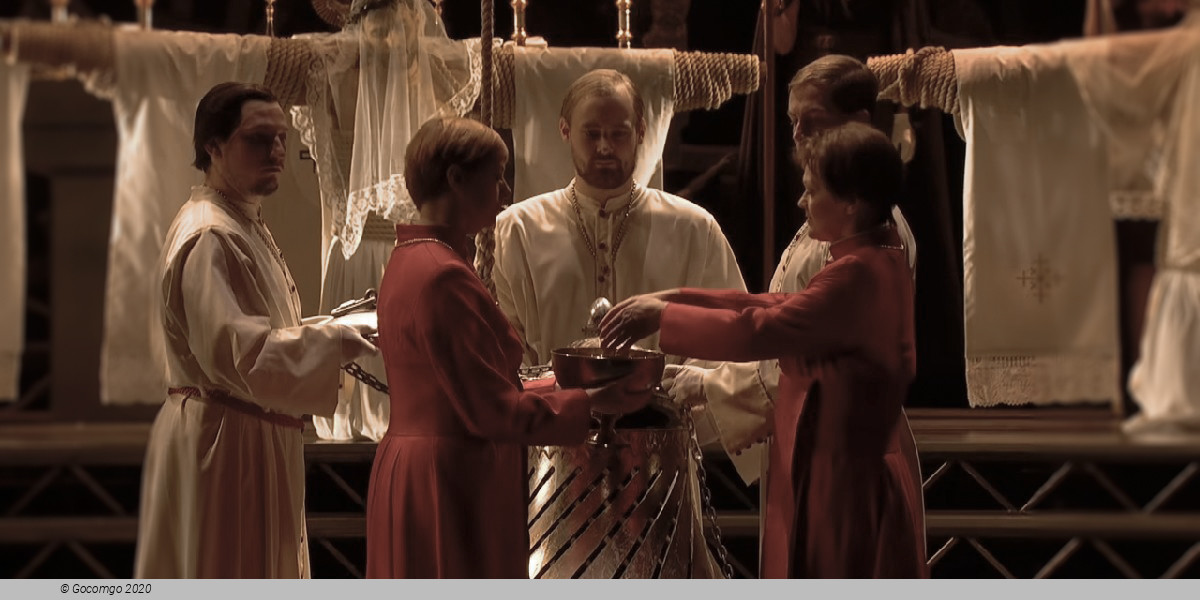
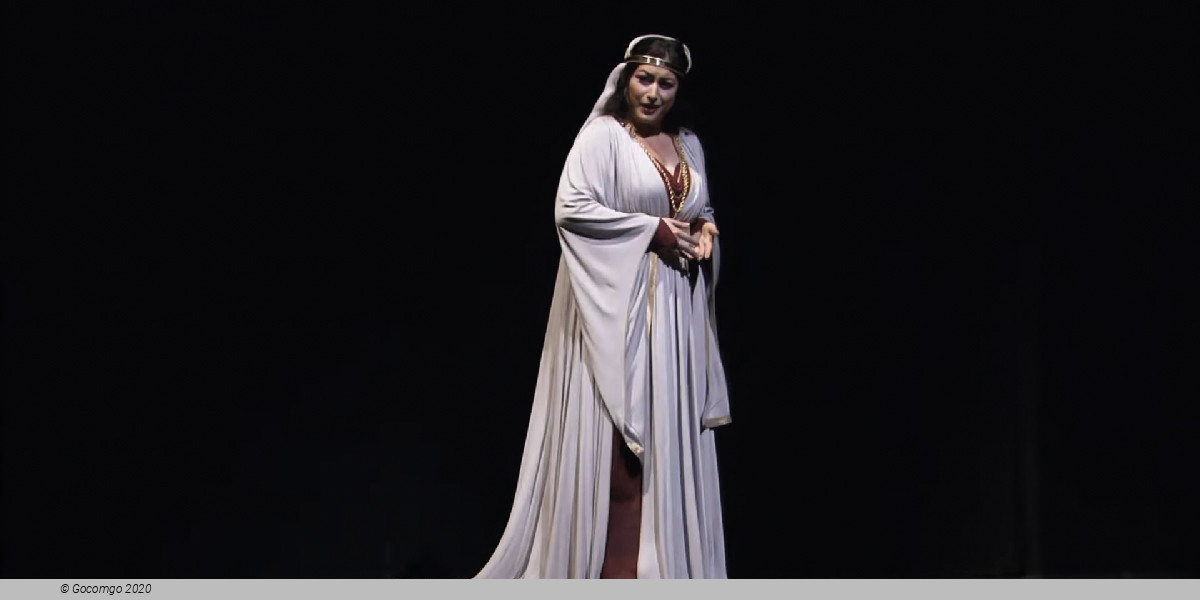
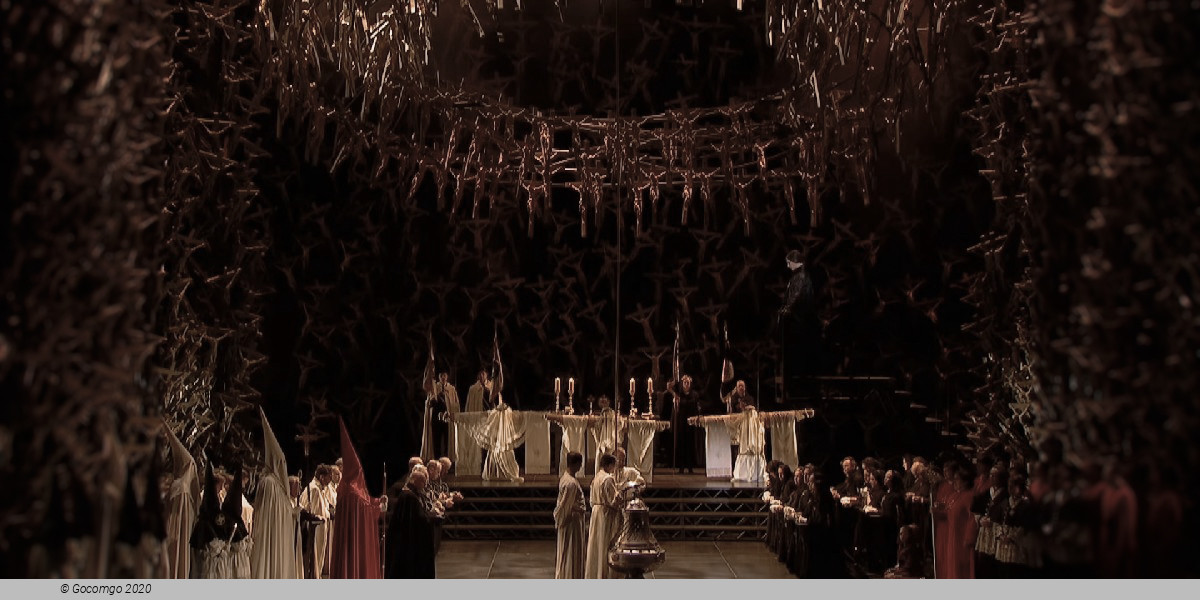
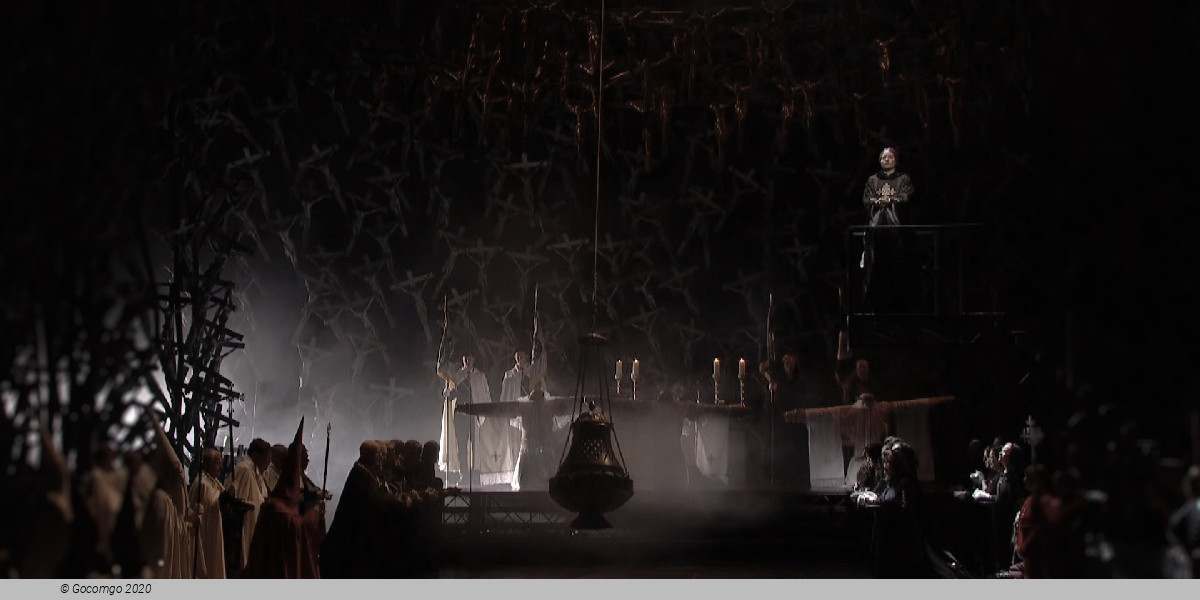
As Norma leads the druids and priestesses, the crowd proclaims: "Norma viene" / "Norma is coming" and, as Oroveso awaits her, they describe her dress and manner. All kneel as she approaches. "The time is not ripe for our revenge", she declares, stating that Rome will perish one day by being worn down. Then, with the mistletoe in hand, she approaches the altar with a plea to the moon (the "Chaste Goddess"): (cavatina: "Casta diva" / "Chaste goddess"). Continuing, she pleads that the goddess shed upon earth that peace which she has created in heaven. She calls for all to complete the rites and then clear the uninitiated from the grove. To herself, she declares that she cannot hurt Pollione, but desires that things return to where they used to be: (Cabaletta: "Ah! bello a me ritorna" / "Return to me, O beautiful one"). The assembled crowd accepts her cautious approach, and all leave the grove.

Later that night: The Temple of Irminsul in the grove

Adalgisa prays at the temple, remembering with some sorrow how she became involved with Pollione. He enters, telling her that she prays to a cruel god and is not trying to invoke the god of love. While she appears to reject him, he declares (Aria: "Va crudele" /"Go, O cruel one") but he is convinced that he cannot leave her; he is distraught, but she is equally torn, until the moment when he declares that he must return to Rome the following day. He begs Adalgisa to go with him: (Duet: Pollione, then Adalgisa, then together: "Vieni in Roma" / "Come to Rome"). She resists him, but finally appears to agree that they will leave together the following day.

Scene 2: Norma's dwelling

Alessandro Sanquirico's set design for act 1, scene 2, for the original production
Norma appears to be upset and orders her maid, Clotilde, to take the two children away from her, expressing very conflicted feelings about them. She tells Clotilde that Pollione has been recalled to Rome, but does not know if he will take her or how he feels about leaving his children. As Adalgisa approaches, the children are taken away.

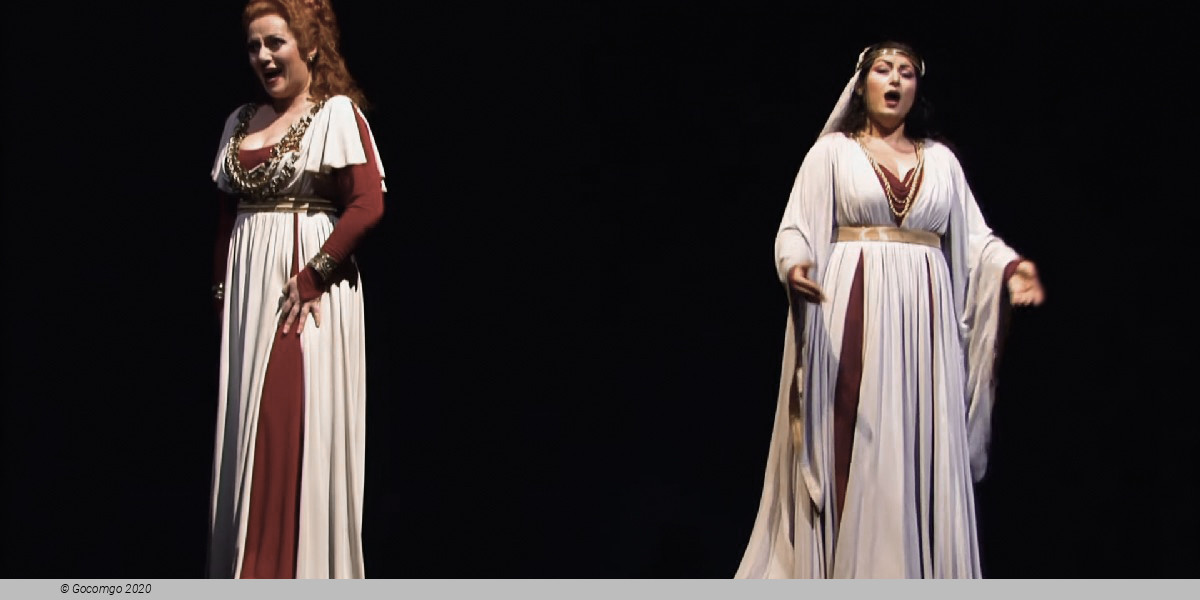
Adalgisa tells Norma she has fallen in love with a Roman, whom she does not name. As she describes how she fell in love while waiting at the temple and seeing "his handsome face" appear, Norma recalls (as an aside) her own feelings for Pollione ("my passions, too, burned like this"), and more and more, their experiences of falling in love run parallel: (Norma and Adalgisa, duet: "Sola, furtiva al tempio" / "Often I would wait for him"). Adalgisa pleads for help and forgiveness, and Norma pledges that she will do that and will also free her from her vows as a priestess: (Norma: "Ah! sì, fa core, abbracciami" / "Yes, take heart, embrace me". Adalgisa: "Ripeti, o ciel, ripetimi" / "Say that again, heavens, say again")

Norma asks Adalgisa to describe the man whom she loves. Responding, she tells her that he is a Roman, and, at that moment, turns to indicate that it is Pollione who is just then entering the room. As Norma furiously turns to confront Pollione, Adalgisa is confused: Norma: "Oh! non tremare, o perfido" / "O faithless man, do not tremble".

Forcing the priestess to realise that she is the victim of a huge deception, Norma addresses Adalgisa. (Trio: each sings in succession, beginning with Norma: "Oh! di qual sei tu vittima" / "Oh, you are the victim"; then Adalgisa: "Oh! qual traspare orribile" / "What horror has been revealed"; then the two women together, followed by Pollione alone: "Norma! de' tuoi rimproveri" / "Norma, do not reproach me now", continuing with "Please give this wretched girl some respite"; after which all three repeat their words, singing at first singly, then together.)

There follow angry exchanges among the three, Norma declaring Pollione to be a traitor; he trying to persuade Adalgisa to leave with him; and she angrily telling him to go away. When he declares that it is his fate to leave Norma, she encourages the young priestess to go with him, but the latter declares that she would rather die. Norma then demands that her lover go, leaving behind his children—and his honour. (Finale: brief duet, Adalgisa and Pollione: he declares his love, and she her desire to Norma not to be the cause of grief to her. Trio: Norma continues to rage at Pollione, Adalgisa repeats her desire to make him return to Norma, and Pollione curses the day when he met Norma.) Then the sound of the druids calling Norma to the temple is heard. They report that the angry god, Irminsul, has spoken. Pollione storms out.

Act 2
Orchestral introduction
Scene 1: Norma's dwelling
Norma looks at both of her sons, who are asleep. She considers killing them. Advancing towards them with knife upraised, she hesitates. (Recitative: "Dormono entrambi ... non vedran la mano che li percuote" / "They are both asleep ... they shall not see the hand which strikes them.") But she cannot bring herself to do it: (Aria: "Teneri, teneri figli" / "My dear, dear sons") The children wake up and she calls for Clotilde, demanding that Adalgisa be brought to her.

The young priestess enters, concerned at how pale Norma looks. Norma makes her swear to do everything she asks and, upon her agreement, tells her that she is entrusting the two children to her care and states that they should be taken to the Roman camp to their father Pollione, a man whom she hopes will make a better mate for Adalgisa than he was for her. Adalgisa is aghast. Norma: "I beg you for his children's sake." (Duet, first Norma: "Deh! con te, con te li prendi" / "Please, take them with you") Adalgisa tells her that she will never leave Gaul and only agreed to the request in order to do what was good for Norma. (Duet, Adalgisa: "Vado al campo") In the duet, Adalgisa agrees to go to the Roman camp and tell Pollione of Norma's grief but her hope is to persuade him to return to Norma. She then renounces Pollione: (Duet: "Mira, o Norma" / "Look, o Norma") They sing together, each expressing her own thoughts and feelings until Norma realises that Adalgisa will give up Pollione and remain with her: (Cabaletta: Duet, Norma and Adalgisa: "Si fino all'ore estreme" / "Until the last hour")

Scene 2: The grove
The druid warriors gather and prepare themselves to attack the Romans. Oroveso enters with news from the gods: the time has not arrived to strike. Somewhat frustrated, the soldiers accept the decision.

Scene 3: The temple of Irminsul
Norma enters. (Aria: "Ei tornerà" / "He will come back") Then Clotilde arrives with news that Adalgisa has failed to persuade Pollione to return. Although Norma questions whether she should have trusted her, she then learns from her servant that Adalgisa is returning and wishes to take her vows at the altar and that the Roman has sworn to abduct her from the temple. In anger, Norma strikes a gong-like shield as a summons to war. Trumpets sound and Oroveso and the druids all rush in, demanding to know what is happening. They hear Norma's answer and the soldiers take up the refrain: "Guerra, guerra!" / "War, war!", while Norma proclaims "Blood, blood! Revenge!"

In order for Norma to complete the rites to authorise going to war, Oroveso demands to know who will be the sacrificial victim. At that moment, Clotilde rushes in to announce that a Roman has desecrated the temple, but that he has been apprehended. It is Pollione who is led in, and Norma is urged to take the sacrificial knife to stab him but, approaching him, she is unable to perform the deed. The assembled crowd demands to know why, but she dismisses them, stating that she needs to question her victim.

The crowd departs: (Duet, Norma and Pollione: "In mia man alfin tu sei" / "At last you are in my hands"). Norma demands that he forever shun Adalgisa; only then will she release him and never see him again. He refuses, and she vents her anger by telling him that she will then kill her children. "Strike me instead", he demands, "so that only I alone will die", but she quickly asserts that not only will all the Romans die, but so will Adalgisa, who has broken her vows as a priestess. This prompts him to plead for her life. (Cabaletta: Norma and Pollione: "Già mi pasco ne' tuoi sguardi" / "Already I take pleasure in the looks you give me".) When Pollione demands the knife, she calls the priests to assemble. Norma announces that it would be better to sacrifice a priestess who has broken her vows, and orders the pyre to be lit. Oroveso demands to know who is to be sacrificed while Pollione begs that she stays silent. Norma then wonders to herself if she is not in fact the guilty one, then reveals that it is she who is to be the victim: a high priestess who has broken her vows, has become involved with the enemy, and has borne his children. (Aria, Norma to Pollione: "Qual cor tradisti" / "The heart you betrayed"; Duet: Norma and Pollione; ensemble, Norma, Oroveso, Pollione, druids, priests: each expresses his/her sorrow, anger, pleas to Norma, with Oroveso learning for the first time that Norma is a mother.)

In the concerted finale, Norma pleads with Oroveso to spare her children ("Deh! non volerli vittime" / "Please don't make them victims"). As she prepares to leap into the flames, the re-enamoured Pollione joins her, declaring "your pyre is mine as well. There, a holier and everlasting love will begin".

Venue Info

National Opera and Ballet of Bulgaria - Sofia
Location   bul. Kniaz Aleksandar Dondukov 30

The National Opera and Ballet is a national cultural institution in Bulgaria that covers opera and ballet. It is based in an imposing building in Sofia, the capital of Bulgaria. The first opera company in Bulgaria was founded in 1890 as part of the Capital Opera and Drama Company. The two sections split in 1891 to form the Salza i Smyah theatrical company and the Capital Bulgarian Opera. It was, however, disbanded the next year due to lack of government funding and financial difficulties.

The Bulgarian Opera Society was established in 1908 and staged its first test performance. The first full opera was performed in 1909 — Pagliacci by Leoncavallo. The first Bulgarian opera works were also presented in the period, including Siromahkinya by Emanuil Manolov, Kamen i Tsena by Ivan Ivanov and Václav Kaucký, Borislav by Georgi Atanasov and Tahir Begovitsa by Dimitar Hadzhigeorgiev.

As the company evolved under the ensemble system and style, the permanent troupe of soloists, choir, orchestra, ballet, technical and production teams produced up to 10 opera and ballet premieres a year, in addition to concert programs. Gradually, the basic repertory of world opera classics was established at the same time as the theatre began to attract Bulgarian composers who created new national works. 20th Century performers such as Nicolai Ghiaurov, Nicola Ghiuselev, and Ghena Dimitrova began their careers within the structure of the National Opera, as did later singers such as Irena Petkova and Kiril Manolov.

The institution became a national one in 1922 and changed its name to National Opera. A ballet company was established and gave its first performance in 1928. The opera ceased its activity for a while after the 1944 bombing of Sofia, but was restored shortly afterward with a significant increase of government funding.

The National Opera and Ballet's building was designed in 1921 and built for the most part between 1947 and its opening in 1953.

In 2000, the company co-organized the Boris Christoff Twelfth International Competition for Young Opera Singers with the idea of attracting a younger audience and supporting young and upcoming singers.

The repertoire historically tended to favour the Italian and French repertoire with little Wagnerian tradition, although since 2010, the artistic director of the opera company Plamen Kartaloff began a Ring Cycle with entirely Bulgarian casts. Following the entry of Parsifal and Tristan und Isolde into the repertoire, the complete cycle was performed both in Moscow and Sofia during 2018.

Important Info
Type: Opera
City: Sofia, Bulgaria
Starts at: 19:00
Intervals: 1
Duration: 3h
Sung in: Italian
Titles in: Bulgarian,English
Top of page