


Belarus National Bolshoi Opera and Ballet Theater 30 June 2021 - Le Villi. Fatum | GoComGo.com

Le Villi. Fatum

Belarus National Bolshoi Opera and Ballet Theater, Minsk, Belarus
All photos (3)
Select date and time
7 PM
Request for Tickets
Important Info
Type: Opera - Ballet
City: Minsk, Belarus
Starts at: 19:00
Acts: 2
Intervals: 1
Duration: 1h 30min
Sung in: Italian
Titles in: Russian

E-tickets: Print at home or at the box office of the event if so specified. You will find more information in your booking confirmation email.

You can only select the category, and not the exact seats.
If you order 2 or 3 tickets: your seats will be next to each other.
If you order 4 or more tickets: your seats will be next to each other, or, if this is not possible, we will provide a combination of groups of seats (at least in pairs, for example 2+2 or 2+3).

Overview
History
Premiere of this production: 31 May 1884, Teatro Dal Verme, Milan

Le Villi (The Willis or The Fairies) is an opera-ballet in two acts (originally one) composed by Giacomo Puccini to an Italian libretto by Ferdinando Fontana, based on the short story Les Willis by Jean-Baptiste Alphonse Karr. Karr's story was in turn based in the Central European legend of the Vila, also used in the ballet Giselle. The opera, in its original one-act version, was first performed at the Teatro Dal Verme, Milan, on 31 May 1884. Le Villi is Puccini's first stage work. It was written for an 1883 competition of one-act operas by the publisher Sonzogno in his periodical Il teatro illustrato, but did not even earn an honourable mention. According to Mosco Carner, this may have been because it was written in such haste that the score was all but illegible. His supporters, who included Arrigo Boito, funded the first production, whose favorable reception led to publication by Giulio Ricordi. Puccini's mother received the following telegram on the night of premiere at the Teatro dal Verme on 31 May 1884: "Theatre packed, immense success; anticipations exceeded; eighteen calls; finale of first act encored thrice"'. Ricordi urged the composer to expand the work, and Puccini did, producing a new version later that year, which was followed by modifications in 1885, and the final version in 1889. A performance typically lasts 64 minutes.

Synopsis

Act 1

Guglielmo devotes his entire life to his young daughter, Anna, creating an ideal world for her. Similarly, grown-up Anna selflessly gives her love to her fiancé Roberto. However, the young man’s feelings are not so deep; moreover, the thought about sudden luck fills his mind: a rich relative has left a substantial inheritance, so he has to leave. Anna is downhearted with the coming separation and tormented by terrible forebodings. Roberto reassures his bride by promising to come back with the inheritance for a happy new life.

Act 2 

Anna dies, still waiting for the return of her groom. The inconsolable father curses Roberto at her grave and calls on Willis (vengeful fairy brides) to help carry out the punishment.

Having received the inheritance, Roberto discovers a world of wealth, beautiful women, delights and carnal pleasure. Falling under the spell of the Siren and her girlfriends, Roberto loses track of the time. When he comes to his senses, he realizes that he has wasted his life.

Roberto hears otherworldly voices. It seems to him that he has returned to the past, to the house where he was happy with Anna, and he remembers their feelings. He returns to his beloved only to see the burial mound. In desperation, Roberto hears a voice calling him – it’s Anna, she is not dead! He runs up to the girl, but he cannot recognize his beloved: he sees a cold, lifeless shadow before him. The ghost of Anna repeats as a sentence the words of love uttered once by her unfaithful bridegroom. Strength and hope leave Roberto, and he feels the approach of death. An inexorable fate overtakes him.

Place: The Black Forest
Time: Indeterminate

Act 1

Spring

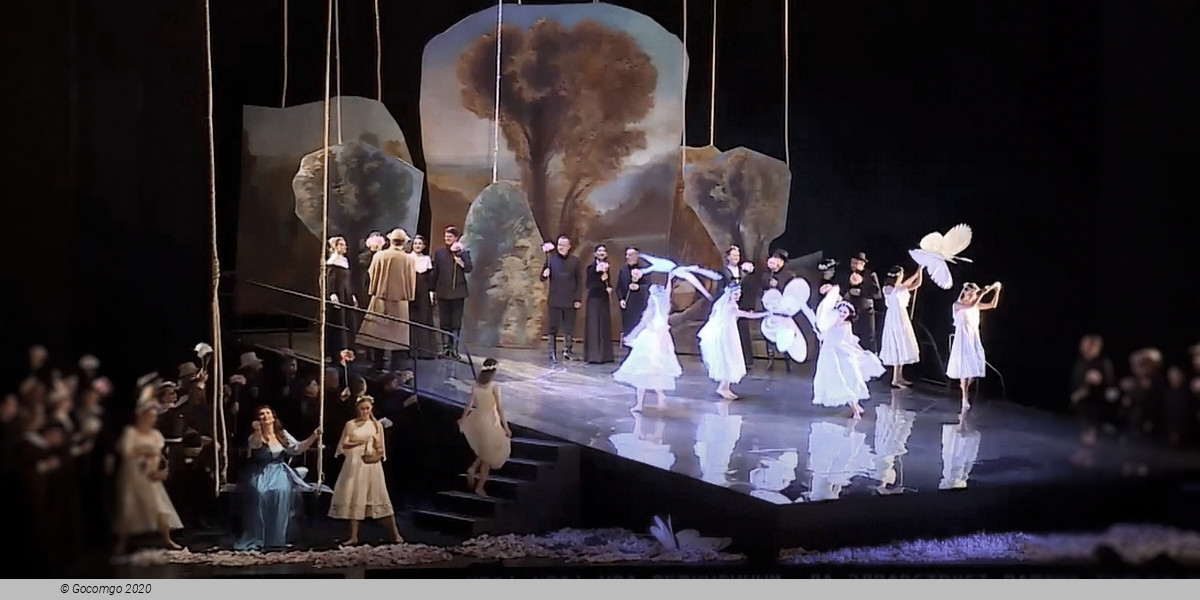
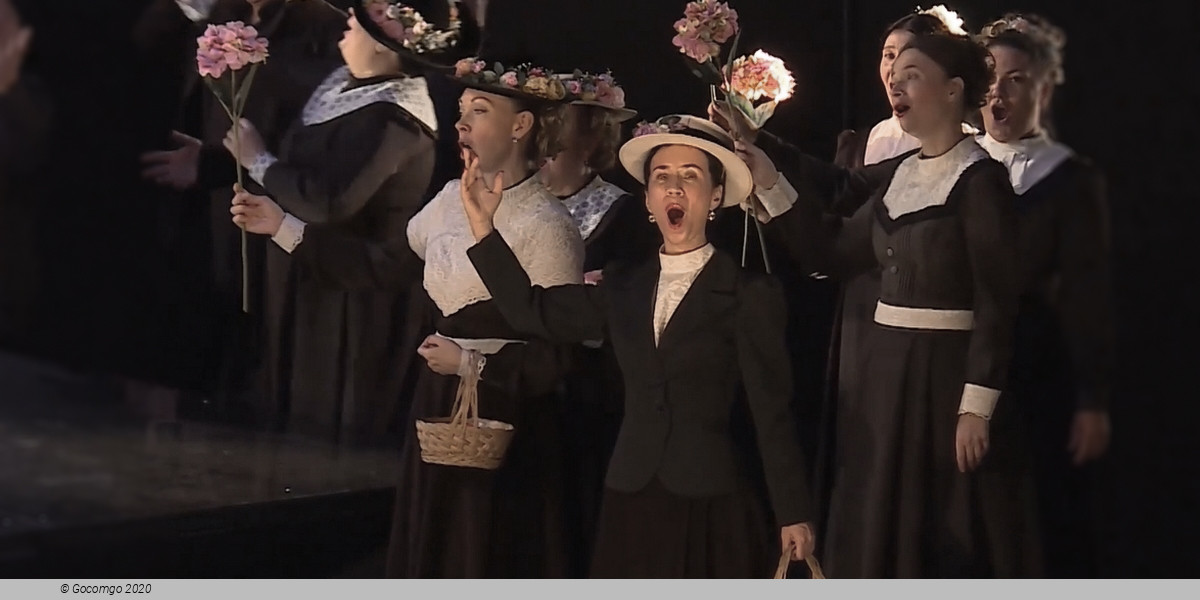
Family and guests dance at a celebration of the engagement in marriage of Roberto and Anna. Roberto must leave before the ceremony to collect an inheritance, and Anna worries that she will never see him again (Aria: Se come voi piccina). Roberto comforts Anna telling her that it will be fine and they will marry when he returns from Mainz. Anna tells Roberto of her dreams of him dying but Roberto tells Anna that she should not worry about his love failing and that she may doubt her God but not his love for her. The crowd returns and Anna is still worried about Roberto leaving. Roberto then asks Guglielmo, Anna's father, to bless them before his journey and Roberto sets off for Mainz.

Intermezzo
Roberto is enchanted by a siren, and forgets Anna. Anna waits through the summer and the autumn and in the winter dies in his absence. The legend of the fairies (Le Villi) is then explained. When a woman dies of a broken heart, the fairies force the heart breaker to dance until death.

Act 2

Winter

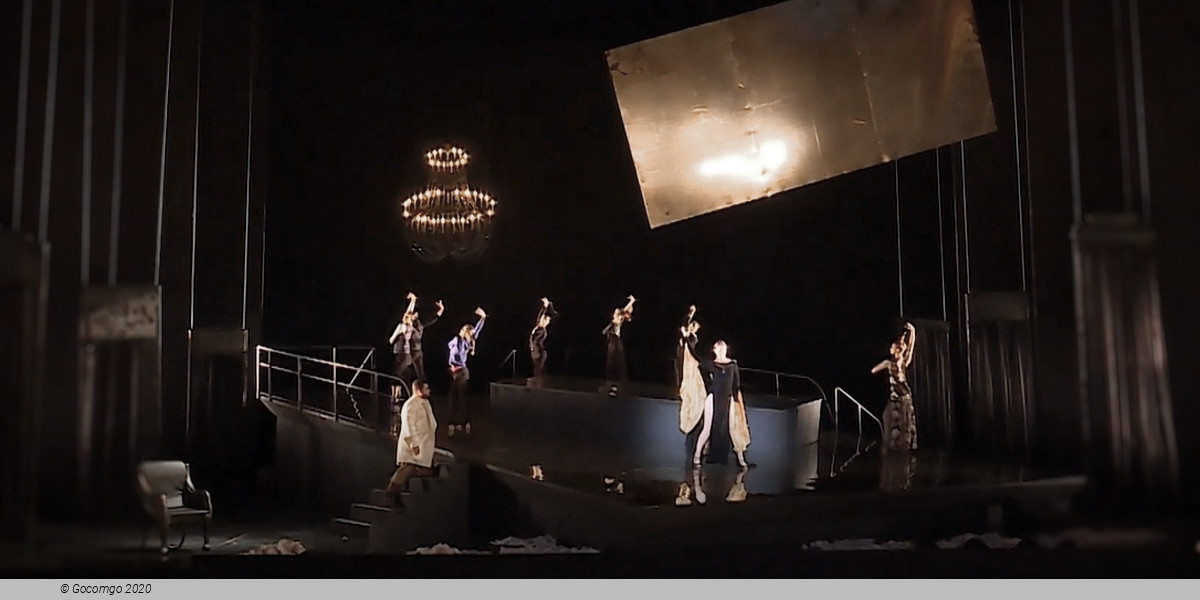
Anna's father, Guglielmo, holds Roberto responsible for Anna's death and calls upon the Villi to take vengeance on Roberto (Aria: Anima santa della figlia mia). The Villi call upon the ghost of Anna and lure Roberto into the forest. Roberto, now penniless and abandoned by the seductress, returns when news of Anna's death reaches him. Hoping that he will be forgiven the Villi stalk Roberto as he mourns the loss of the days of his youth (Aria: Torna ai felici dì). Roberto then finds the one last flower left alive in the winter and tries to find hope that Anna lives but is repelled by the Villi when he tries to knock on the door of Guglielmo's house. Roberto then tries to pray for forgiveness but finds he cannot because of the curse put upon him by the Villi. As Roberto curses his fate Anna appears to him and tells him of the suffering that she had to endure. Roberto begs for forgiveness and he too feels the pain of Anna burning in his heart. But Roberto is not forgiven and Anna calls upon the Villi, who curse Roberto with cries of "traitor." There, the Villi and Anna dance with Roberto until he dies of exhaustion at Anna's feet.

Venue Info

Belarus National Bolshoi Opera and Ballet Theater - Minsk
Location   Paryžskaj Kamuny Square, 1

The National Academic Grand Opera and Ballet Theatre of the Republic of Belarus is located in a park in the Trinity Hill district of Minsk. Local people call it the "Opierny Teatr" (Belarusian) or the "Opera and Ballet Theatre." While the theatre opened on 15 May 1933, in the beginning, it did not have its own performance venue. Until 1938, the troupe performed at the Belarusian Drama Theatre building.

The first permanent theatre was founded in Belarus in 1933 based on the Belarusian Opera and ballet school; the founder of the studio was a famous Russian Opera singer Anton Bonachich (Belarusian: Anton Bonatschitsch). Shortly after, Bonachich died in 1933.

The current theatre's building was opened in 1939. It was designed by the Belarusian architect from Leningrad, Iosif Langbard, whose original design was only partially implemented; some design details were omitted for financial reasons. The theatre has reliefs done by Zair Azgur.

Bizet's Carmen opened the theatre on 25 May 1933 with the title role being sung by Larisa Aleksandrovskaya. Several professional soloists and dancers were added to the troupe in the first few years at this location. Swan Lake, performed by K. Muller, was the first show on the stage of the new theatre. By 1940, Grand was added to the theatre's name to indicate its expansion. The performances by the theatre company during the "Decade of Belarusian Art" in Moscow in June 1940 was a great success which included the first Belarusian ballet, The Nightingale composed by Mikhail Kroshner, as well as other national operas such as "In the Dense Forest of Palesse", "The Flower of Fortune", and the second version of "Mikhas Podgorny". Performances continued during the war in Nizhny Novgorod, then known as Gorky until the liberation of Minsk in 1944; after that performances took place in Kovrov.

Enrichment of post World War 2 repertoire and expansion

During this time the repertoire was greatly enriched. The most famous operas staged in this theatre include Boris Godunov by Modest Mussorgsky, Otello and Don Carlo by Giuseppe Verdi, Jacques Offenbach's The Tales of HoffmannSadko and The Golden Cockerel by Nikolai Rimsky-Korsakov, and Lohengrin by Richard Wagner. Socialist realist operas by Belarusian composers such as Yuri Semenyako, Yevgeny Glebov (Your Spring, 1963) and Heinrich Wagner were included.

Among the most notable composers has been Kulikovich Shcheglov, who like some of the writers went into exile after the war. Others include Yevgeny Glebov, composer of the opera Your Spring (1963) and the ballet Alpine Ballad (1967), ..." In 1967, the theatre was awarded the title of Academic for its status in the progression of the performing arts.

In 1996 the State Theater was divided into two independent theatres: the National Academic Grand Ballet Theatre of the Republic of Belarus and the National Academic Opera Theatre of Belarus, but in 2008 they once again combined to become the present name, National Academic Grand Opera and Ballet Theatre of the Republic of Belarus.

The building was renovated and it reopened in 2009. Many sculptures were added around the theatre, its stage was slightly moved and audience space expanded. The most up-to-date lighting and motion equipment were added while adhering to the original design. The ballet company is considered one of the foremost companies in the world.

The theatre today

Works by Belarus composers in the company's repertoire today include Dmitry Smolsky's The Grey Legend (Russian "Седая легенда" 1978).

The troupe tours internationally. Fans from Spain, Russia, Germany, Poland, Switzerland, Israel, Portugal, and China are well acquainted with the repertoire of the Belarusian theatre. National Opera and Ballet of Belarus performs annually at the German festival "Classic Open Air."

Important Info
Type: Opera - Ballet
City: Minsk, Belarus
Starts at: 19:00
Acts: 2
Intervals: 1
Duration: 1h 30min
Sung in: Italian
Titles in: Russian
Top of page