


Belarus National Bolshoi Opera and Ballet Theater 20 June 2021 - La Bayadère | GoComGo.com

La Bayadère

Belarus National Bolshoi Opera and Ballet Theater, Minsk, Belarus
All photos (8)
Select date and time
6 PM
Request for Tickets
Important Info
Type: Ballet
City: Minsk, Belarus
Starts at: 18:00
Acts: 3
Intervals: 2
Duration: 2h 40min

E-tickets: Print at home or at the box office of the event if so specified. You will find more information in your booking confirmation email.

You can only select the category, and not the exact seats.
If you order 2 or 3 tickets: your seats will be next to each other.
If you order 4 or more tickets: your seats will be next to each other, or, if this is not possible, we will provide a combination of groups of seats (at least in pairs, for example 2+2 or 2+3).

Overview

"La Bayadere" ballet by L.Minkus was first staged in St. Petersburg`s Mariinsky Theatre by the prominent choreographer Marius Petipa. It is considered one of the best productions of the world classical ballet heritage. This performance has summed up the findings and gains of the world ballet theatre and has become a landmark for a whole period in ballet history. It is here that the dramaturgy got its perfect forms of poetic transformation in dance. Many a time the ballet was staged on the theatrical boards of the world, but nevertheless, it typically belongs to St. Petersburg, as it demands crystal purity of dance, refined generosity of form and highest performance culture, both dancing and acting.
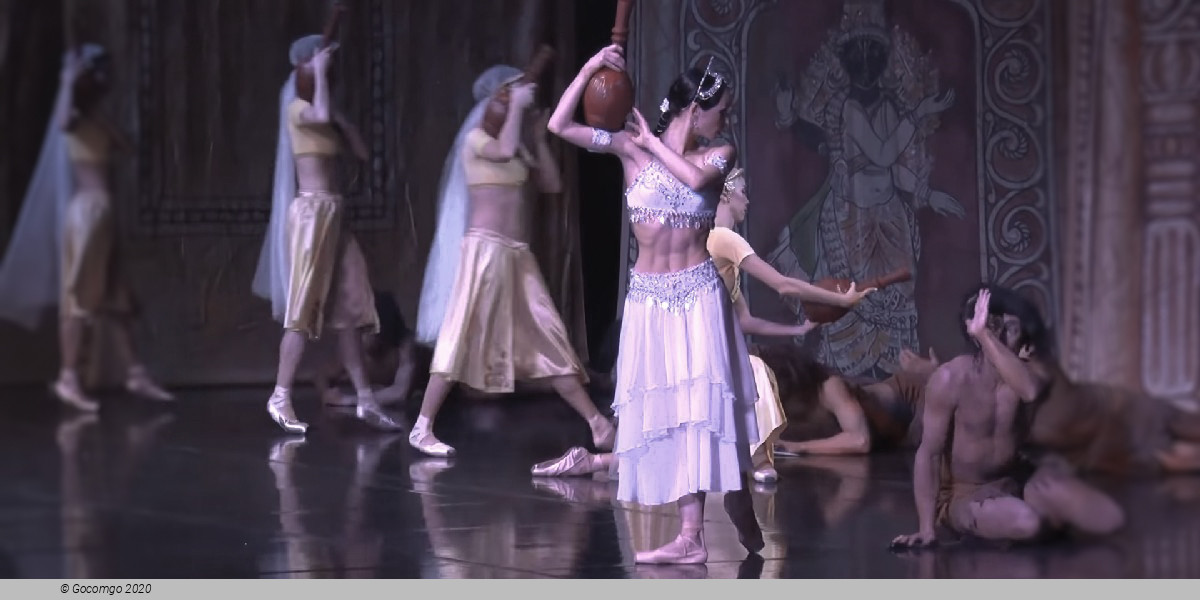
The literary sources of "La Bayadere" are the drama "Shakuntala" by the ancient Indian poet Kalidasa and Goethe`s "The God and the Temple Dancer". The action takes place in Ancient India. The heroes are Brahmins, Fakirs, Dancers (bayaderes) who lived in the Temple since early childhood and who took part in the religious ceremonies. At the heart of the plot lies the all-consuming love of the Bayadere Nikiya, faithfulness and betrayal, sincerity and treachery…
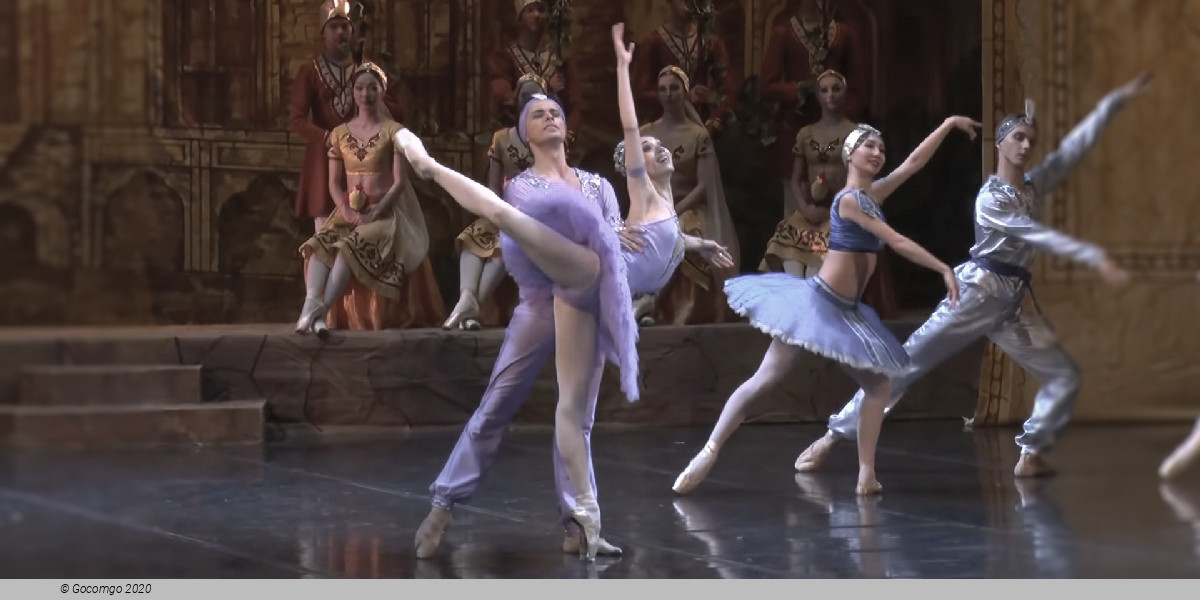
Making use of the exotic plot, Marius Petipa has expanded a series of classical dances exquisitely ornamented with elements of oriental plastics (the "Indian dance", the "Dance with the snake"). The fantastic scene "The Kingdom of Shades" from the third act even till now remains a masterpiece, unsurpassed in beauty and harmony and it is often performed as a separate concert piece.
During its long stage history, the choreography of the ballet underwent inevitable, at times considerable alterations. The XX century choreographers were anxious either to restore the original or to create new versions as Petipa's masterpiece gradually slipped away.
Almost 130 years have passed since the first staging of the ballet "La Bayadere", but it is still among the favourite performances both with the choreographers and with the dancers. It still attracts and excites the spectators with the emotional expressiveness of the music, the dramatic plot and the beauty of the choreography. "La Bayadere" stands in the repertoire of the Biggest theatres of the world, including the Mariinsky Theatre in St. Petersburg, Bolshoi Theatre in Moscow, the Royal Opera House "Covent Garden" in London, New-York Ballet Theatre, Grand Opera in Paris, etc. masterpiece gradually slipped away.
"La Bayadere" was staged in Belarus only once, in 1959. In those days the main role of the bayadere Nikiya was played by the dazzling dancers, People`s Artists of Belarus Lidiya Ryazhenova and Nina Davidenko.

History
Premiere of this production: 23 January 1877, Imperial Bolshoi Kamenny Theatre in St. Petersburg, Russia

La Bayadère (en. The Temple Dancer) is a ballet, originally staged in four acts and seven tableaux by French choreographer Marius Petipa to the music of Ludwig Minkus. The ballet was staged especially for the benefit performance of the Russian Prima ballerina Ekaterina Vazem, who created the principal role of Nikiya.

Synopsis

ACT I

Scene 1

Nighttime. The Sacred Forest. The military commander Solor is hunting near the Temple where his beloved bayadère Nikiya lives. Solor entrusts his devoted fakir Magedaveya to let Nikiya know that he will be waiting for her near the Temple when darkness falls. 

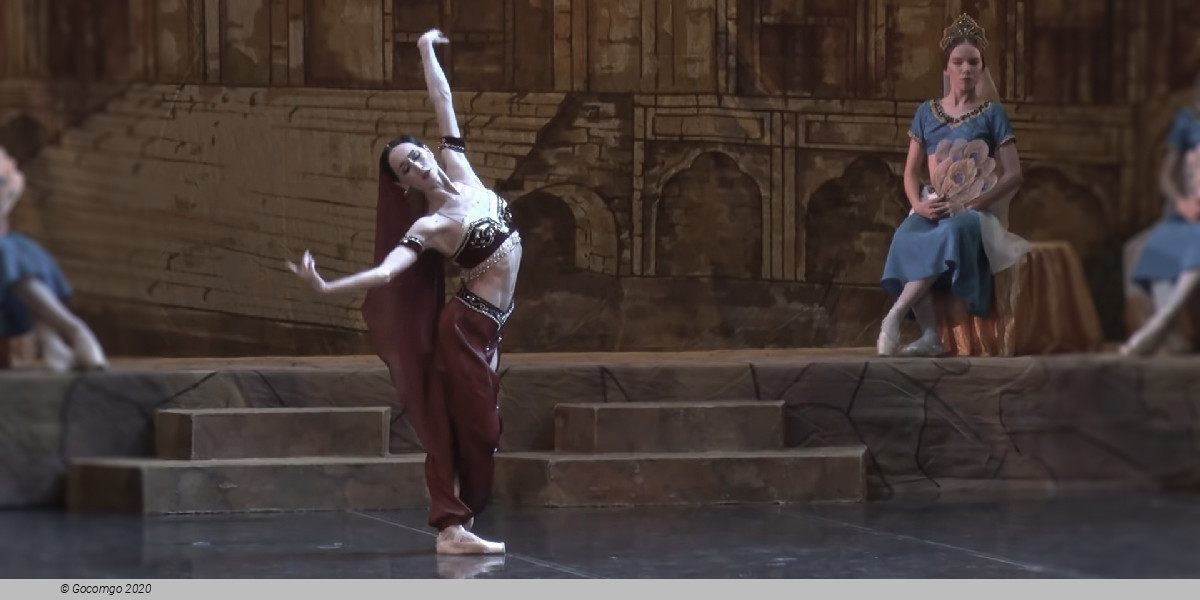
The High Brahmin, his priests and the bayadères, the temple dancers, open the Fire Worship Festival. The culmination of the festivities is the dance of the beautiful bayadère Nikiya.

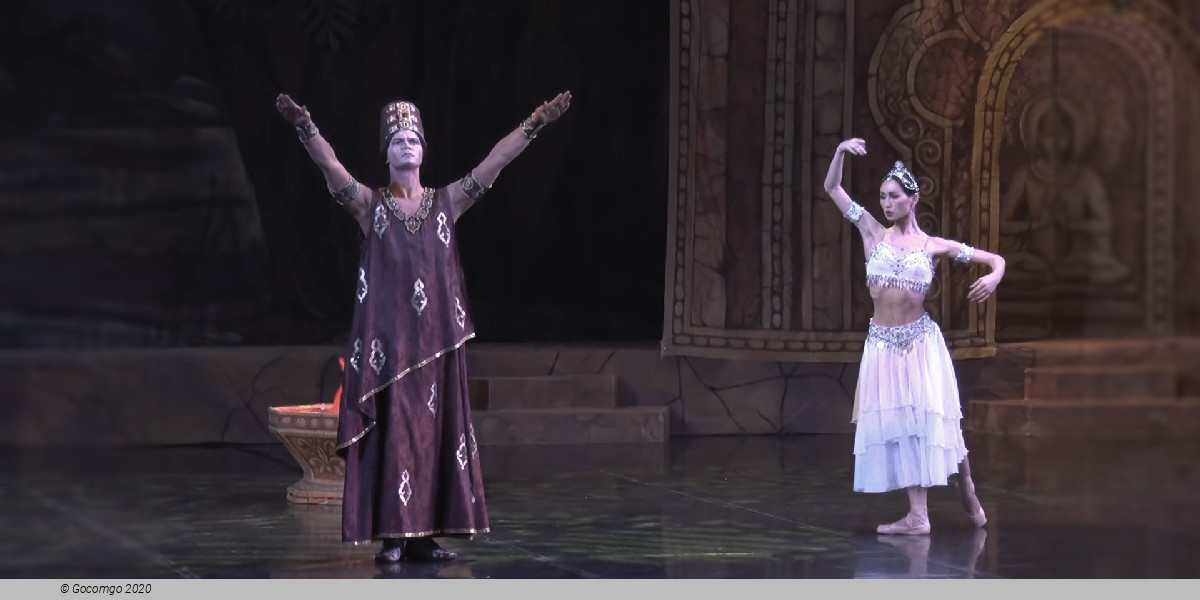
The passionate love for Nikiya makes the High Brahmin forget about his rank and celibacy. He promises all the riches of India for her love. But Nikiya rejects his ardent declaration of love.

The rite is over. The holy procession returns back to the Temple. Nikiya is impatiently waiting for her beloved. The fakir Magedaveya is standing guard over the secret meeting of Nikiya and Solor. 

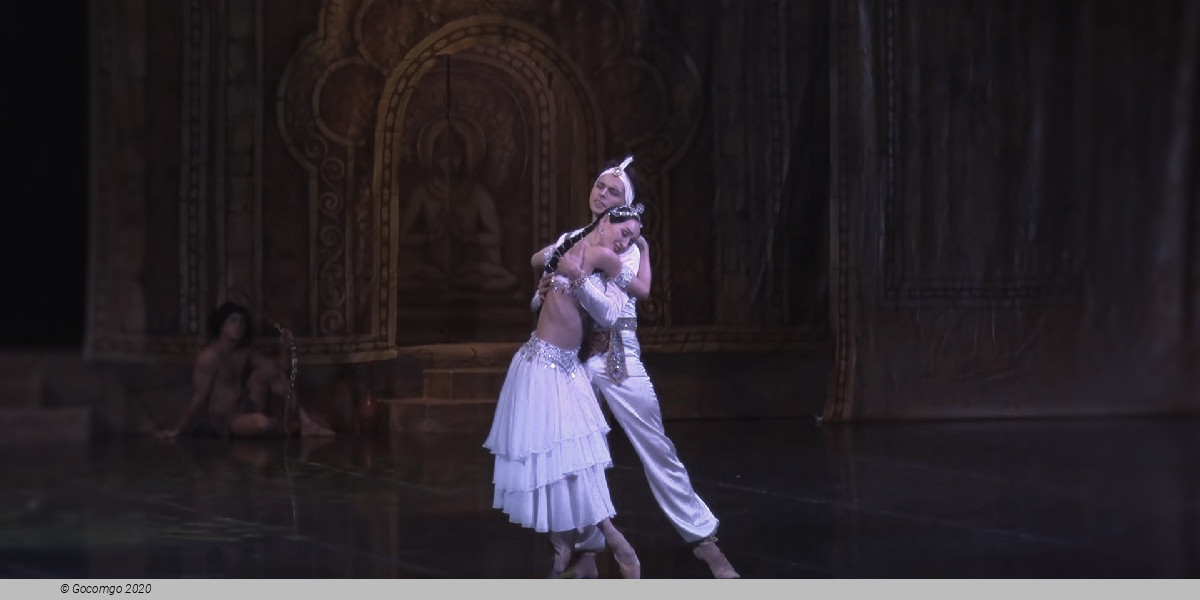
Solor urges Nikiya to run away. Far away from this place, where they are unknown, where they will be happy. The bayadère agrees. At the Sacred Fire site, the military commander vows everlasting love and fidelity to her. Unseen by the lovers, the High Brahmin witnesses their meeting and swears revenge.

Scene 2

The Palace of the Rajah. The Rajah Dugmanta announces to his daughter Gamzatti that she is to marry the noble warrior Solor. Gamzatti is thrilled. In spite of the fact that Solor is amazed by the beauty of Gamzatti, he cannot forget the bayadère, he has vowed to be faithful to her. But he has no right to refuse the high honour of becoming Gamzatti`s husband.

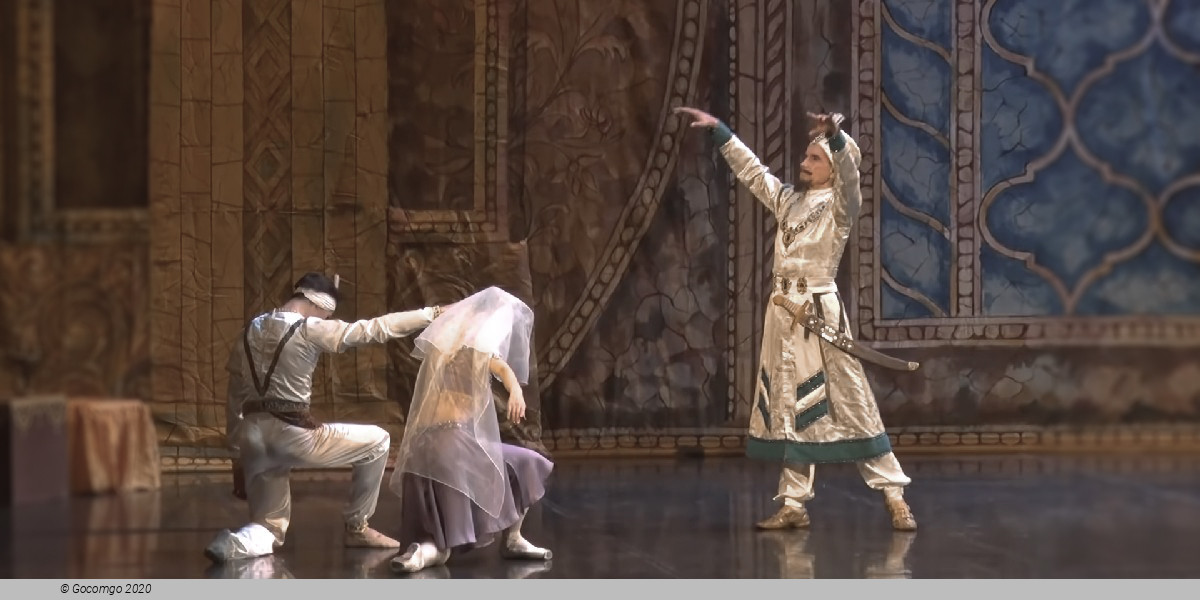
Nikiya is invited to the Palace for the rite of Gamzatti`s engagement. The High Brahmin also appears at the Palace. Plotting to ruin his rival, he tells Rajah about the love between Nikiya and Solor. Dugmanta is enraged but he doesn`t change his mind. Solor is to be his daughter`s husband and the bayadère must die. The High Brahmin is astounded by such a denouement, he threatens the Rajah with the wrath of gods, but Dugmanta is adamant.

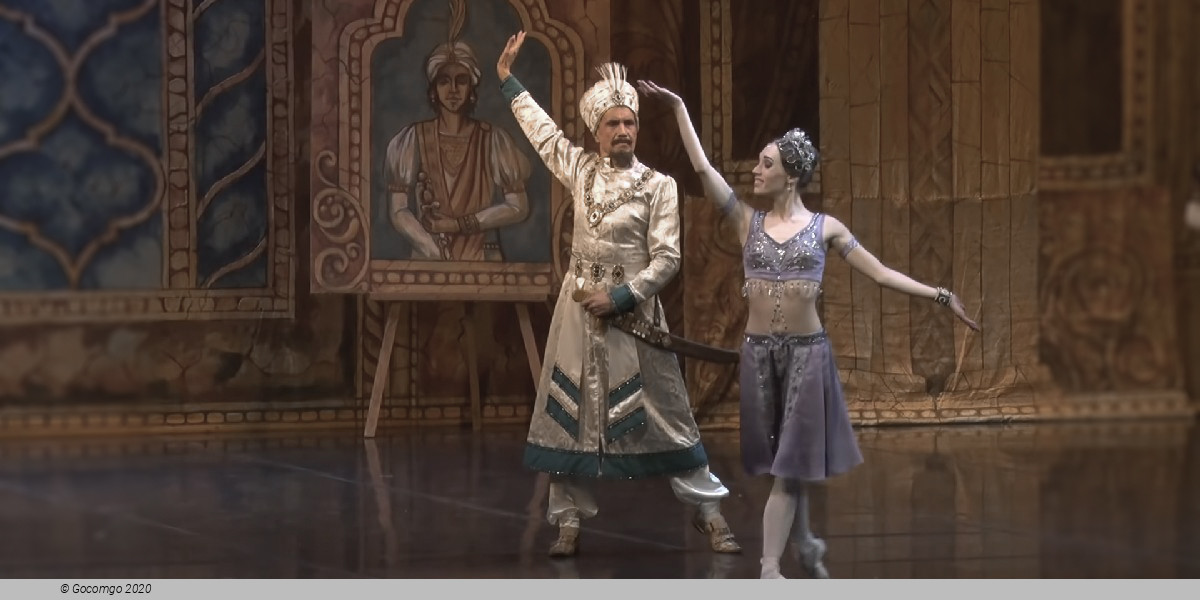
Having overheard the conversation, Gamzatti sends the slave girl off to fetch Nikiya and as if by chance shows her the portrait of her fiancé. Nikiya is in anguish: Solor loves only her and will belong only to her. Gamzatti threatens Nikiya and demands that she should give Solor up, but the bayadère would rather die than part with her beloved. In a fit of anger, Nikiya raises a dagger over her rival, but the slave girl appears just in time to grasp her hand. The Rajah`s daughter vows vengeance: Nikiya will die!

ACT II 

The square in front of the Rajah`s palace. The celebration in honour of Gamzatti and Solor`s engagement is underway. Nikiya has to dance at this event, but she cannot conceal her grief. During Nikiya`s ritual dance she has bestowed a basket of flowers on Gamzatti`s order. Nikiya takes the basket and continues the dance. All of a sudden a snake crawls out of the flowers and bites the bayadère to death. This is Gamzatti`s revenge.

The High Brahmin offers an antidote to Nikiya that will save her. Faithful to her love, Nikiya pushes the flask away and throws herself into the arms of Solor. Dying, she reminds her beloved about his oath.

ACT III

An opium den. Inconsolable Solor cannot find peace. He is torn by remorse. To distract him, Magedaveya summons a snake charmer. Solor drifts into slumber to the sounds of the flute.

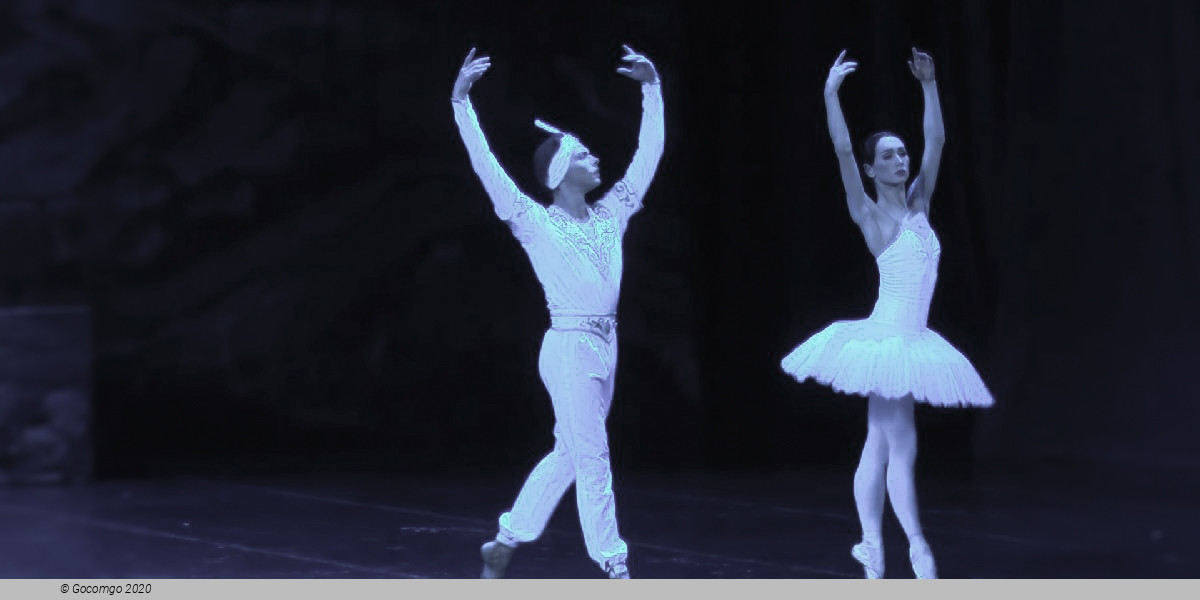
The Kingdom of Shades materializes before him from the darkness. A long succession of dancing shades drifts from mountain cliffs. The apparition of the slain bayadère is among them. She calls for Solor…

Bayadère (from the Portuguese “bailadeira” – dancer): an Indian temple dancer who participates in religious ceremonies and festivities.

Set in the Royal India of the past, La Bayadère is a story of eternal love, mystery, fate, vengeance, and justice.  The ballet relates the drama of a temple dancer (bayadère), Nikiya, who is loved by Solor, a noble warrior.  She is also loved by the High Brahmin, but does not love him in return, as she does Solor.

Act I

Scene I, Outside Temple in the Sacred Forest.

The High Brahmin, priests, and temple dancers are celebrating the Indian Ritual of Fire.  Nikiya, the most beautiful of the bayadères, has been chosen to be consecrated the lead temple dancer.  The High Brahmin declares his love for Nikiya, but is rejected by her.  Nikiya meets secretly with Solor later that evening.  They dance together and swear eternal love over the Sacred Fire, but are discovered by the jealous High Brahmin, who vows to kill Solor.

Scene II, A Room in the Palace.

The Rajah has decided to reward Solor’s valor and decrees that the warrior will marry his daughter, Gamzatti.  Gamzatti falls in love with Solor’s portrait, and when they meet, he is overwhelmed by her beauty.  Even though he has sworn eternal love to Nikiya, he cannot defy the wishes of the Rajah and agrees to marry Gamzatti.  The High Brahmin informs the Rajah of Nikiya and Solor’s secret love, hoping that the Rajah will do away with Solor.  Instead, the Rajah decides to kill Nikiya.

This conversation is overhead by Gamzatti, who summons Nikiya to her rooms and attempts to bribe Nikiya to give up Solor.  Refusing, Nikiya frantically attempts to kill  Gamzatti.  Nikiya flees and Gamzatti swears to destroy her.

Scene III, The Garden of the Palace.

At the betrothal of Solor and Gamzatti, Nikiya is commanded to dance.  Gamzatti presents her with a basket of flowers that Nikiya believes to be from Solor, and which conceals a deadly snake.  Nikiya is bitten, and when Solor leaves with Gamzatti, she refuses the proffered antidote and dies.

Act II. The Tent of Solor.

Solor, grief‑stricken and under the influence of opium, dreams of being reunited with Nikiya in the Kingdom of the Shades.  Awakening, he realizes that he must prepare to marry Gamzatti.

Act III. The Temple.

The vision of Nikiya remains with Solor as the wedding ceremony begins at the Sacred Temple.  As Solor and Gamzatti say their vows and are blessed by the High Brahmin, the vengeance of the gods is unleashed, and the temple and all the celebrants are destroyed.  Nikiya and Solor are once again united in eternal love.

Venue Info

Belarus National Bolshoi Opera and Ballet Theater - Minsk
Location   Paryžskaj Kamuny Square, 1

The National Academic Grand Opera and Ballet Theatre of the Republic of Belarus is located in a park in the Trinity Hill district of Minsk. Local people call it the "Opierny Teatr" (Belarusian) or the "Opera and Ballet Theatre." While the theatre opened on 15 May 1933, in the beginning, it did not have its own performance venue. Until 1938, the troupe performed at the Belarusian Drama Theatre building.

The first permanent theatre was founded in Belarus in 1933 based on the Belarusian Opera and ballet school; the founder of the studio was a famous Russian Opera singer Anton Bonachich (Belarusian: Anton Bonatschitsch). Shortly after, Bonachich died in 1933.

The current theatre's building was opened in 1939. It was designed by the Belarusian architect from Leningrad, Iosif Langbard, whose original design was only partially implemented; some design details were omitted for financial reasons. The theatre has reliefs done by Zair Azgur.

Bizet's Carmen opened the theatre on 25 May 1933 with the title role being sung by Larisa Aleksandrovskaya. Several professional soloists and dancers were added to the troupe in the first few years at this location. Swan Lake, performed by K. Muller, was the first show on the stage of the new theatre. By 1940, Grand was added to the theatre's name to indicate its expansion. The performances by the theatre company during the "Decade of Belarusian Art" in Moscow in June 1940 was a great success which included the first Belarusian ballet, The Nightingale composed by Mikhail Kroshner, as well as other national operas such as "In the Dense Forest of Palesse", "The Flower of Fortune", and the second version of "Mikhas Podgorny". Performances continued during the war in Nizhny Novgorod, then known as Gorky until the liberation of Minsk in 1944; after that performances took place in Kovrov.

Enrichment of post World War 2 repertoire and expansion

During this time the repertoire was greatly enriched. The most famous operas staged in this theatre include Boris Godunov by Modest Mussorgsky, Otello and Don Carlo by Giuseppe Verdi, Jacques Offenbach's The Tales of HoffmannSadko and The Golden Cockerel by Nikolai Rimsky-Korsakov, and Lohengrin by Richard Wagner. Socialist realist operas by Belarusian composers such as Yuri Semenyako, Yevgeny Glebov (Your Spring, 1963) and Heinrich Wagner were included.

Among the most notable composers has been Kulikovich Shcheglov, who like some of the writers went into exile after the war. Others include Yevgeny Glebov, composer of the opera Your Spring (1963) and the ballet Alpine Ballad (1967), ..." In 1967, the theatre was awarded the title of Academic for its status in the progression of the performing arts.

In 1996 the State Theater was divided into two independent theatres: the National Academic Grand Ballet Theatre of the Republic of Belarus and the National Academic Opera Theatre of Belarus, but in 2008 they once again combined to become the present name, National Academic Grand Opera and Ballet Theatre of the Republic of Belarus.

The building was renovated and it reopened in 2009. Many sculptures were added around the theatre, its stage was slightly moved and audience space expanded. The most up-to-date lighting and motion equipment were added while adhering to the original design. The ballet company is considered one of the foremost companies in the world.

The theatre today

Works by Belarus composers in the company's repertoire today include Dmitry Smolsky's The Grey Legend (Russian "Седая легенда" 1978).

The troupe tours internationally. Fans from Spain, Russia, Germany, Poland, Switzerland, Israel, Portugal, and China are well acquainted with the repertoire of the Belarusian theatre. National Opera and Ballet of Belarus performs annually at the German festival "Classic Open Air."

Important Info
Type: Ballet
City: Minsk, Belarus
Starts at: 18:00
Acts: 3
Intervals: 2
Duration: 2h 40min
Top of page