
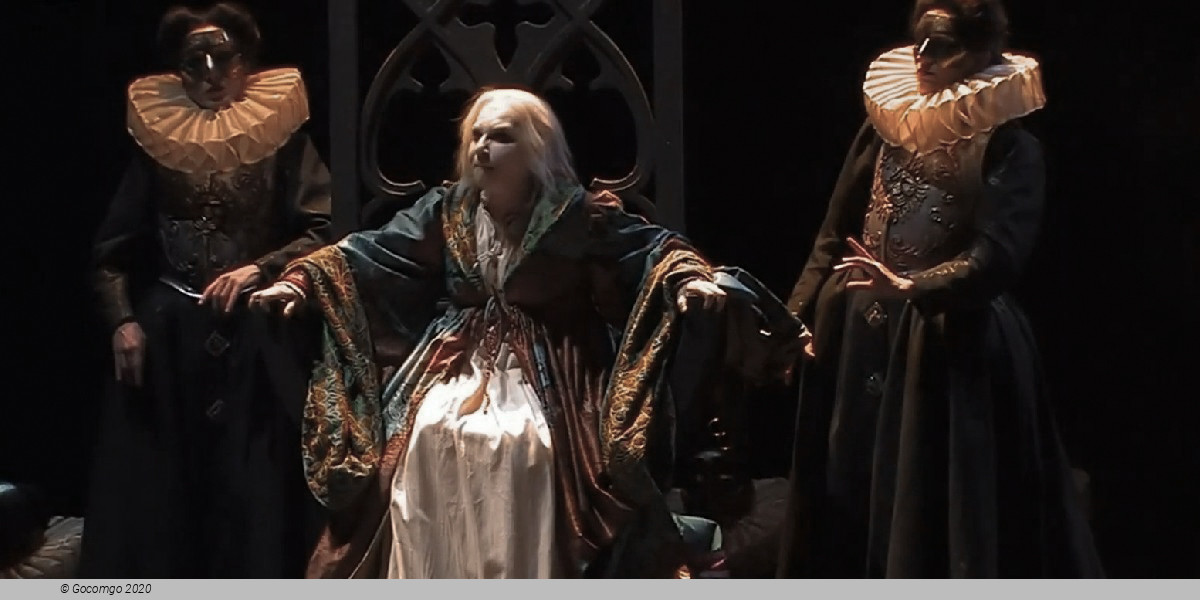
Lyric Opera House: Roberto Devereux Tickets | Event Dates & Schedule | GoComGo.com

Roberto Devereux Tickets

Lyric Opera House, Chicago, USA
Important Info
Type: Opera
City: Chicago, USA

E-tickets: Print at home or at the box office of the event if so specified. You will find more information in your booking confirmation email.

You can only select the category, and not the exact seats.
If you order 2 or 3 tickets: your seats will be next to each other.
If you order 4 or more tickets: your seats will be next to each other, or, if this is not possible, we will provide a combination of groups of seats (at least in pairs, for example 2+2 or 2+3).

Cast
Performers
Choose the date to see the peformers
History
Premiere of this production: 28 October 1837, Teatro San Carlo, Naples

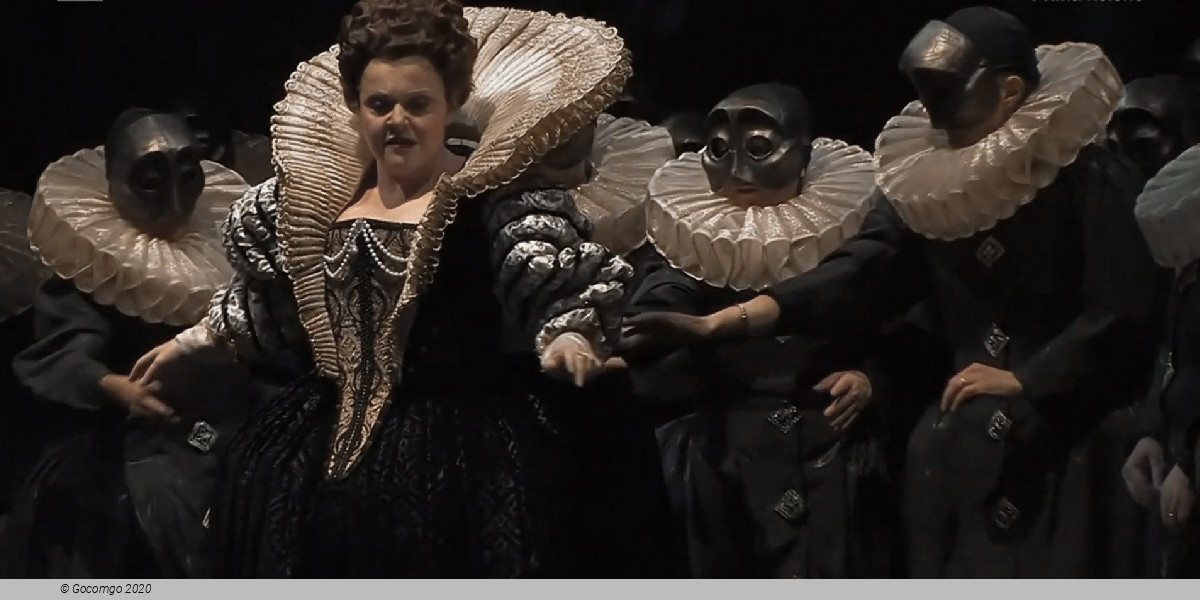
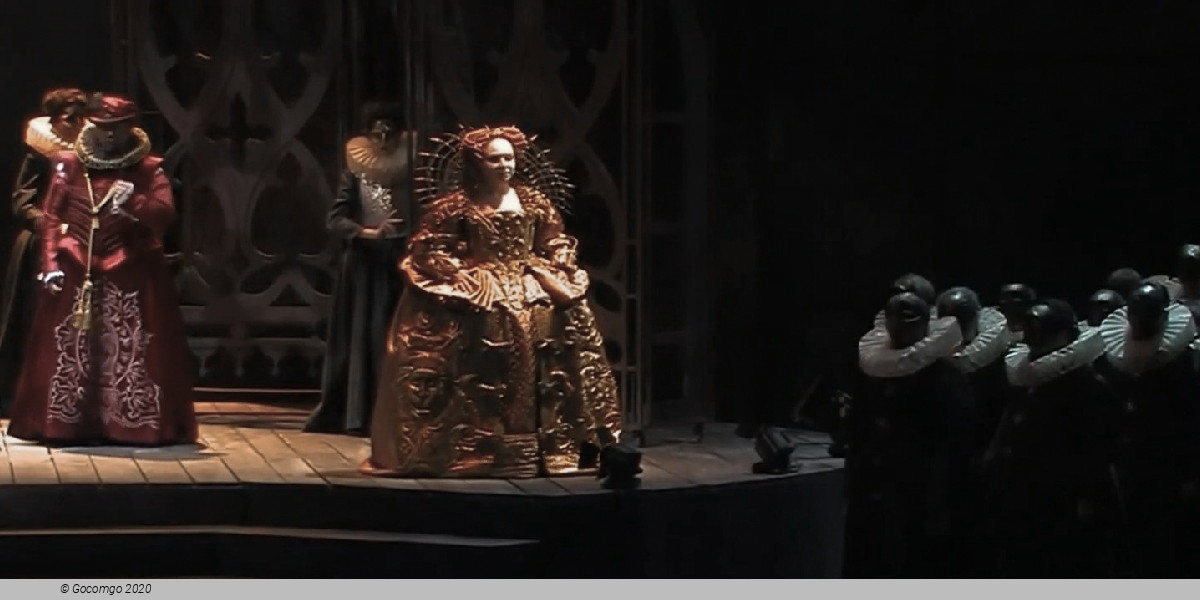
Roberto Devereux (or Roberto Devereux, ossia Il conte di Essex [Robert Devereux, or the Earl of Essex]) is a tragedia lirica, or tragic opera, by Gaetano Donizetti. Salvadore Cammarano wrote the Italian libretto after François Ancelot's tragedy Elisabeth d'Angleterre (1829), and based as well on the Historie secrete des amours d'Elisabeth et du comte d'Essex (1787) by Jacques Lescéne des Maisons, although Devereux was the subject of at least two other French plays: Le Comte d'Essex by Thomas Corneille and Le Comte d'Essex by Gauthier de Costes, seigneur de la Calprenède.

Synopsis

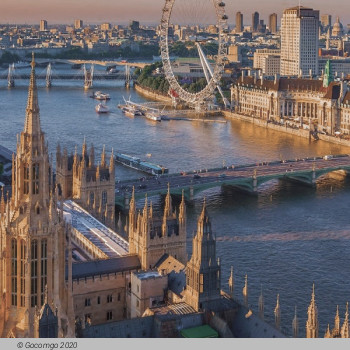
Place: London, England
Time: 1601, during the reign of Queen Elizabeth I

Robert Devereux, 2nd Earl of Essex, favorite of Queen Elisabeth, has been removed from office as Governor of Ireland because, acting on his own initiative, he has agreed to a ceasefire with the rebels. Following an attempted uprising, he is awaiting his trial for high treason in London.

Act 1
Scene 1: The Great Hall at Westminster

Sara, Duchess of Nottingham, is trying in vain to hide her tears from the eyes of the Court, as she reads the sad story of Fair Rosamond, the unfortunate lover of King Henry II of England, and therein recognizes a very similar situation to her own. She is in love with Robert Devereux, her husband's closest friend. The Ladies of the court express concern, but she replies that she is happy, while privately revealing her sadness (All'afflitto è dolce il pianto). Elizabeth enters and states that, at the insistence of Nottingham, she has agreed to see Robert once again, now that he has returned from Ireland accused of treason (Duchessa..Alle fervide preci). The Queen is willing to release him without charges if she can be sure of his continued loyalty. To Sara's gradual dismay, the Queen reveals her love for Robert (L'amor suo mi fe' beata). Cecil enters and announces that Parliament is waiting for an answer from the Queen regarding the charges against Robert, since it considers her as being too lenient towards him, but she refuses to sign the death warrant proposed by the Royal Council.

Robert enters and, in a conversation overheard by the increasingly distraught Sara, Elizabeth declares her love for him. Now alone together, Elizabeth promises Robert that the ring she once gave him will always be the pledge of his safety should he ever return it to her. The dream of bygone happy days is shattered by an inappropriate comment by Robert, who assumes that Elizabeth knows the secret of his love for Sara. The Queen, increasingly jealous, demands that Robert name the woman he loves. He denies that he loves anyone (Nascondi, frena i palpiti), and then the Queen leaves.

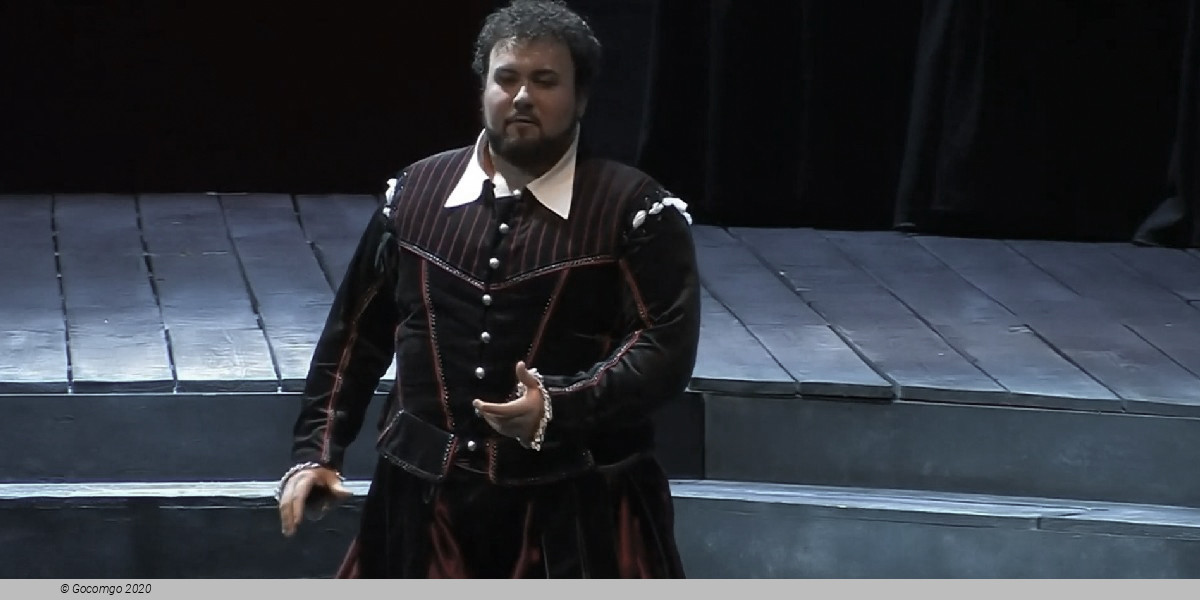
Nottingham, Robert's friend and supporter, enters and the two men discuss Robert's situation and Nottingham's concerns about his wife's behaviour after he has observed her embroidering a blue shawl (Forse in quel cor sensible, Qui ribelle ognum ti chiama). The two men are interrupted by Cecil demanding that Nottingham attend a meeting of the Peers of the Realm.

Scene 2: Sara's Apartments at Nottingham House

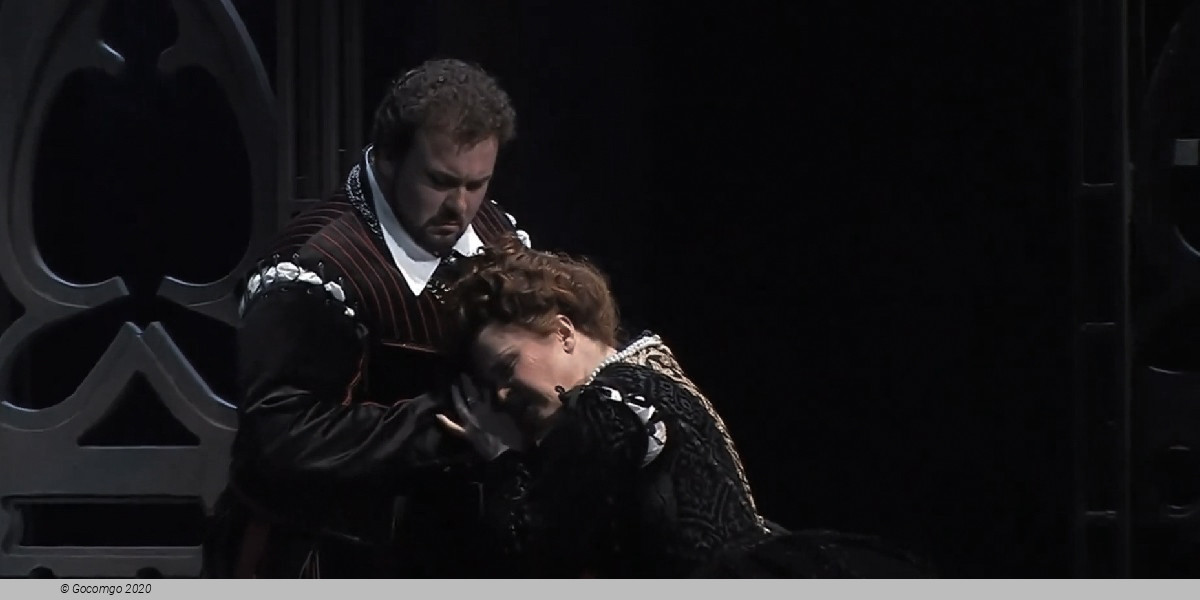
Sara is alone when Robert enters, declaring her to be faithless because she has married Nottingham while he was in Ireland. She defends herself saying that it was the Queen's idea and that she was forced to do her bidding. At the same time, seeing the ring on Robert's finger, she assumes it to be a love token from the Queen, and tells him that they must never see each other again, giving him the blue shawl as a love token. In a final duet (Dacchè tornasti, ahi misera) each declares love for the other and they accept that they must say goodbye. Robert makes plans to escape.

Act 2
The Great Hall at Westminster

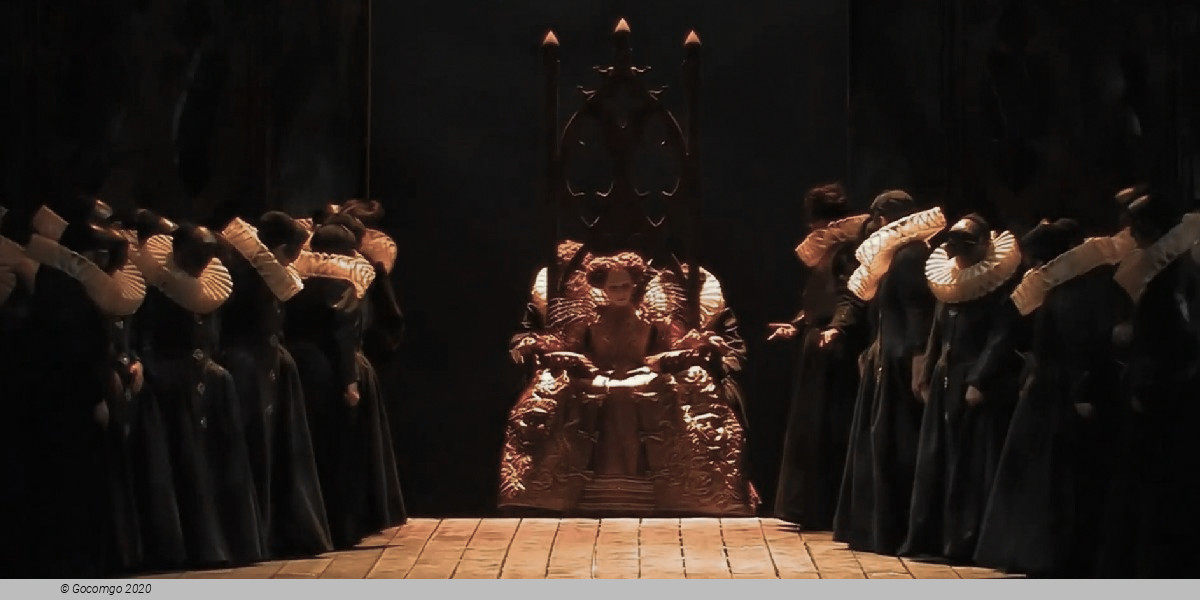
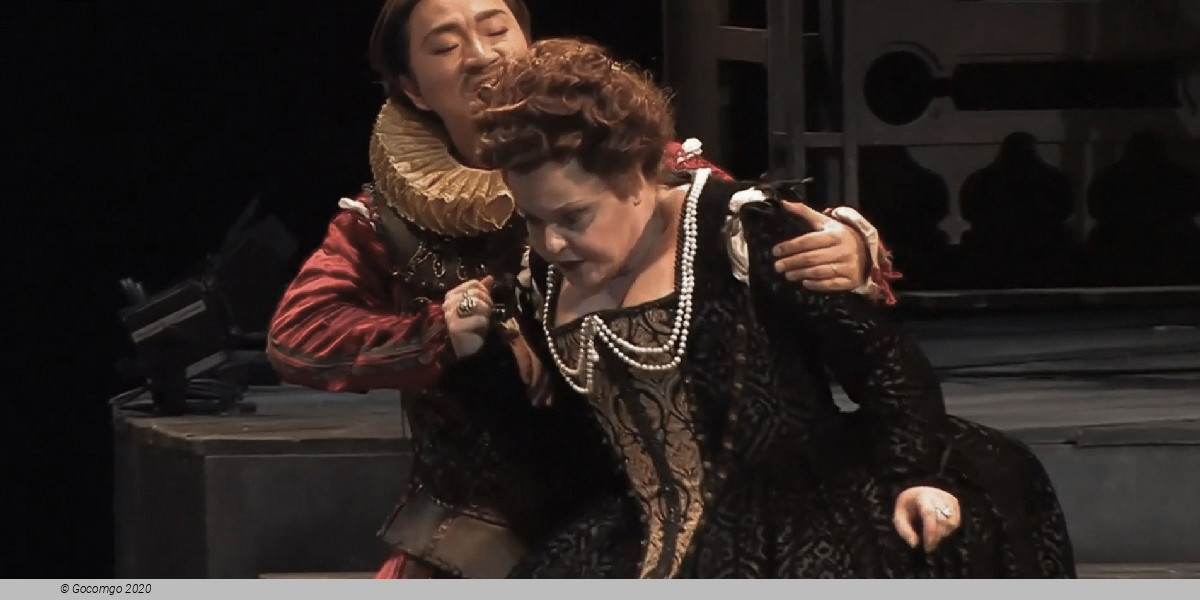
The Queen approaches Cecil to find out what has been decided. Cecil declares that the sentence is death. The Queen, asking Raleigh why the whole process took so long, learns that Robert had a shawl in his possession which he resisted giving over. It is handed to her. Nottingham enters and pleads for Robert's life (Non venni mai si mesto), insisting that he is innocent, but the Queen continues to describe how she knows that Robert has been unfaithful and, when he is brought in, confronts him, showing him the scarf. Nottingham sees it as well and recognizes it. Furious, he declares that he will have vengeance; while at the same time, Elizabeth offers Robert his freedom if he reveals the name of her rival. He refuses and she signs the death warrant, announcing that a cannon shot will be heard as the axe falls. Nottingham fumes that the axe is not a suitable punishment.

Act 3
Scene 1: Sara's Apartments

Alone, Sara receives Robert's ring along with a letter from him. In it, he tells her to take the ring to Elizabeth and beg for mercy. Before she can leave, Nottingham arrives and reads the letter (Non sai che un nume vindice). Although she protests her innocence, he prevents her from leaving. They both hear the funeral march for Robert as he is led to the Tower, and Nottingham leaves to exact his revenge on Robert. She faints.

Scene 2: The Tower of London

In his cell, Robert ponders as to why it appears that his ring has not been received by the Queen. But he refuses to betray Sara (Come uno spirto angelico... Bagnato il sen di lagrime), and when Cecil arrives at the door of the cell, it is not to free Robert but to take him to his execution. He is led away.

Scene 3: The Great Hall at Westminster

Elizabeth is mournful about the pending death of her lover and wonders why Sara is not there to give her comfort (Vivi ingrato, a lei d'accanto). Cecil announces that Robert is on his way to the block, and Sara arrives disheveled. She gives Elizabeth the ring along with confessing her guilt at being the Queen's rival. In vain, the Queen tries to stop the execution, but they hear the cannon announcing Robert's death. After Nottingham has arrived, Elizabeth demands to know why he prevented the ring from being brought to her. He replies: "Blood I wanted, and blood I got!" Elizabeth is haunted by the headless corpse of Robert, and longs for her own death, announcing that James VI of Scotland (son of Mary Queen of Scots) will be king. Alone, she kisses Robert's ring.

Venue Info

Lyric Opera House - Chicago
Location   20 North Wacker Drive

The world-renowned Lyric Opera of Chicago performs in one of North America's most beautiful opera houses, the Lyric Opera House at 20 North Wacker Drive.

In 2017, Lyric Opera of Chicago as house manager of the theater announced that the Joffrey Ballet planned to move from its longtime performance venue at the Auditorium Theatre to the opera house in 2020. The announcement coincided with Lyric's presentation of a new production of Gluck's Orfeo ed Euridice by choreographer John Neumeier; the production fused the musical and ballet elements of the opera and featured the Joffrey Ballet.

Opened as the Civic Opera House in 1929, the building was the vision of utility magnate Samuel Insull (1859–1938), a populist billionaire known as "the Prince of Electricity." Insull, the president of the Chicago Civic Opera Association, wanted to erect a new opera house to replace Louis B. Sullivan's Auditorium Building on South Michigan Avenue as the home of the Chicago Civic Opera — one that would be democratic in scope, and would be housed in and supported by a commercial office building.

The design team chosen by Insull, the Chicago architectural firm of Graham, Anderson, Probst & White, wanted the Civic Opera Building to symbolize "the spirit of a community which is still youthful and not much hampered by traditions." The firm was already famous for designing the Field Museum of Natural History, the Wrigley Building on North Michigan Avenue, and the Continental Illinois Bank Building on South LaSalle Street. In the 1930s the firm created the massive Merchandise Mart Building, also on the Chicago River.

From its opening on Nov. 4, 1929 (just six days after the stock-market crash) until Lyric Opera of Chicago was founded in 1954 (as Lyric Theatre), the Lyric Opera House was home to the Chicago Civic Opera, Chicago Grand Opera Company, Chicago City Opera Company and Chicago Opera Company.

Over the years the Lyric Opera House has also hosted visiting opera and dance companies, as well as touring operettas, musical shows, and a great number of orchestral, dance, and vocal concerts. The adjoining Civic Theatre, at the north end of the block-long building, was used to present plays (including the premiere of Tennessee Williams' The Glass Menagerie), dance performances, and films; for a considerable time it also served as a television studio.

The Civic Opera Building is a majestic limestone skyscraper with a 45-story office tower and two 22-story wings. Shaped like a gigantic throne facing the Chicago River between Washington and Madison streets, it was completed after just 22 months of planning and construction.

The auditorium and its backstage areas occupy approximately one-third of the total space of the building. The distinguishing feature on the Wacker Drive side of the Civic Opera Building is the colonnaded portico that runs the entire length of the building. At the south end, large bronze doors open onto the grand foyer of the Lyric Opera House, whose gilt cornices glitter beneath the sparkling lights of Austrian crystal chandeliers and elaborately stenciled ceilings.

The magnificent space, named the Daniel F. and Ada L. Rice Grand Foyer in honor of major benefactors in 1994, features a floor and wainscoting of pink and gray Tennessee marble, and fluted Roman travertine columns and pilasters. The 40-foot-high columns are topped with carved capitals covered in gold leaf. An imposing grand double staircase leads to the mezzanine foyer.

The decorative character of the entire building is a hybrid of Art Nouveau and Art Deco styles. Comedy-tragedy masks and cornucopia of instruments abound as playful ornaments around entrances, inspired by the Paris Opera House designed by Jean-Louis-Charles Garnier.

The famous painted fire curtain (depicting the parade scene from Aida) and the interior decoration details of the Lyric Opera House were created by American artist Jules Guerin in a palette of salmon pinks, roses, olives, golds and bronzes.

In 1993, Lyric Opera of Chicago purchased all of the theater and backstage space in the Civic Opera Building. Previously Lyric Opera had rented the auditorium and backstage areas.

A massive $100-million renovation of the backstage area commenced in 1993, and continued during Lyric's off-seasons (mid-March through early September) through 1996. The improvements made during this project allowed Lyric Opera to continue producing world-class opera well into the 21st century. The purchase and renovation was made possible by Lyric's $100-million "Building on Greatness" capital campaign. The Lyric Opera of Chicago/Chicago Symphony Orchestra Facilities Fund helped launch Lyric's campaign with a $50 million commitment.

The final phase of renovations took place between early April and early August of 1996 when all 3,563 seats, along with the carpeting, were removed from the auditorium so that artisans could clean and completely repaint. Previously, the theater had never been fully repainted since it opened in 1929 — just patched and touched up as needed over the years.

During the summer of 1996 more than 30 highly skilled artisans from around the country worked in the Lyric Opera House six days a week, 10 hours a day, applying 2,000 gallons of gold paint to the elegant ornamentation of the auditorium, Rice Grand Foyer, and all lobbies. The painters also hand-stenciled and hand-detailed the exquisite colorful ornamentation that adorns the Lyric Opera House ceilings.

Every seat in the auditorium was beautifully refurbished for the first time since 1929. The metal portions were repainted and the wood arms were refinished; the upholstery, seat and back of each chair were replaced. 6,000 square yards of new deep-red carpeting were installed in the theater and lobbies of the Lyric Opera House. The 31 boxes on the mezzanine level were rebuilt and enlarged by 18 inches.

A new 500-pound mainstage curtain was installed, made of 580 yards of heavy-weight wool velour and silk fringe to replicate the original 1929 curtain. All the bronze decorative features and railings in the Lyric Opera House were polished to a just-like-new sheen. The beautiful travertine marble was thoroughly cleaned.

Backstage, a 40-foot-high, 40,000-pound soundproof door was installed to acoustically separate the scenery handling area from the mainstage. During the renovation 32 miles of new rope and cable were installed backstage to update the scenery rigging system. Additionally, 170 miles of electrical wiring and 38 miles of electrical conduit were installed throughout the Lyric Opera House.

Important Info
Type: Opera
City: Chicago, USA

E-tickets: Print at home or at the box office of the event if so specified. You will find more information in your booking confirmation email.

You can only select the category, and not the exact seats.
If you order 2 or 3 tickets: your seats will be next to each other.
If you order 4 or more tickets: your seats will be next to each other, or, if this is not possible, we will provide a combination of groups of seats (at least in pairs, for example 2+2 or 2+3).

Top of page