








Mariinsky Theatre 13 April 2020 - Mlada | GoComGo.com

Mlada

Mariinsky Theatre, Concert Hall, Saint Petersburg, Russia
All photos (2)
Select date and time
7 PM
Request for Tickets
Important Info
Type: Opera
City: Saint Petersburg, Russia
Starts at: 19:00
Duration:
Titles in: Russian,English

E-tickets: Print at home or at the box office of the event if so specified. You will find more information in your booking confirmation email.

You can only select the category, and not the exact seats.
If you order 2 or 3 tickets: your seats will be next to each other.
If you order 4 or more tickets: your seats will be next to each other, or, if this is not possible, we will provide a combination of groups of seats (at least in pairs, for example 2+2 or 2+3).

Overview

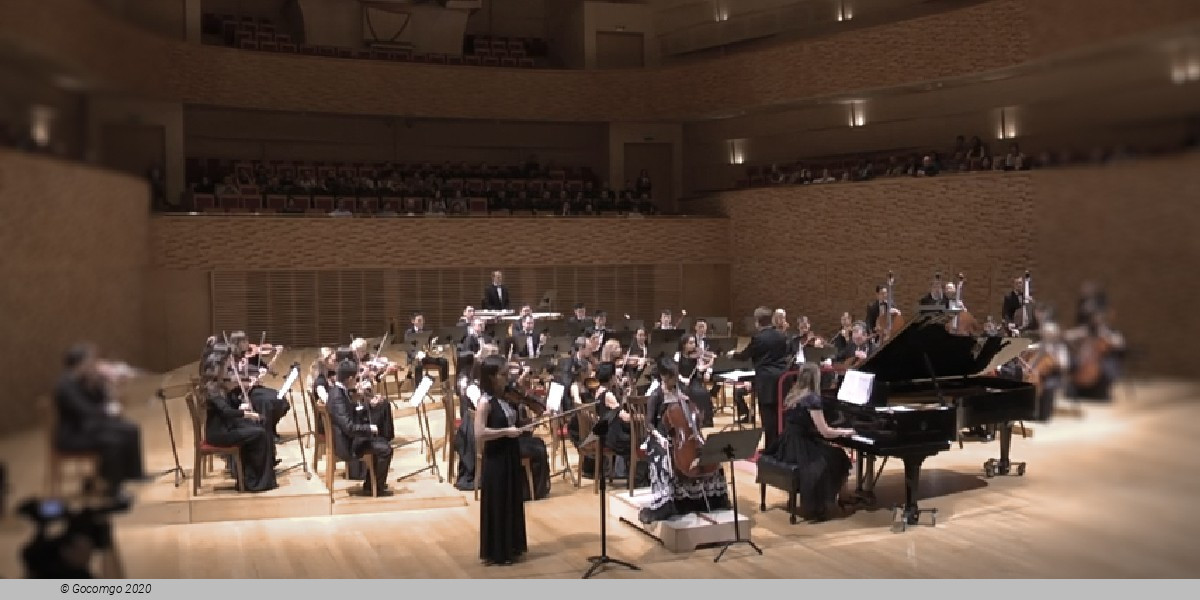
Opera in concert

History
Premiere of this production: 01 November 1892, Mariinsky Theatre, St. Petersburg

Mlada is an opera-ballet in four acts, composed between 1889 and 1890 by Nikolai Rimsky-Korsakov, to a libretto by Viktor Krylov that was originally employed for an aborted project of the same name from 1872. In the middle of Mlada, a fantasy tale about ancient pagan Slavs, Cleopatra emerges in a scene that exudes sensuality. Rimsky-Korsakov said "Among my musical impressions of Paris [at the World Exhibition, summer 1889] I reflect on music in Hungarian and Algerian cafes. The virtuoso playing of a Hungarian orchestra on tsevnitsas (Pan flutes) gave me the idea of introducing this ancient instrument... during the dances at Cleopatra's. In an Algerian cafe, I was attracted to the beat of a large drum... This effect I also borrowed for the scene of Cleopatra."

Synopsis

The city of Rethra, near the Laba (Elbe) in the Slavonic territories on the Baltic shore, 9th or 10th century

Act 1
Mstivoy’s lands. Maidens are weaving garlands for the midsummer holiday. Mstivoy’s daughter Voyslava is troubled; her passionate love for the young Arkonian prince Yaromir has led her into wrongdoing – she has killed Mlada, Yaromir’s bride. Faithful to the memory of his beloved, Yaromir has spurned her. She calls to Lada, the goddess of love, for assistance, but her crime has turned the beneficent deities against her. Her old nurse Svyatokhna promises help if Voyslava will pledge herself to Morena, goddess of the underworld. Voyslava agrees; thunder is heard, the scene is plunged into darkness, and before her stands not Svyatokhna but Morena herself, who calls upon the dark forces on Voyslava’s behalf.
Yaromir arrives with his retinue to celebrate midsummer. Morena’s spell begins to work: struck by Voyslava’s beauty, Yaromir pledges his troth to her. Mstivoy orders a dance of celebration (a redowa). Yaromir falls into a charmed sleep, and in a vision sees how Voyslava had murdered Mlada with a poisoned ring. He awakes in confusion. Servants of Mstivoy summon him to the festival.

Act 2
A lakeside valley outside the Temple of Radegast. Tradespeople from many countries have gathered for the festival. A fight nearly breaks out between the Polabians and the Novgorod merchants, but the bard Lumir calms them, reminding them of their common enemy, the Teutonic Christians. The princes of the land assemble in a procession. The High Priest leads a divination rite. Mstivoy orders entertainment (Lithuanian Dance; Hindu Dance). The ritual of wreaths and idols now begins with a khorovod, in which couples kiss periodically. At each such moment, however, Mlada’s shade materializes between Voyslava and Yaromir, separating them; Yaromir rushes off after the shade. Voyslava curses Morena, whose spell has proved weaker than Yaromir’s love for her rival. Mstivoy leads his daughter away, commanding that the khorovod continue. It reaches its climax with the ritual casting of wreaths on the waters of the lake.

Act 3
A gorge at the summit of Mount Triglav (Three Peaks); night, lit by shooting stars. The shades of departed souls weave their midsummer garlands (Fantastic Kolo). The moon rises, revealing Mlada leading Yaromir up the mountainside. He pleads with her to forgive him and admit him to the silent world of shades, but she disappears, telling him (by gesture) that he must endure the trial. The moon turns crimson; subterranean thunder announces the beginning of a Witches’ Sabbath. The bright shades disperse, to be replaced by Chernobog’s entourage of monsters and demons (Hellish Kolo). Morena beseeches the evil god to break Lada’s spell and let Voyslava gain Yaromir. At Chernobog’s command the sorcerer Kashchey conjures up a vision of Cleopatra to seduce Yaromir. The cock’s crow brings the orgy to a halt. Morning finds Yaromir asleep beneath a tall tree. Awakening, he decides to return to the Temple of Radegast and ask the priest to explain the meaning of his visions.

Act 4
The Temple of Radegast. Yaromir makes his way to the temple and watches the priests perform their ceremonies. The High Priest bids him await dark, when the shades of ancient heroes will appear to reveal the truth. Night falls; the shades arrive and tell him ‘Voyslava has indeed poisoned Mlada; avenge her!’. Voyslava enters in pursuit; she confessed her crime but tries to excuse it by her love for Yaromir. But he seizes her by the hair and runs her through with his sword. Dying, she calls on Morena to avenge her. The goddess commands the dark forces to send storm and earthquakes to destroy the temple; the lake overflow and the city of Rethra is submerged. When the storm subsides a rainbow lights the air, and the shades of Yaromir and Mlada are seen embracing atop the Holy Rock, surrounded by all the beneficent deities.

Time: The ninth or tenth century
Place: The Slavic lands of the Baltic sea-coast, in the city of Rethra, near the Labe (Elbe) River, in modern-day Germany.

Act 1
Voyslava has killed Mlada, Yaromir's bride, to have him for herself. With the help of Morena, the goddess of the underworld, she has captivated Yaromir. But he sees the murder in his dreams.

Act 2
At the midsummer festival the people dance, while the spirit of Mlada intervenes between Yaromir and Voyslava.

Act 3
By night Mlada leads Yaromir up Mount Triglav, where the dead gather, before the Witches' Sabbath in which Yaromir is shown a vision of Cleopatra.

Act 4
Yaromir, at the Temple of Radegast, is shown by the spirits that Voyslava is guilty. She confesses her sin and he kills her. Morena, with whom Voyslava had made a compact, destroys the temple and the city of Rethra, but Yaromir is united with Mlada in heaven.

Venue Info

Mariinsky Theatre - Saint Petersburg
Location   1 Theatre Square

The Mariinsky Theatre is a historic theatre of opera and ballet in Saint Petersburg, Russia. Opened in 1860, it became the preeminent music theatre of late 19th-century Russia, where many of the stage masterpieces of Tchaikovsky, Mussorgsky, and Rimsky-Korsakov received their premieres. Through most of the Soviet era, it was known as the Kirov Theatre. Today, the Mariinsky Theatre is home to the Mariinsky Ballet, Mariinsky Opera and Mariinsky Orchestra. Since Yuri Temirkanov's retirement in 1988, the conductor Valery Gergiev has served as the theatre's general director.

The theatre is named after Empress Maria Alexandrovna, wife of Tsar Alexander II. There is a bust of the Empress in the main entrance foyer. The theatre's name has changed throughout its history, reflecting the political climate of the time.

The theatre building is commonly called the Mariinsky Theatre. The companies that operate within it have for brand recognition purposes retained the Kirov name, acquired during the Soviet era to commemorate the assassinated Leningrad Communist Party leader Sergey Kirov (1886–1934).

The Imperial drama, opera and ballet troupe in Saint Petersburg was established in 1783, at the behest of Catherine the Great, although an Italian ballet troupe had performed at the Russian court since the early 18th century. Originally, the ballet and opera performances were given in the wooden Karl Knipper Theatre on Tsaritsa Meadow, near the present-day Tripartite Bridge (also known as the Little Theatre or the Maly Theatre). The Hermitage Theatre, next door to the Winter Palace, was used to host performances for an elite audience of aristocratic guests invited by the Empress.

A permanent theatre building for the new company of opera and ballet artists was designed by Antonio Rinaldi and opened in 1783. Known as the Imperial Bolshoi Kamenny Theatre the structure was situated on Carousel Square, which was renamed Theatre Square in honour of the building. Both names – "Kamenny" (Russian word for "stone") and "Bolshoi" (Russian word for "big") – were coined to distinguish it from the wooden Little Theatre. In 1836, the Bolshoi Kamenny Theatre was renovated to a design by Albert Cavos (son of Catterino Cavos, an opera composer), and served as the principal theatre of the Imperial Ballet and opera.

On 29 January 1849, the Equestrian circus (Конный цирк) opened on Theatre Square. This was also the work of the architect Cavos. The building was designed to double as a theatre. It was a wooden structure in the then-fashionable neo-Byzantine style. Ten years later, when this circus burnt down, Albert Cavos rebuilt it as an opera and ballet house with the largest stage in the world. With a seating capacity of 1,625 and a U-shaped Italian-style auditorium, the theatre opened on 2 October 1860, with a performance of A Life for the Tsar. The new theatre was named Mariinsky after its imperial patroness, Empress Maria Alexandrovna.

Under Yuri Temirkanov, Principal Conductor from 1976 to 1988, the Opera Company continued to stage innovative productions of both modern and classic Russian operas. Although functioning separately from the Theatre’s Ballet Company, since 1988 both companies have been under the artistic leadership of Valery Gergiev as Artistic Director of the entire Theatre.

The Opera Company has entered a new era of artistic excellence and creativity. Since 1993, Gergiev’s impact on opera there has been enormous. Firstly, he reorganized the company’s operations and established links with many of the world's great opera houses, including the Royal Opera House, Covent Garden, the Metropolitan Opera, the Opéra Bastille, La Scala, La Fenice, the Israeli Opera, the Washington National Opera and the San Francisco Opera. Today, the Opera Company regularly tours to most of these cities.

Gergiev has also been innovative as far as Russian opera is concerned: in 1989, there was an all-Mussorgsky festival featuring the composer’s entire operatic output. Similarly, many of Prokofiev’s operas were presented from the late 1990s. Operas by non-Russian composers began to be performed in their original languages, which helped the Opera Company to incorporate world trends. The annual international "Stars of the White Nights Festival" in Saint Petersburg, started by Gergiev in 1993, has also put the Mariinsky on the world’s cultural map. That year, as a salute to the imperial origins of the Mariinsky, Verdi's La forza del destino, which received its premiere in Saint Petersburg in 1862, was produced with its original sets, costumes and scenery. Since then, it has become a characteristic of the "White Nights Festival" to present the premieres from the company’s upcoming season during this magical period, when the hours of darkness practically disappear as the summer solstice approaches.

Presently, the Company lists on its roster 22 sopranos (of whom Anna Netrebko may be the best known); 13 mezzo-sopranos (with Olga Borodina familiar to US and European audiences); 23 tenors; eight baritones; and 14 basses. With Gergiev in charge overall, there is a Head of Stage Administration, a Stage Director, Stage Managers and Assistants, along with 14 accompanists.

Important Info
Type: Opera
City: Saint Petersburg, Russia
Starts at: 19:00
Duration:
Titles in: Russian,English
Top of page