








Mariinsky Theatre tickets 7 March 2026 - Mandragora | GoComGo.com

Mandragora

Mariinsky Theatre, Mariinsky II, Saint Petersburg, Russia
All photos (1)
Select date and time
12 PM 7 PM
Request for Tickets
Important Info
Type: Opera
City: Saint Petersburg, Russia
Starts at: 19:00
Acts: 2
Sung in: Russian
Titles in: Russian,English

E-tickets: Print at home or at the box office of the event if so specified. You will find more information in your booking confirmation email.

You can only select the category, and not the exact seats.
If you order 2 or 3 tickets: your seats will be next to each other.
If you order 4 or more tickets: your seats will be next to each other, or, if this is not possible, we will provide a combination of groups of seats (at least in pairs, for example 2+2 or 2+3).

Cast
Creators
Composer: Pyotr Tchaikovsky
Composer: Pyotr Dranga
Director: Ilya Ustyantsev
Overview

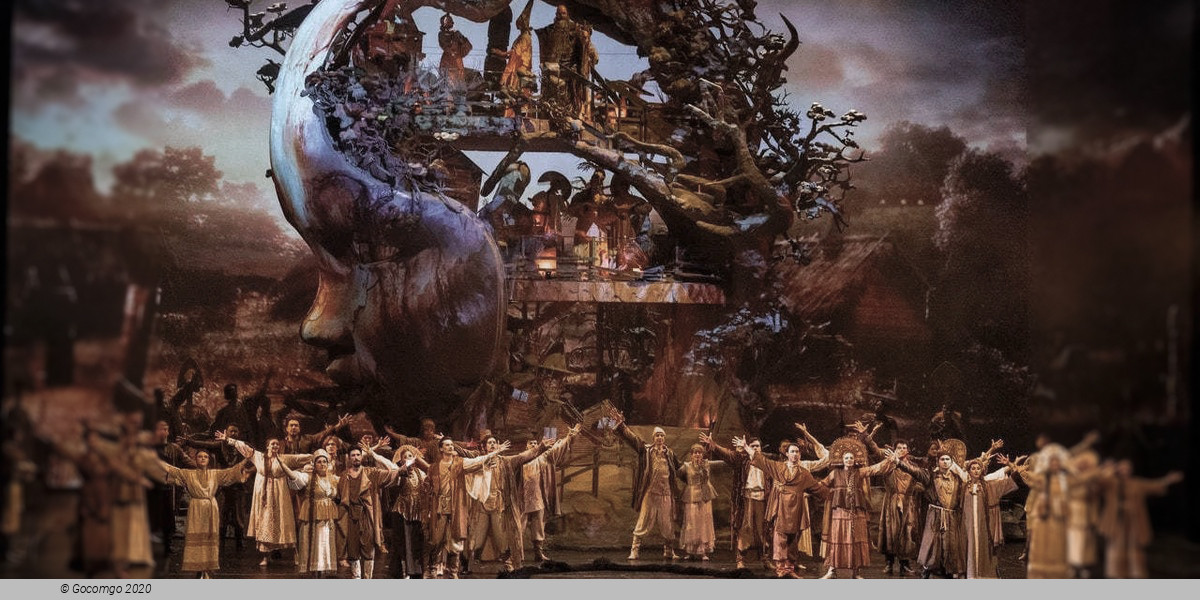
The first performance in history, created with the participation of artificial intelligence (libretto, set design, costumes)

Synopsis

Act I

In one of the Russian villages, on a sweltering summer evening, the people welcome the Pomors who have successfully returned from an expedition. The celebration of the hunters coincides with preparations for magical rites on the eve of Ivan Kupala Night. The villagers rejoice. The festival is attended by the wisest elder, Methodius, who sternly instructs the young to honor family traditions; the girls promise to cherish and respect their future husbands. The youth eagerly await the night of fortune-telling.

At the height of the festivities, a brave young man, Veles, also appears in the village. He is hopelessly in love with one of the maidens, Mlada. The young man is deeply saddened, as he feels no reciprocity from her. The men support their companion, praising his strength and kindness. The women, however, are in no hurry to give away the best bride in the village and suggest waiting until Ivan Kupala Night. As the sun sets, the celebrations end and the crowd disperses.

That evening, in a conversation between Mlada and her mother, Rosana, the girl’s secret is revealed. During fortune-telling, she was foretold a love that would come at the cost of another’s misfortune. This dreadful prophecy weighs heavily on her heart: she loves Veles but is forced to avoid him because of it. The long-awaited night of divination begins. Not only the people rejoice on Kupala Night — beings from other worlds also emerge from the waters onto fields and meadows.

Near the shore of the lake, the brave young man mourns. Mlada remains cold and indifferent, like the smooth surface of the lake that beckons on this night. Hearing Veles’s anguish, a drowned spirit named Sord rises from the parted waters, moved by the young man’s story. Long ago, he too suffered from unrequited love and went beneath the waters of the lake. The spirit reveals to Veles the secret of a plant capable of fulfilling any wish — the Mandrake, which can be obtained only on Ivan Kupala Night. Obsessed with the idea of enchanting his beloved, the young man sets off on his journey.

Forest sirin birds, spirits, and witches try to bar Veles’s path as he makes his way through twisted branches and roots into the depths of the forest, guarding the wondrous plant. But the brave man’s determination knows no bounds. Soon he reaches a forest clearing, where an astonishing sight opens before him — the glowing Mandrake. Overcome with joy, Veles pulls the plant out by its roots. The Mandrake emits a human cry and miraculously transforms into a beautiful maiden, who thanks her savior and vows to serve him faithfully.

Act II

Veles and the miracle maiden make their way back to the village through the dense forest. As the brave young man speaks of his love for Mlada and asks the Mandrake to awaken reciprocal feelings in his beloved, the Mandrake herself begins to see in him a strong and kind hero, to whom she irrevocably gives her own heart. Along the way, she suggests that Veles lie down and rest. Exhausted from the long journey, he falls asleep.

Guarding his sleep, the Mandrake recalls her own story: once she was turned into a plant as punishment for rejecting a young man who loved her passionately. Unable to bear the pain of unrequited love, he went beneath the waters of the lake. The Mandrake was condemned to loneliness in the depths of the dark forest until true love would save her soul — and now that moment has come. Veles is her only salvation and her love. Unable to restrain her feelings and unwilling to give him up to another, she performs a powerful magical rite over the sleeping hero and makes Veles fall in love with her.

The next morning, Mlada awakens with a troubled heart and tells her mother about an unsettling dream in which she saw Veles leading a bride by the hand, though she could not see the bride’s face. Their conversation is interrupted by the шум of mass festivities on the morning after Ivan Kupala Night. Sunlight increasingly floods Mlada’s room; outside, the noise gives way to joyful songs. Suddenly, startling news pierces the air: Veles, who was absent all night, is returning to the village with a bride of extraordinary beauty. Mlada’s heart bleeds — she realizes her dream was prophetic.

Mandrake and the brave young man enter the village and head to the elder to ask for his blessing on their union. Unable to endure any longer, Mlada confesses her deep love for Veles, whom she had once so cruelly rejected. She sees no meaning in life without him. Mandrake stops her, realizing that she has deprived her savior of happiness. Unwilling to stand in the way of true love, and understanding that genuine love is sacrifice, she lifts the spell from Veles at the cost of her own life.

Awakening, the brave man realizes that a beautiful being has perished out of love for him. Only a great soul could be capable of such a deed. He gives a posthumous promise to Mandrake — to marry Mlada. Veles carries Mandrake’s body to the lake. From the waters reappears the spirit Sord, whom she once rejected. The drowned spirit takes her lifeless body.

The people glorify the god Yarilo, honor the young couple, and perform the wedding ritual over them. Yet everything that has happened changes them all. In the midst of the wedding, Veles and Mlada can scarcely carry out the rites, struck by the magnitude of the sacrifice made in the name of love. Veles falls to his knees. The prophecy has come true.

Venue Info

Mariinsky Theatre - Saint Petersburg
Location   1 Theatre Square

The Mariinsky Theatre is a historic theatre of opera and ballet in Saint Petersburg, Russia. Opened in 1860, it became the preeminent music theatre of late 19th-century Russia, where many of the stage masterpieces of Tchaikovsky, Mussorgsky, and Rimsky-Korsakov received their premieres. Through most of the Soviet era, it was known as the Kirov Theatre. Today, the Mariinsky Theatre is home to the Mariinsky Ballet, Mariinsky Opera and Mariinsky Orchestra. Since Yuri Temirkanov's retirement in 1988, the conductor Valery Gergiev has served as the theatre's general director.

The theatre is named after Empress Maria Alexandrovna, wife of Tsar Alexander II. There is a bust of the Empress in the main entrance foyer. The theatre's name has changed throughout its history, reflecting the political climate of the time.

The theatre building is commonly called the Mariinsky Theatre. The companies that operate within it have for brand recognition purposes retained the Kirov name, acquired during the Soviet era to commemorate the assassinated Leningrad Communist Party leader Sergey Kirov (1886–1934).

The Imperial drama, opera and ballet troupe in Saint Petersburg was established in 1783, at the behest of Catherine the Great, although an Italian ballet troupe had performed at the Russian court since the early 18th century. Originally, the ballet and opera performances were given in the wooden Karl Knipper Theatre on Tsaritsa Meadow, near the present-day Tripartite Bridge (also known as the Little Theatre or the Maly Theatre). The Hermitage Theatre, next door to the Winter Palace, was used to host performances for an elite audience of aristocratic guests invited by the Empress.

A permanent theatre building for the new company of opera and ballet artists was designed by Antonio Rinaldi and opened in 1783. Known as the Imperial Bolshoi Kamenny Theatre the structure was situated on Carousel Square, which was renamed Theatre Square in honour of the building. Both names – "Kamenny" (Russian word for "stone") and "Bolshoi" (Russian word for "big") – were coined to distinguish it from the wooden Little Theatre. In 1836, the Bolshoi Kamenny Theatre was renovated to a design by Albert Cavos (son of Catterino Cavos, an opera composer), and served as the principal theatre of the Imperial Ballet and opera.

On 29 January 1849, the Equestrian circus (Конный цирк) opened on Theatre Square. This was also the work of the architect Cavos. The building was designed to double as a theatre. It was a wooden structure in the then-fashionable neo-Byzantine style. Ten years later, when this circus burnt down, Albert Cavos rebuilt it as an opera and ballet house with the largest stage in the world. With a seating capacity of 1,625 and a U-shaped Italian-style auditorium, the theatre opened on 2 October 1860, with a performance of A Life for the Tsar. The new theatre was named Mariinsky after its imperial patroness, Empress Maria Alexandrovna.

Under Yuri Temirkanov, Principal Conductor from 1976 to 1988, the Opera Company continued to stage innovative productions of both modern and classic Russian operas. Although functioning separately from the Theatre’s Ballet Company, since 1988 both companies have been under the artistic leadership of Valery Gergiev as Artistic Director of the entire Theatre.

The Opera Company has entered a new era of artistic excellence and creativity. Since 1993, Gergiev’s impact on opera there has been enormous. Firstly, he reorganized the company’s operations and established links with many of the world's great opera houses, including the Royal Opera House, Covent Garden, the Metropolitan Opera, the Opéra Bastille, La Scala, La Fenice, the Israeli Opera, the Washington National Opera and the San Francisco Opera. Today, the Opera Company regularly tours to most of these cities.

Gergiev has also been innovative as far as Russian opera is concerned: in 1989, there was an all-Mussorgsky festival featuring the composer’s entire operatic output. Similarly, many of Prokofiev’s operas were presented from the late 1990s. Operas by non-Russian composers began to be performed in their original languages, which helped the Opera Company to incorporate world trends. The annual international "Stars of the White Nights Festival" in Saint Petersburg, started by Gergiev in 1993, has also put the Mariinsky on the world’s cultural map. That year, as a salute to the imperial origins of the Mariinsky, Verdi's La forza del destino, which received its premiere in Saint Petersburg in 1862, was produced with its original sets, costumes and scenery. Since then, it has become a characteristic of the "White Nights Festival" to present the premieres from the company’s upcoming season during this magical period, when the hours of darkness practically disappear as the summer solstice approaches.

Presently, the Company lists on its roster 22 sopranos (of whom Anna Netrebko may be the best known); 13 mezzo-sopranos (with Olga Borodina familiar to US and European audiences); 23 tenors; eight baritones; and 14 basses. With Gergiev in charge overall, there is a Head of Stage Administration, a Stage Director, Stage Managers and Assistants, along with 14 accompanists.

Important Info
Type: Opera
City: Saint Petersburg, Russia
Starts at: 19:00
Acts: 2
Sung in: Russian
Titles in: Russian,English
Top of page