









Mariinsky Theatre 20 March 2020 - Beatrice di Tenda | GoComGo.com

Beatrice di Tenda

Mariinsky Theatre, Concert Hall, Saint Petersburg, Russia
All photos (2)
Select date and time
7 PM
Request for Tickets
Important Info
Type: Opera
City: Saint Petersburg, Russia
Starts at: 19:00
Acts: 2
Duration:
Sung in: Italian
Titles in: Russian

E-tickets: Print at home or at the box office of the event if so specified. You will find more information in your booking confirmation email.

You can only select the category, and not the exact seats.
If you order 2 or 3 tickets: your seats will be next to each other.
If you order 4 or more tickets: your seats will be next to each other, or, if this is not possible, we will provide a combination of groups of seats (at least in pairs, for example 2+2 or 2+3).

Overview

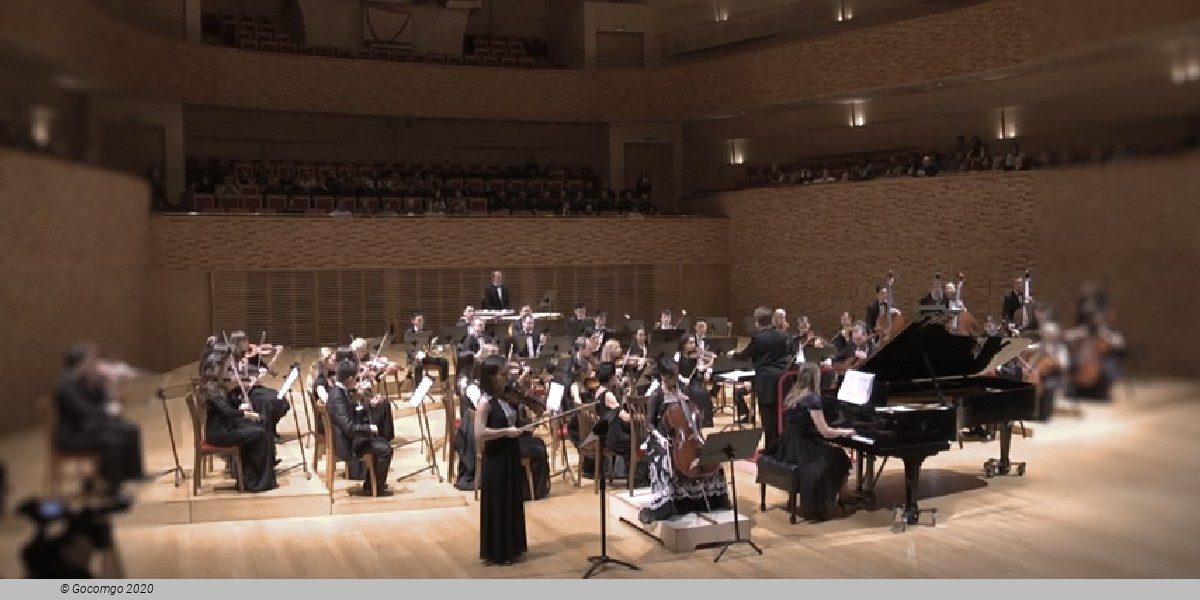
Opera in concert performance

History
Premiere of this production: 16 March 1833, La Fenice, Venice

Beatrice di Tenda is a tragic opera in two acts by Vincenzo Bellini, from a libretto by Felice Romani, after the play of the same name by Carlo Tedaldi Fores. This is the story of Beatrice Lascaris di Tenda, the woman who was the widow of the condottiere Facino Cane and later the wife of Duke Filippo Maria Visconti, in 15th-century Milan. Filippo has grown tired of his wife Beatrice; she regrets her impetuous marriage to him after her first husband's death, a marriage that has delivered her and her people into the Duke's tyrannical power.

Synopsis

Time: 1418
Place: The Castle of Binasco, near Milan

Act 1

Scene 1: "Internal courtyard of the Castle of Binasco. View of the facade of the illuminated palace"

Filippo Maria Visconti, the Duke of Milan, has attended a ball, but he leaves early and encounters his assembled courtiers. He is bored with everyone; all seem to be paying obeisance to his wife because they regard her as the more powerful, his title and power having come only from his marriage to her: “Such torment and such martyrdom I cannot bear much longer”. His sycophantic courtiers tell him how much they sympathize but wonder why he does not break free given his position as Duke. Also, they warn him that if he does not act, Beatrice's servants may well begin plotting against him.

Beautiful harp music is heard. Agnese, the current object of Filippo's desire, sings from afar that life is empty without love: (Aria: Agnese: Ah! Non pensar che pieno / "Ah! Don't believe that power brings fulfillment and joy"); then Filippo, who echoes her thoughts and states how much he loves her: (Aria:Riccardo: O divina Agnese! Come t'adoro e quanto / "Oh Agnes, I should want none but you.") Again, the courtiers encourage him to seize the moment and break free after which he will have many desirable women available to him. All leave.

Scene 2: "Agnese's quarters"

Agnese appears, this time singing for a yet-unnamed love: Aria: Silenzio – E notte intorno / "Silence and night all around. May the voice of the lute guide you to me, my love". As she hopes that the anonymous letter, which she has sent, and now her song will guide him to her arms, Orombello suddenly appears, but he is attracted only by the sounds of sweet music. Since the letter was written to him, she assumes an attraction to her on his part, and he is somewhat confused over this turn of events. Somewhat bluntly, she moves towards asking if he is in love, and he decides to confide in her. He confesses that he is deeply in love and, when asked about a letter which she assumes to be the one she wrote to him, he reveals that he had written to Beatrice. At that point, she realises that she has a rival: (Duet: Sì: rivale… rival regnante / "A royal rival"). Agnese's expectations collapse as Orombello reveals that it Beatrice with whom he is in love and he pleads for her to understand. She is furious; her tenderness turns to vitriol and in a dramatic finale, she explodes while he attempts to protect Beatrice's honour – and her life: (Duet: La sua vita? Ma la sola, ohime! / "Her life? My life means nothing to you?").

Scene 3: "A grove in the ducal garden"

Beatrice enters one of her secret places. She is relaxed: "Here I can breathe freely among these shady trees" she says, as her ladies appear, also happy to be in the sun. They try to comfort her and express their affection, but she describes her unhappiness by explaining that, once a flower has withered, when cut at its roots it cannot come back to life. Then, she expresses her real feelings of frustration against Filippo: (Aria: Ma la sola, oimė! son io, / che penar per lui si veda? / "Am I the only one to whom he has brought grief"? she asks) and feels her shame, to the sorrow of her ladies. In a finale, first Beatrice, then the ladies express their frustrations: (Cabaletta: Ah! la pena in lor piombò / "Ah, they have been punished for the love that ruined me").

Filippo sees them in the distance and, believing she is avoiding him, confronts her. He questions her, regarding her as unfaithful: "I can see your guilty thoughts", he says. In a duet, he admits that his jealousy is due to the power she has, but confronts her with proof of her support for her subjects' protests by producing some secret papers stolen from her apartment. She responds that she will listen to the peoples' complaints and confronts him: Se amar non puoi, rispettami / "If you cannot love me, respect me! At least leave my honour intact!"

Scene 4: "A remote part of the Castle of Binasco. At one side, the statue of Facino Cane (Beatrice's first husband)"

Filippo's soldiers are seeking Orombello and conclude that eventually either love or anger will cause him to give himself away and they must match his cunning. They continue the search.

Beatrice enters carrying a portrait of her beloved deceased husband, Facino. Aria: Il mio dolore, e l'ira... inutile ira / "My sorrow and anger, my futile anger I must hide from everyone" and she pleads with the Facino's spirit: "alone, unprotected, unarmed, I'm abandoned by everybody". "Not by me" a voice cries out—and it is Orombello who excitedly tells her his plans to rally the troops and help her free herself. She crushes him saying that she does not highly regard his expertise in security matters. Orombello tells of how his compassion was mistaken for love, but that he gradually came to love her and, as he kneels to protest his love and refusal to leave her, Filippo and Agnese enter, proclaiming the two traitors of having an affair. Filippo calls the guards, courtiers arrive, and all express their conflicting emotions in a scene finale with Filippo recognising that Beatrice's reputation is besmirched, she realises that "this shame is my due reward for making this wretch my equal", and Orombelo tries to persuade the Duke that she is innocent. The couple is taken away for trial for adultery.

Act 2
Scene 1: "Gallery in the Castle of Binasco ready for the sitting of a tribunal. Guards at the door"

In a major opening chorus, the courtiers learn from Beatrice's maids of the terrible torture that has been applied to Orombello and, "no longer able to withstand the atrocious suffering, he declared his guilt", thus implicating Beatrice. The Court is summoned and Anichino, Orombello's friend, pleads for Beatrice. Agnese declares that the "longed-for hour of my revenge has come" but, at the same time she is troubled. Filippo addresses the judges. Beatrice is brought in, and protests: "who gave you the right to judge me?" Orombello then appears and Beatrice is told that she has been denounced. "What do you expect to gain from lying?" she demands of him. He desperately seeks forgiveness from Beatrice: under torture "my mind became delirious, it was pain, not I that spoke" and he proclaims her innocence to the amazement of all. She forgives him and Beatrice regains her will to live.

Filippo is touched by her words: (Aria-to himself: In quegli atti, in quegli accenti / V'ha poter ch'io dir non posso / "In these actions and in these words there is a power I cannot explain"), but he quickly recovers and rejects weak-minded pity. Together, all express their individual feelings with Filippo ruthlessly pressing on while Agnese is remorseful. However, he does announce that the sentence shall be delayed.

The Court overrules him, stating that more torture should be applied until the truth is spoken. Again, Filippo changes his mind and supports the Court's decision. Agnese pleads with Filppo for Beatrice and Orombello, confessing her own behaviour in defaming them. The couple is led away, with Filippo and Agnese, full of remorse, left alone. She realises that things have gone much further than she had expected and begs Filippo to drop all the charges. However, not wishing to look weak, he dismisses the idea and orders her to leave.

Alone, Filippo wonders why others suffer remorse and he does not, but confesses that he is in the grip of terror. When Anichino announces that Beatrice has not broken under torture, but nevertheless, the court has condemned the couple to death, he brings the death warrant for signature. Filippo is even more conflicted, stating first that he must be firm and then remembering the joy he experienced with Beatrice: (Aria: Qui mi accolse oppresso, errante, / Qui dié fine a mie sventure... / "She welcomed me here, oppressed and homeless, here she put an end to my misfortunes. I am repaying her love with torture")

Filippo declares to all who have now assembled that Beatrice shall live, but courtiers announce that troops loyal to Beatrice and to the late condottiere Facino are about to storm the walls. Hearing this, he signs the execution order and tries to justify his actions to the crowd, blaming Beatrice's behaviour: (cabaletta finale: Non son'io che la condanno; / Ė la sua, l'altrui baldanza. / "It is not only I who condemn her, but her own and others' audacity...Two realms cannot be united while she lives.")

Scene 2: "Ground level vestibule above the castle prisons. Beatrice's maidens and servants emerge from the cells. All are mourning. Sentinels everywhere"

Beatrice's ladies gather outside the cell while Beatrice prays. In her cell, she affirms that she said nothing under torture: (Aria: Nulla diss'io...Di sovrumana forza / Mi armava il cielo... Io nulla dissi, oh, gioja / "I said nothing! Heaven gave me superhuman strength. I said nothing..."). Agnese enters and confesses that it was she who instigated, through jealousy, the plot to accuse the couple. She explains that she was in love with Orombello and that she believed Beatrice to be her rival. From his cell, Orombello's voice is heard (Aria: Angiol di pace / "Angel of peace"). Along with the two women, he forgives Agnese as does Beatrice. Agnese leaves and Beatrice declares herself to be ready for death. (Aria finale: Deh! se un'urna ė a me concessa / Senza un fior non la lasciate / "Oh, if I'm vouchsafed a tomb, Leave it not bare of flowers".) Anicino and the ladies lament; in a spirited finale, Beatrice declares "the death that I am approaching is a triumph not defeat. I leave my sorrows back on earth."

Venue Info

Mariinsky Theatre - Saint Petersburg
Location   1 Theatre Square

The Mariinsky Theatre is a historic theatre of opera and ballet in Saint Petersburg, Russia. Opened in 1860, it became the preeminent music theatre of late 19th-century Russia, where many of the stage masterpieces of Tchaikovsky, Mussorgsky, and Rimsky-Korsakov received their premieres. Through most of the Soviet era, it was known as the Kirov Theatre. Today, the Mariinsky Theatre is home to the Mariinsky Ballet, Mariinsky Opera and Mariinsky Orchestra. Since Yuri Temirkanov's retirement in 1988, the conductor Valery Gergiev has served as the theatre's general director.

The theatre is named after Empress Maria Alexandrovna, wife of Tsar Alexander II. There is a bust of the Empress in the main entrance foyer. The theatre's name has changed throughout its history, reflecting the political climate of the time.

The theatre building is commonly called the Mariinsky Theatre. The companies that operate within it have for brand recognition purposes retained the Kirov name, acquired during the Soviet era to commemorate the assassinated Leningrad Communist Party leader Sergey Kirov (1886–1934).

The Imperial drama, opera and ballet troupe in Saint Petersburg was established in 1783, at the behest of Catherine the Great, although an Italian ballet troupe had performed at the Russian court since the early 18th century. Originally, the ballet and opera performances were given in the wooden Karl Knipper Theatre on Tsaritsa Meadow, near the present-day Tripartite Bridge (also known as the Little Theatre or the Maly Theatre). The Hermitage Theatre, next door to the Winter Palace, was used to host performances for an elite audience of aristocratic guests invited by the Empress.

A permanent theatre building for the new company of opera and ballet artists was designed by Antonio Rinaldi and opened in 1783. Known as the Imperial Bolshoi Kamenny Theatre the structure was situated on Carousel Square, which was renamed Theatre Square in honour of the building. Both names – "Kamenny" (Russian word for "stone") and "Bolshoi" (Russian word for "big") – were coined to distinguish it from the wooden Little Theatre. In 1836, the Bolshoi Kamenny Theatre was renovated to a design by Albert Cavos (son of Catterino Cavos, an opera composer), and served as the principal theatre of the Imperial Ballet and opera.

On 29 January 1849, the Equestrian circus (Конный цирк) opened on Theatre Square. This was also the work of the architect Cavos. The building was designed to double as a theatre. It was a wooden structure in the then-fashionable neo-Byzantine style. Ten years later, when this circus burnt down, Albert Cavos rebuilt it as an opera and ballet house with the largest stage in the world. With a seating capacity of 1,625 and a U-shaped Italian-style auditorium, the theatre opened on 2 October 1860, with a performance of A Life for the Tsar. The new theatre was named Mariinsky after its imperial patroness, Empress Maria Alexandrovna.

Under Yuri Temirkanov, Principal Conductor from 1976 to 1988, the Opera Company continued to stage innovative productions of both modern and classic Russian operas. Although functioning separately from the Theatre’s Ballet Company, since 1988 both companies have been under the artistic leadership of Valery Gergiev as Artistic Director of the entire Theatre.

The Opera Company has entered a new era of artistic excellence and creativity. Since 1993, Gergiev’s impact on opera there has been enormous. Firstly, he reorganized the company’s operations and established links with many of the world's great opera houses, including the Royal Opera House, Covent Garden, the Metropolitan Opera, the Opéra Bastille, La Scala, La Fenice, the Israeli Opera, the Washington National Opera and the San Francisco Opera. Today, the Opera Company regularly tours to most of these cities.

Gergiev has also been innovative as far as Russian opera is concerned: in 1989, there was an all-Mussorgsky festival featuring the composer’s entire operatic output. Similarly, many of Prokofiev’s operas were presented from the late 1990s. Operas by non-Russian composers began to be performed in their original languages, which helped the Opera Company to incorporate world trends. The annual international "Stars of the White Nights Festival" in Saint Petersburg, started by Gergiev in 1993, has also put the Mariinsky on the world’s cultural map. That year, as a salute to the imperial origins of the Mariinsky, Verdi's La forza del destino, which received its premiere in Saint Petersburg in 1862, was produced with its original sets, costumes and scenery. Since then, it has become a characteristic of the "White Nights Festival" to present the premieres from the company’s upcoming season during this magical period, when the hours of darkness practically disappear as the summer solstice approaches.

Presently, the Company lists on its roster 22 sopranos (of whom Anna Netrebko may be the best known); 13 mezzo-sopranos (with Olga Borodina familiar to US and European audiences); 23 tenors; eight baritones; and 14 basses. With Gergiev in charge overall, there is a Head of Stage Administration, a Stage Director, Stage Managers and Assistants, along with 14 accompanists.

Important Info
Type: Opera
City: Saint Petersburg, Russia
Starts at: 19:00
Acts: 2
Duration:
Sung in: Italian
Titles in: Russian
Top of page