
Beijing National Grand Theater (NCPA) 10 December 2023 - Zhang Guoyong, Leonidas Kavakos and China Philharmonic Orchestra | GoComGo.com

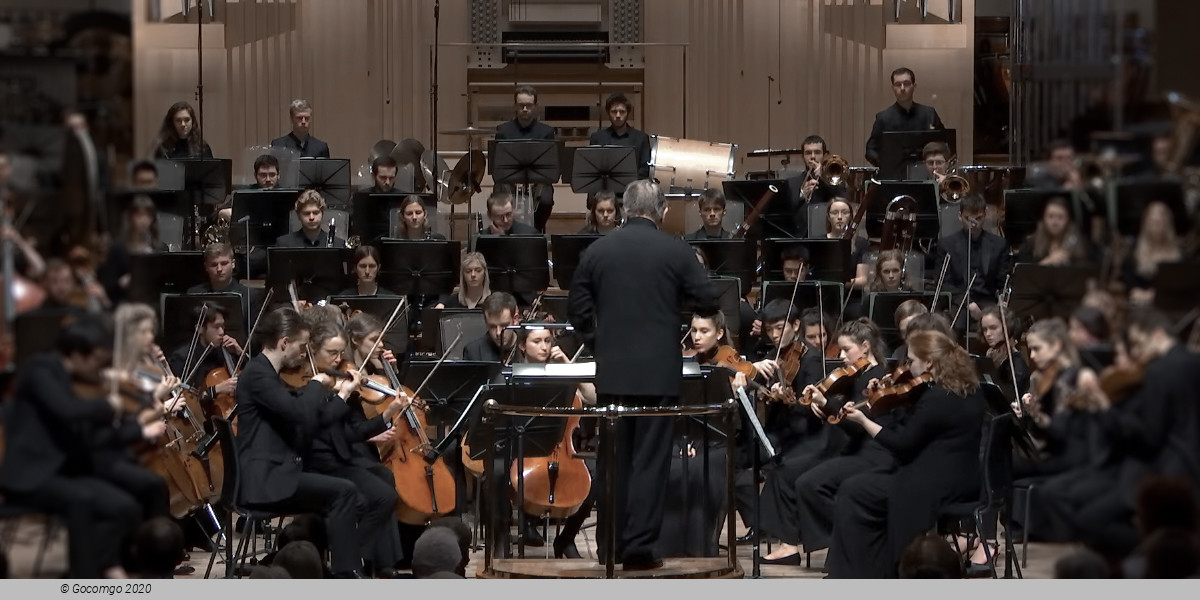
Zhang Guoyong, Leonidas Kavakos and China Philharmonic Orchestra

Beijing National Grand Theater (NCPA), Concert Hall, Beijing, China
All photos (1)
Select date and time
7:30 PM
Request for Tickets
Important Info
Type: Classical Concert
City: Beijing, China
Starts at: 19:30

E-tickets: Print at home or at the box office of the event if so specified. You will find more information in your booking confirmation email.

You can only select the category, and not the exact seats.
If you order 2 or 3 tickets: your seats will be next to each other.
If you order 4 or more tickets: your seats will be next to each other, or, if this is not possible, we will provide a combination of groups of seats (at least in pairs, for example 2+2 or 2+3).

Programme
Overview

ZHANG Guoyong is a renowned Chinese conductor and music educator. He graduated from the Conducting Department of the Shanghai Conservatory of Music in 1983 and was awarded the doctorate in music by the Tchaikovsky Moscow State Conservatory in 1997. He successively studied with the Chinese conductor and music educator Prof. HUANG Xiaotong and the world-renowned master conductor Rozhdestvensky. He is Professor and Head of the Conducting Department of the Shanghai Conservatory of Music, Principal Conductor of the Shanghai Opera House and Music Director of the Qingdao Symphony Orchestra.

During ZHANG’s many years of artistic career, he has conducted classical works covering operas, ballets, and symphonic choruses in cooperation with many famous opera houses and symphony orchestras at home and abroad. He is particularly adept at conducting Russian works. He is recognized as one of the best interpreters of Shostakovich’s symphonies in China.

ZHANG’s conducting style is clean, natural and soulful with a passion complemented by a profound rationality, resulting in a strong artistic tension appealing to the audiences. With his keen ear, excellent skills, effective rehearsal methods and comprehensive grasp of the structure of the works, he impresses orchestras and audiences every time he appears on the stage.

In recent years, he has acted as China’s cultural ambassador in many major international cultural exchange events, representing the country in the Year of Culture activities co-hosted with the U.S., Russia, Germany, Italy, France and Latin America.

In 2014, ZHANG conducted the critically acclaimed HD opera film Carmen and Rickshaw Boy produced by the NCPA. In 2015, he was invited by the NCPA to participate in the Italian tour of Chinese operas. In the next year, he conducted the China Philharmonic Orchestra in its successful Russian debut, receiving wide acclaim.

In 2016, he was invited to be a member of the jury of the 8th Cadaqués Orchestra International Conducting Competition in Spain.

ZHANG’s mentor Rozhdestvensky once told music critics excitedly, “I gave ZHANG Guoyong the highest marks ever awarded by the conducting department of Tchaikovsky Moscow State Conservatory. He could find his place in any orchestra in the world.”

ZHANG is Vice-Chairman of the Shanghai Musicians Association and Vice-Chairman of the China Musicians Association.

Leonidas Kavakos 

Leonidas Kavakos is recognized across the world as a violinist and artist of rare quality, acclaimed for his matchless technique, his captivating artistry and his superb musicianship as well as for the integrity of his playing. He works with the world’s greatest orchestras and conductors and plays as recitalist in the world’s premier recital halls and festivals. He is an exclusive recording artist with Sony Classical.

The three important mentors in his life have been Stelios Kafantaris, Josef Gingold, and Ferenc Rados, with whom he still works. By the age of 21, Leonidas Kavakos had already won three major competitions: the Sibelius Competition in 1985, and the Paganini and Naumburg competitions in 1988. This success led to him recording the original Sibelius Violin Concerto (1903/4), the first recording of this work in history, and which won Gramophone Concerto of the Year Award in 1991.

Kavakos is now an exclusive recording artist with Sony Classics. His latest recording, to be released worldwide in October 2019 in anticipation of the 250th anniversary of Beethoven’s birth in 2020, is the Beethoven Violin Concerto which he conducted and played with the Bavarian Radio Symphony Orchestra, coupled with the Beethoven Septet played with members of the orchestra. In the anniversary year, Kavakos will both play and play/conduct the Beethoven Violin Concerto with orchestras across Europe and the USA. He will also play the complete Beethoven Sonata cycle in Shanghai and Guangzhou, Milan and Rome, and a number of single Beethoven recitals in various cities including London’s Wigmore Hall, Barcelona, Parma and Copenhagen.

In 2007, for his recording of the complete Beethoven Sonatas with Enrico Pace, Kavakos was named Echo Klassik Instrumentalist of the year. In 2014, Kavakos was awarded Gramophone Artist of the Year.

Further accolades came in 2017 when Kavakos was awarded the prestigious Leonie Sonning Prize – Denmark’s highest musical honour, given annually to an internationally recognised composer, conductor, instrumentalist or singer. Previous winners include Daniel Barenboim, Leonard Bernstein, Pierre Boulez, Alfred Brendel, Benjamin Britten, Dietrich Fischer-Dieskau, Yehudi Menuhin, Simon Rattle, Mstislav Rostropovich, Arthur Rubenstein and Dmitri Shostakovich.

August 2019 was a full and rewarding month: after the Verbier Festival where he appeared in recital with Evgent Kissin and conducted the Verbier Festival Chamber Orchestra in a programme in which he played Mozart’s Sinfonia Concertante with Antoine Tamestit, he joined YoYo Ma and Emanuel Ax at the Tanglewood Music Festival for a programme of Beethoven Piano trios, in a duo recital with Ax of Beethoven Sonatas, and in an orchestral concert with the Boston Symphony in which he played and conducted Beethoven’s Violin Concerto and Dvořák Symphony No. 7.

Kavakos was also invited as Artiste Etoile at the Lucerne Festival where he appeared with the Lucerne Festival Orchestra with Yannick Nézet-Séguin, Mariinsky Orchestra with Valery Gergiev, Vienna Philharmonic with Andrés Orozco-Estrada, and in recital with Yuja Wang.

In the 2019/20 season, in addition to concerts with major orchestras in Europe and the United States, Kavakos will once again join Yo-yo Ma and Emanuel Ax for three programmes in Carnegie Hall comprising Beethoven trios and sonatas. He will undertake two Asian tours, first as soloist with the Singapore Symphony and Seoul Philharmonic and in recital in the NCPA Beijing, and then in the spring he performs with the Hong Kong Philharmonic and Taiwan Symphony Orchestra, prior to playing Beethoven Sonata Cycles in Shanghai and Guangzhou with Enrico Pace.

In recent years, Kavakos has succeeded in building a strong profile as a conductor and has conducted the London Symphony Orchestra, New York Philharmonic, Houston Symphony, Dallas Symphony, Gürzenich Orchester, Budapest Festival Orchestra, Vienna Symphony, Chamber Orchestra of Europe, Orchestra dell’Accademia Nazionale di Santa Cecilia, Maggio Musicale Fiorentino, Filarmonica Teatro La Fenice, and the Danish National Symphony Orchestra. In the forthcoming season he will return to two orchestras where he has developed close ties as both violinist and conductor: L’Orchestre de la Suisse Romande and L’Orchestre Philharmonique de Radio France. This season he also play/conducts the Czech Philharmonic, Deutsches Symphonie-Orchester Berlin, and the Orchestra Sinfonica Nazionale della RAI.

Born and brought up in a musical family in Athens, Kavakos curates an annual violin and chamber-music masterclass in Athens, which attracts violinists and ensembles from all over the world and reflects his deep commitment to the handing on of musical knowledge and traditions. Part of this tradition is the art of violin and bow-making, which Kavakos regards as a great mystery and to this day, an undisclosed secret. He plays the "Willemotte" Stradivarius violin of 1734 and owns modern violins made by F. Leonhard, S. P. Greiner, E. Haahti and D. Bagué.

Venue Info

Beijing National Grand Theater (NCPA) - Beijing
Location   2 W Chang'an Ave

The National Centre for the Performing Arts (NCPA) is an arts centre containing an opera house in Beijing, People's Republic of China. The Centre, an ellipsoid dome of titanium and glass surrounded by an artificial lake, seats 5,452 people in three halls and is almost 12,000 m² in size. It was designed by French architect Paul Andreu. Construction started in December 2001 and the inaugural concert was held in December 2007.

The exterior of the theater is a titanium-accented glass dome that is completely surrounded by a man-made lake. It is said to look like an egg floating on water, or a water drop. It was designed as an iconic feature, something that would be immediately recognizable.

The dome measures 212 meters in east–west direction, 144 meters in north–south direction, and is 46 meters high. The main entrance is at the north side. Guests arrive in the building after walking through a hallway that goes underneath the lake. The titanium shell is broken by a glass curtain in north–south direction that gradually widens from top to bottom.

The location, immediately to the west of Tiananmen Square and the Great Hall of the People, and near the Forbidden City, combined with the theatre's futuristic design, created considerable controversy. Paul Andreu countered that although there is indeed value in ancient traditional Chinese architecture, Beijing must also include modern architecture, as the capital of the country and an international city of great importance. His design, with large open space, water, trees, was specially designed to complement the red walls of ancient buildings and the Great Hall of the People, in order to melt into the surroundings as opposed to standing out against them.

Internally, there are three major performance halls:

The Opera Hall is used for operas, ballet, and dances and seats 2,416 people.
The Music Hall is used for concerts and recitals and seats 2,017 people.
The Theatre Hall is used for plays and the Beijing opera. It has 1,040 seats.
The NCPA also distributes filmed and recorded performances of its concerts, plays and operas through the in-house label NCPA Classics, established in 2016.

The initial planned cost of the theatre was 2.688 billion yuan. When the construction had completed, the total cost rose to more than CNY3.2 billion. The major cause of the cost increase was a delay for reevaluation and subsequent minor changes as a precaution after a Paris airport terminal building collapsed. The cost has been a major source of controversy because many believed that it is nearly impossible to recover the investment. When the cost is averaged out, each seat is worth about half a million CNY. The Chinese government answered that the theater is not a for profit venture.

The government sanctioned study completed in 2004 by the Research Academy of Economic & Social Development of the Dongbei University of Finance and Economics, of the upkeep costs of the building were publicized in domestic Chinese media:

The water and electricity bills and the cleaning cost for the external surface would be at least tens of millions CNY, and with another maintenance cost, the total could easily exceed one billion CNY. Therefore, at least 80 percent of the annual operational costs must be subsidized by the government for at least the first three years after the opening, and for the rest of its operational life, at least 60 percent of the annual operational cost must be subsidized by the government.

The director of the art committee of the National Centre for the Performing Arts and the standing committee member of the Standing Committee of the Chinese People's Political Consultative Conference, Mr Wu Zuqiang (吴祖强) and the publicist / deputy director of the National Centre for the Performing Arts Mr Deng (邓一江) have announced that 70 percent of the tickets would be sold at low price for ordinary citizens, while 10% of the tickets would be sold at relatively expensive prices for separate market segments, and the 60% of annual operating cost needed to be subsidized by the government would be divided between the central government and the Beijing municipal government.

Important Info
Type: Classical Concert
City: Beijing, China
Starts at: 19:30
Top of page