
Beijing National Grand Theater (NCPA) 17 April 2024 - Xu Zhijun and National Traditional Orchestra Academia China | GoComGo.com

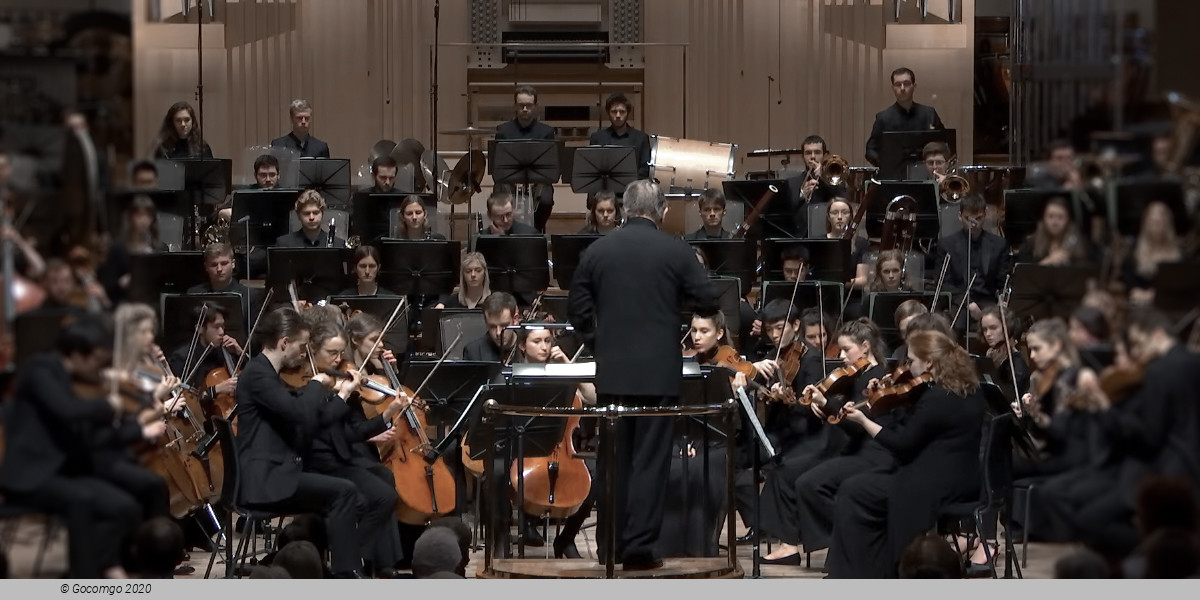
Xu Zhijun and National Traditional Orchestra Academia China

Beijing National Grand Theater (NCPA), Concert Hall, Beijing, China
All photos (1)
Select date and time

E-tickets: Print at home or at the box office of the event if so specified. You will find more information in your booking confirmation email.

You can only select the category, and not the exact seats.
If you order 2 or 3 tickets: your seats will be next to each other.
If you order 4 or more tickets: your seats will be next to each other, or, if this is not possible, we will provide a combination of groups of seats (at least in pairs, for example 2+2 or 2+3).

Important Info
Type: Classical Concert
City: Beijing, China
Starts at: 19:30

E-tickets: Print at home or at the box office of the event if so specified. You will find more information in your booking confirmation email.

You can only select the category, and not the exact seats.
If you order 2 or 3 tickets: your seats will be next to each other.
If you order 4 or more tickets: your seats will be next to each other, or, if this is not possible, we will provide a combination of groups of seats (at least in pairs, for example 2+2 or 2+3).

Programme
Overview

The 2nd Spring of Traditional Chinese Music

XU Zhijun

XU Zhijun is Director of the Department of Chinese Music, China Conservatory of Music, Managing Director and Chief Conductor of the China Chinese Music Orchestra, and Vice Chairman of Chorus China.

As a famous conductor active in today’s music scene, XU Zhijun works with many orchestras and opera houses both at home and abroad. He has visited many countries and regions with the orchestra, including Europe, Asia, the United States and Africa, where the orchestra gave performances under his baton at some well-known concert halls, including the Lincoln Center, New York, Théâtre des Champs-Élysées, Paris, Amsterdam Concertgebouw, Mariinsky Theatre, St. Petersburg, Ancient Theatre of Acropolis of Athens, and etc.

XU Zhijun waves his baton in an elegant and gracious manner, looking like something strongly rhythmic and contagious. Benefiting from his studies and training on professional composition, he has a profound and accurate understanding of the musical content and structure, as well as the composers’ creative ideas. He can conduct a wide range of music genres, including opera, symphony, traditional orchestral music, choral music, traditional symphonic opera, and etc.

Since 1991, when he conducted the premiere of the China National Opera House opera commission Marco Polo, XU Zhijun has been conducting the premiere of many other operas, dance dramas and traditional symphonic opera, including operas YuniangFishing TownMissile CommanderGoing HomeSnowy PlainThe HeroDustChasing the Moon, and ZHUO Wenjun, dance drama Mulan, symphonic Peking opera ZHENG He’s Voyages, symphonic Xi opera The Wandering Songstress, and etc.

XU Zhijun used to be a member of the All-China Youth Federation, a director of the China Musicians Association, a principal conductor of the China National Opera House, and a principal conductor of the China National Traditional Orchestra. He attended the Symposium on “Virtue and Art” at the invitation of the China Federation of Literary and Art Circles. He has served as a jury member for the “Golden Bell Award” many times, as well as for other national composition, instrumental performance and chorus competitions.

National Traditional Orchestra Academia China

The National Traditional Orchestra Academia China is the core project of the Beijing Advanced Innovation Centre for Chinese National School of Music. Relying on the strengths of the Global Music Education League, the orchestra is open to professional Chinese instrumentalists from both at home and abroad and aims to build itself into an orchestra with world-class artistic standards. The orchestra’s mission is to explore the innovative development of musical theory, composition and performance of Chinese music, to interpret classical Chinese pieces, to spread the voice of China, to tell the story of China and to showcase the excellent Chinese culture to the world. The orchestra will help the China Conservatory of Music build first-class schools and disciplines, helping it to become a high-level, research-oriented university and promoting the five-in-one concerted development covering talent training, academic research, social services, cultural heritage and international exchanges, thus contributing to the construction of the China Conservatory of Music as a world class university.

Professor WANG Liguang, renowned composer and President of the China Conservatory of Music, is the artistic director of the orchestra, and Professor XU Zhijun, renowned conductor and Head of the Chinese Instruments Department of the China Conservatory of Music, is the principal conductor and head of the orchestra.

Venue Info

Beijing National Grand Theater (NCPA) - Beijing
Location   2 W Chang'an Ave

The National Centre for the Performing Arts (NCPA) is an arts centre containing an opera house in Beijing, People's Republic of China. The Centre, an ellipsoid dome of titanium and glass surrounded by an artificial lake, seats 5,452 people in three halls and is almost 12,000 m² in size. It was designed by French architect Paul Andreu. Construction started in December 2001 and the inaugural concert was held in December 2007.

The exterior of the theater is a titanium-accented glass dome that is completely surrounded by a man-made lake. It is said to look like an egg floating on water, or a water drop. It was designed as an iconic feature, something that would be immediately recognizable.

The dome measures 212 meters in east–west direction, 144 meters in north–south direction, and is 46 meters high. The main entrance is at the north side. Guests arrive in the building after walking through a hallway that goes underneath the lake. The titanium shell is broken by a glass curtain in north–south direction that gradually widens from top to bottom.

The location, immediately to the west of Tiananmen Square and the Great Hall of the People, and near the Forbidden City, combined with the theatre's futuristic design, created considerable controversy. Paul Andreu countered that although there is indeed value in ancient traditional Chinese architecture, Beijing must also include modern architecture, as the capital of the country and an international city of great importance. His design, with large open space, water, trees, was specially designed to complement the red walls of ancient buildings and the Great Hall of the People, in order to melt into the surroundings as opposed to standing out against them.

Internally, there are three major performance halls:

The Opera Hall is used for operas, ballet, and dances and seats 2,416 people.
The Music Hall is used for concerts and recitals and seats 2,017 people.
The Theatre Hall is used for plays and the Beijing opera. It has 1,040 seats.
The NCPA also distributes filmed and recorded performances of its concerts, plays and operas through the in-house label NCPA Classics, established in 2016.

The initial planned cost of the theatre was 2.688 billion yuan. When the construction had completed, the total cost rose to more than CNY3.2 billion. The major cause of the cost increase was a delay for reevaluation and subsequent minor changes as a precaution after a Paris airport terminal building collapsed. The cost has been a major source of controversy because many believed that it is nearly impossible to recover the investment. When the cost is averaged out, each seat is worth about half a million CNY. The Chinese government answered that the theater is not a for profit venture.

The government sanctioned study completed in 2004 by the Research Academy of Economic & Social Development of the Dongbei University of Finance and Economics, of the upkeep costs of the building were publicized in domestic Chinese media:

The water and electricity bills and the cleaning cost for the external surface would be at least tens of millions CNY, and with another maintenance cost, the total could easily exceed one billion CNY. Therefore, at least 80 percent of the annual operational costs must be subsidized by the government for at least the first three years after the opening, and for the rest of its operational life, at least 60 percent of the annual operational cost must be subsidized by the government.

The director of the art committee of the National Centre for the Performing Arts and the standing committee member of the Standing Committee of the Chinese People's Political Consultative Conference, Mr Wu Zuqiang (吴祖强) and the publicist / deputy director of the National Centre for the Performing Arts Mr Deng (邓一江) have announced that 70 percent of the tickets would be sold at low price for ordinary citizens, while 10% of the tickets would be sold at relatively expensive prices for separate market segments, and the 60% of annual operating cost needed to be subsidized by the government would be divided between the central government and the Beijing municipal government.

Important Info
Type: Classical Concert
City: Beijing, China
Starts at: 19:30
Top of page