









Beijing National Grand Theater (NCPA) 26 July 2023 - The Bolshoi Ballet Gala | GoComGo.com

The Bolshoi Ballet Gala

Beijing National Grand Theater (NCPA), Opera House, Beijing, China
All photos (1)
Select date and time
7:30 PM

E-tickets: Print at home or at the box office of the event if so specified. You will find more information in your booking confirmation email.

You can only select the category, and not the exact seats.
If you order 2 or 3 tickets: your seats will be next to each other.
If you order 4 or more tickets: your seats will be next to each other, or, if this is not possible, we will provide a combination of groups of seats (at least in pairs, for example 2+2 or 2+3).

Important Info
Type: Ballet
City: Beijing, China
Starts at: 19:30

E-tickets: Print at home or at the box office of the event if so specified. You will find more information in your booking confirmation email.

You can only select the category, and not the exact seats.
If you order 2 or 3 tickets: your seats will be next to each other.
If you order 4 or more tickets: your seats will be next to each other, or, if this is not possible, we will provide a combination of groups of seats (at least in pairs, for example 2+2 or 2+3).

Overview

The Bolshoi Ballet Gala programme introduces the divertissement with several of the most brilliant pieces from the Bolshoi Theatre’s repertoire which has been formed during a few centuries. The Gala presents the pieces from the early ballets as well as the Soviet classics.

Pas de deux from the ballet The Talisman

The Talisman is one of the most popular ballets of the Imperial Theatres and narrates about love between the heavenly goddess and a human being. After the Great October Revolution in 1917 the ballet was lost, but it was revived in 1950s. This ballet gave rise to the so-called Talisman Pas de Deux, which is today danced by many ballet companies.

Music: Riccardo Drigo
Choreographer: Marius Petipa
Performers: Anastasia Stashkevich, Vyacheslav Lopatin

Adagio from the ballet Romeo and Juliet
Romeo and Juliette was created by the choreographer Leonid Lavrovsky in collaboration with the composer Sergey Prokofiev. It was premiered in 1940 at the Kirov Theatre of Opera and Ballet (now the Mariinsky Theatre) with Galina Ulanova and Konstantin Sergeev in the leading roles. This production received the international acclaim and established the ballet tradition of reading Shakespeare’s tragedies which was followed by Frederick Ashton, John Cranco, Sir Kenneth MacMillan, John Neumeier, Rudolf Nureev and many other choreographers.

Music: Sergey Prokofiev
Choreographer: Leonid Lavrovsky
Performers: Eleonora Sevenard, Artemy Belyakov

Pas de deux from the ballet The Sleeping Beauty
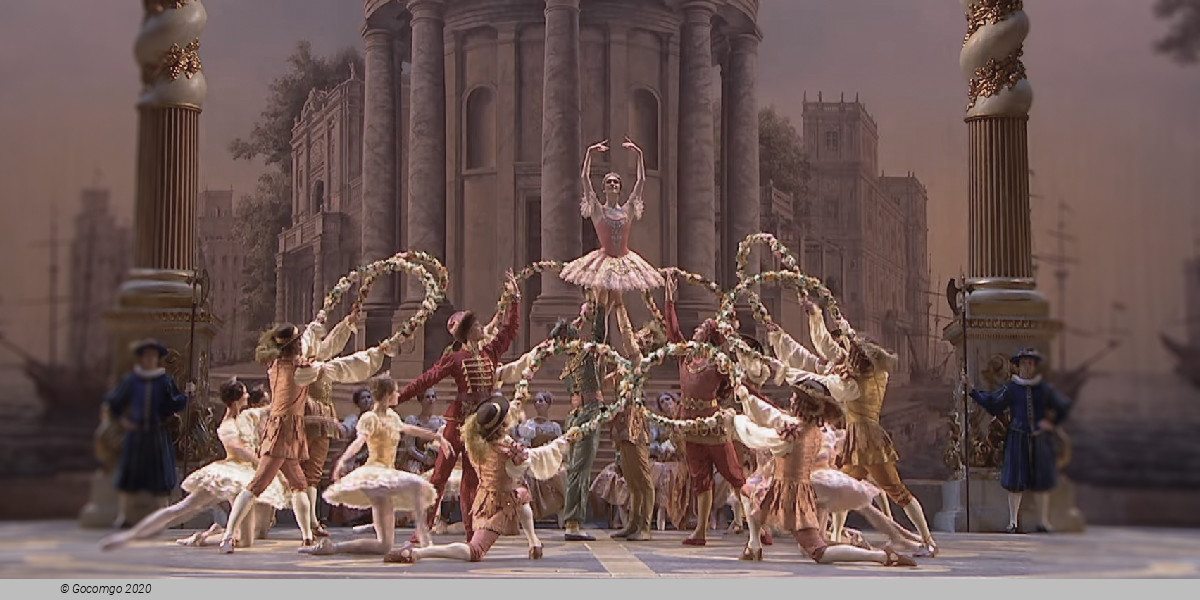
The Sleeping Beauty is an encyclopedia of classical ballet. The premiere took place at the Mariinsky Theatre in St. Petersburg in 1890, and from that year forward The Sleeping Beauty has remained one of the most famous of all ballets. It is based on the classical fairy tale by Charles Perrault about a princess cursed by an evil fairy to sleep for a hundred years before being awakened by a handsome prince. In the ballet the wonderful world of Princess Aurora is associated with the French Court of the Lois XII era; while the world of Prince Desire is associated with the Lois XIV era and the Versailles Palace. Yury Grigorovich, the Bolshoi’s choreographer, presented the new choreographic version of The Sleeping Beauty for the opening of the Bolshoi’s Historic Stage after its renovation in 2011.


Music: Pyotr Tchaikovsky
Choreographer: Marius Petipa
Choreographer of New Version: Yuri Grigorovich
Performers: Anna Nikulina, Artem Ovcharenko

Monologue of Phrygia and Adagio of Spartacus and Phrygia from the 3rd act of the ballet Spartacus
Spartacus by Yury Grigorovich is the visiting card of the Bolshoi Theatre. Premiered in 1968, it has still been in the Bolshoi’s repertory as one of the most prominent and spectacular ballets. The themes of heroism, struggle and devoted love are closely intertwined in the ballet. The scene of the Adagio of Phrygia and Spartacus is one of the most inspiring pieces of the ballet, an enthusiastic lyrical hymn of loyalty and love.

Music: Aram Khachaturian
Choreographer: Yuri Grigorovich
Performers: Maria Vinogradova, Mikhail Lobukhin

Pas de deux from the ballet The Flames of Paris

The Flames of Paris is devoted to the French Revolution. It is based on the novel by Felix Gras The Marseillais. In the ballet the folk areal scenes alternate with the scenes of the courtiers of Versailles. The famous Pas de Deux of Jeanne and Philippe is staged in the Soviet heroic style and is still being performed in the original choreography by Vasily Vainonen.

Music: Boris Asafyev
Choreographer: Vasily Vainonnen
Choreographer of New Version: Alexei Ratmansky
Performers: Maria Koshkareva, Igor Tsvirko

Pas de deux from the 2nd act of the ballet The Swan Lake

The Swan Lake is a visiting card of the Russian ballet. Pyotr Ilyich Tchaikovsky composed it by the order of the Directorate of the Imperial Theatres. The ballet was premiered by the Bolshoi Ballet in 1877 at the Bolshoi Theatre in Moscow. It was revived by Lev Ivanov and Marius Petipa at the Mariinsky Theatre in St. Petersburg in memory of the composer. There are a lot of versions of the ballet about love between a swan girl and a prince, but one of the most famous was choreographed by Yuri Grigorovich at the Bolshoi Theatre in 1969. The famous Pas de Deux is the key moment of the ballet.

Music: Pyotr Tchaikovsky
Choreographer: Yuri Grigorovich
Performers: Alyona Kovalyova, Artemy Belyakov

Spring Waters

Spring Waters created in 1959 by Asaf Messerer, the choreographer and former chief soloist with the celebrated Bolshoi Ballet, is one of the most complicated ballet duets. It’s an energetic and ethereal Pas de Deux that conjures up the first days of spring and celebrates life renewal. Recognized for its highly athletic factor, this short piece features the agility of dancers in a choreography that is literally astounding.


Music: Sergey Rachmaninov
Choreographer: Asaf Messerer
Performers: Anastasia Stashkevich, Vyacheslav Lopatin
 

Pas de deux of Diana and Acteon from the ballet Esmeralda

One can rarely see the ballet Esmeralda on the modern ballet stage, but Diana and Acteon Pas de Deux enjoys a lot of love. It illustrates the classical Greek myth about Diana, the goddess of hunting, and Acteon, a young hunter, blinded by Diana’s beauty. In 1930s, the Pas de Deux was added to the early ballet by Agrippina Vaganova, the choreographer and the ballet teacher, who created the modern system of ballet teaching and upgraded (modernized) the classical dance. Agrippina Vaganova enriched the Pas de Deux with complex elements, which even nowadays are achievable to a few.

Music: Cesare Pugni
Choreographer: Agrippina Vaganova
Performers: Sofia Maymula, Alexei Putintsev

Grand Pas Classique
Grand pas Classique composed by Daniel Auber is a sample of French ballet academism, though choreographed by a Russian born ballet master Victor Gsovsky. Yvette Chauvire, the great étoile of Paris, was the first to perform in Grand pas Classique. This elegant concert piece has been loved for a long time in Russia.

Music: Daniel Auber
Choreographer: Victor Gzovskiy
Performers: Eleonora Sevenard, Dmitry Vyskubenko

The Swan
The Swan is an iconic ballet piece by Mikhail Fokine. It was created for the ballerina Anna Pavlova in 1907. The ballet with Anna Pavlova became a symbol of the destruction of the old world and old art. Since then almost all ballerinas included and still include this miniature in their repertoire. The most famous among them are Galina Ulanova, Maya Plisetskaya, Galina Mezentseva, Lyudmila Semenyaka, and Uliana Lopatkina. Each generation enriches it with new up-to-date content.

Music: Camille Saint-Saëns
Choreographer: Mikhail Fokine
Performer: Anna Nikulina

Grand Pas from the ballet Don Quixote
Music: Ludwig Minkus
Choreographers: Marius Petipa, Alexander Gorsky
Choreographer of New Version: Alexei Fadeyechev
Performers: Elizaveta Kokoreva, Dmitry Smilevsky, Maria Koshkareva, Antonina Chapkina

Accompanied by the National Ballet of China Symphony Orchestra
Conductor: Pavel Klinichev

Venue Info

Beijing National Grand Theater (NCPA) - Beijing
Location   2 W Chang'an Ave

The National Centre for the Performing Arts (NCPA) is an arts centre containing an opera house in Beijing, People's Republic of China. The Centre, an ellipsoid dome of titanium and glass surrounded by an artificial lake, seats 5,452 people in three halls and is almost 12,000 m² in size. It was designed by French architect Paul Andreu. Construction started in December 2001 and the inaugural concert was held in December 2007.

The exterior of the theater is a titanium-accented glass dome that is completely surrounded by a man-made lake. It is said to look like an egg floating on water, or a water drop. It was designed as an iconic feature, something that would be immediately recognizable.

The dome measures 212 meters in east–west direction, 144 meters in north–south direction, and is 46 meters high. The main entrance is at the north side. Guests arrive in the building after walking through a hallway that goes underneath the lake. The titanium shell is broken by a glass curtain in north–south direction that gradually widens from top to bottom.

The location, immediately to the west of Tiananmen Square and the Great Hall of the People, and near the Forbidden City, combined with the theatre's futuristic design, created considerable controversy. Paul Andreu countered that although there is indeed value in ancient traditional Chinese architecture, Beijing must also include modern architecture, as the capital of the country and an international city of great importance. His design, with large open space, water, trees, was specially designed to complement the red walls of ancient buildings and the Great Hall of the People, in order to melt into the surroundings as opposed to standing out against them.

Internally, there are three major performance halls:

The Opera Hall is used for operas, ballet, and dances and seats 2,416 people.
The Music Hall is used for concerts and recitals and seats 2,017 people.
The Theatre Hall is used for plays and the Beijing opera. It has 1,040 seats.
The NCPA also distributes filmed and recorded performances of its concerts, plays and operas through the in-house label NCPA Classics, established in 2016.

The initial planned cost of the theatre was 2.688 billion yuan. When the construction had completed, the total cost rose to more than CNY3.2 billion. The major cause of the cost increase was a delay for reevaluation and subsequent minor changes as a precaution after a Paris airport terminal building collapsed. The cost has been a major source of controversy because many believed that it is nearly impossible to recover the investment. When the cost is averaged out, each seat is worth about half a million CNY. The Chinese government answered that the theater is not a for profit venture.

The government sanctioned study completed in 2004 by the Research Academy of Economic & Social Development of the Dongbei University of Finance and Economics, of the upkeep costs of the building were publicized in domestic Chinese media:

The water and electricity bills and the cleaning cost for the external surface would be at least tens of millions CNY, and with another maintenance cost, the total could easily exceed one billion CNY. Therefore, at least 80 percent of the annual operational costs must be subsidized by the government for at least the first three years after the opening, and for the rest of its operational life, at least 60 percent of the annual operational cost must be subsidized by the government.

The director of the art committee of the National Centre for the Performing Arts and the standing committee member of the Standing Committee of the Chinese People's Political Consultative Conference, Mr Wu Zuqiang (吴祖强) and the publicist / deputy director of the National Centre for the Performing Arts Mr Deng (邓一江) have announced that 70 percent of the tickets would be sold at low price for ordinary citizens, while 10% of the tickets would be sold at relatively expensive prices for separate market segments, and the 60% of annual operating cost needed to be subsidized by the government would be divided between the central government and the Beijing municipal government.

Important Info
Type: Ballet
City: Beijing, China
Starts at: 19:30
Top of page