
Beijing National Grand Theater (NCPA) 11 May 2023 - The Gate. Performed by the Song and Dance Troup of Xi'an | GoComGo.com

The Gate. Performed by the Song and Dance Troup of Xi'an

Beijing National Grand Theater (NCPA), Opera House, Beijing, China
All photos (6)
Select date and time
7 PM

E-tickets: Print at home or at the box office of the event if so specified. You will find more information in your booking confirmation email.

You can only select the category, and not the exact seats.
If you order 2 or 3 tickets: your seats will be next to each other.
If you order 4 or more tickets: your seats will be next to each other, or, if this is not possible, we will provide a combination of groups of seats (at least in pairs, for example 2+2 or 2+3).

Important Info
Type: Show
City: Beijing, China
Starts at: 19:00

E-tickets: Print at home or at the box office of the event if so specified. You will find more information in your booking confirmation email.

You can only select the category, and not the exact seats.
If you order 2 or 3 tickets: your seats will be next to each other.
If you order 4 or more tickets: your seats will be next to each other, or, if this is not possible, we will provide a combination of groups of seats (at least in pairs, for example 2+2 or 2+3).

Overview

The large-scale dance drama Gate is inspired from Xi’an, a time-honoured capital city in ancient China.

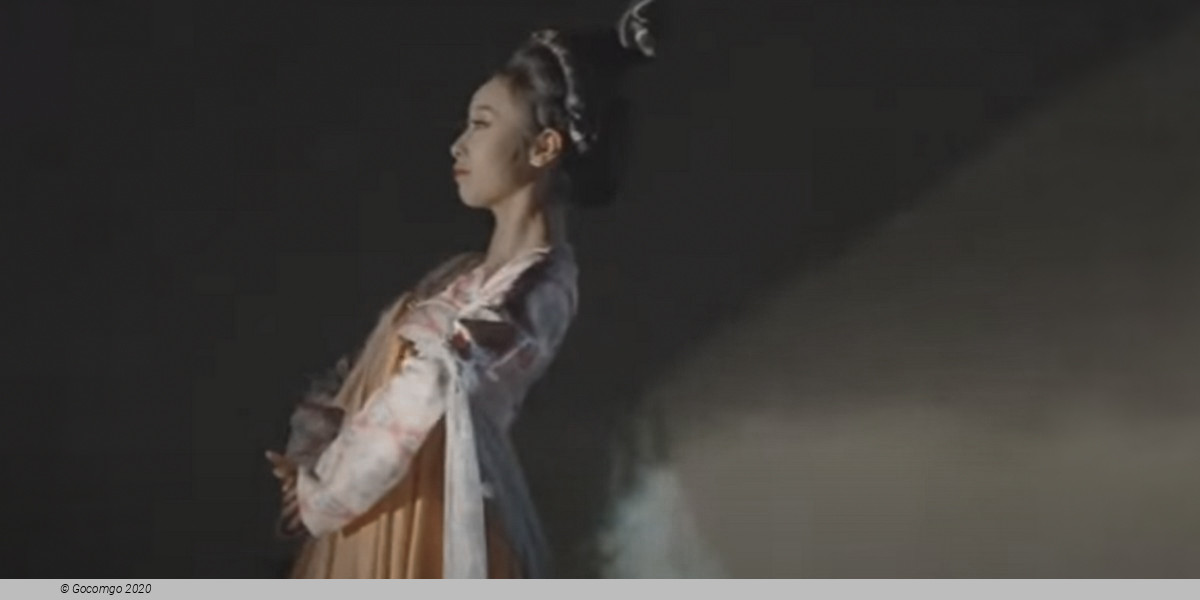
The synopsis is unfolded through the opening of a gate. The dance drama begins with the lively scene of working women in Court Ladies Preparing Silk, which is a famous painting by ZHANG Xuan in the Tang Dynasty. It not only brings together contemporary first-class dancers presenting a total of nine chapters spanning over thousands of years, but reveals a society-wide picture for 108 blocks of ancient Chang’an and the living conditions of the people during the prosperous Kaiyuan Period of the Tang Dynasty. The creative team adopts the unique cavalier perspective method to construct the interrelated section frames. The intimacy of childhood, affection between lovers, aspiration for joining the army, devotion to defending the country, shadow beside the gate and other subtle details are sublimed as distinctive artistic images after typical treatment, accompanied with full of aesthetic connotations. Coupled with a poetry verdure incubated by dreamful narration, the drama can impress the audiences with a variety of reflections on life and philosophical thinking. Love, hatred, lovesickness and devotion are separately described, while loyalty, filial piety, benevolence and justice are eulogized. It not only sheds light on inconstancy of human relationships and the vicissitudes of life, but reveals historical law of feudal dynasties from prosperity to decline to some extent. In shape of family gate, block gate, city gate and national gate, it is also everybody’s innermost world. The past and the future come out when the gate is opened and closed respectively.

The dance drama Gate begins with Court Ladies Preparing Silk, which is a famous painting by ZHANG Xuan in the Tang Dynasty, with focus on working women. With Sihun (gatekeeper) as an introductory role, this work gives a big picture of the people in 108 blocks of Chang’an during the Kaiyuan Period of the Tang Dynasty. Nine chapters are arranged to tell stories of these diverse blocks at that time, centering on a love story about an old Buddhist nun and an old eunuch. In the fickleness of the world, one of the lovers escapes into a nunnery, and the other becomes a eunuch. The eunuch’s adopted daughter Jiubao repeats the love tragedy of the previous generation. Subsequently, this work narrates the life tragedy of the Situ Family which falls after a rise. When Situ retires on account of age, he often recalls the playing scene of his two beloved sons when they were young. Situ’s second son Kuangsheng (unruly young scholar) is fond of poetry. But this obstinate man is eventually imprisoned. A woman swordsman, dressed as a man, admires Kuangsheng and deems him as a bosom friend. She wields her sword and follows Kuangsheng along the way. Situ’s eldest son has learned martial arts since childhood and grows into a general garrisoning the frontiers, but he dies on the battlefield. His lover Chouniang (Ugly Lady) feels grief-stricken and upholds loyalty to love at the expense of scarring her face. The whole dance drama describes three couples of lovers bitterly separated from each other and a pair of soul mates. In the epilogue of this dance drama, the image of a Fish symbolizes a pair of elves of freedom and love. The roles are strangers and overwhelmed by mixed feelings. The dance drama tells a series of sentimental life stories. Trough legends of these devoted and loving people, this dance drama epitomizes the historical landscape and society of 1,300 years ago on the stage.

Synopsis

Prelude
Recalling the blocks in the Tang Dynasty and telling legendary stories.
The opening remarks by Sihun (gatekeeper) who opens the gate to unfold the dance drama.

Chapter I. Yongxing Block · An Old Buddhist Nun
At the time of the Court Ladies Preparing Silk on the stage, a wandering shadow is vaguely seen.
When the old Buddhist nun chants Buddhist scriptures, where is her lover?

Chapter II. Yishan Block · Eunuch
At old age, he is reminiscent of his companion from youth.
He says goodbye to the prime of youth, without any feeling of ease and quietude.

Chapter III. Ande Block · Situ
Grey-haired retired official Situ lives a lonely, dreary life at old age.
He remembers two sons playing the game during childhood.

Chapter IV. Pingkang Block · Chouniang
Situ’s eldest son dies on the frontier.
Chouniang scars her face with loyalty to her lover.

Chapter V. Chongren Block · Kuangsheng
Situ’s second son arrogantly chants and drinks the wine.
Acting with exuberent confidence over his ability, he gets imprisoned.

Chapter VI. Tongyi Block · Swordsman
Although Kuangsheng comes down, swordsman still follows him.
Bosom friends stand together regardless of the situation.

Chapter VII. Changshou Block · Beggar
All prosperities fade away, but inspiration is never extinguished.
He unswervingly loves Jiubao through thick and thin.

Chapter VIII. Huaizhen Block · Jiubao
As the eunuch’s adopted daughter, Jiubao suffers from ups and downs.
She gets locked up inside the imperial palace, but she envies mandarin ducks and fish in pairs.

Chapter IX. East Market · West Market
It is difficult to be as one wishes during their lifetime, but the dream never vanishes.
East Market and West Market are reinvigorated at the scene of reunion.

The above information, including performance times, lineups, programmes and ticket prices, are all subject to change without prior notice and for reference only.

Venue Info

Beijing National Grand Theater (NCPA) - Beijing
Location   2 W Chang'an Ave

The National Centre for the Performing Arts (NCPA) is an arts centre containing an opera house in Beijing, People's Republic of China. The Centre, an ellipsoid dome of titanium and glass surrounded by an artificial lake, seats 5,452 people in three halls and is almost 12,000 m² in size. It was designed by French architect Paul Andreu. Construction started in December 2001 and the inaugural concert was held in December 2007.

The exterior of the theater is a titanium-accented glass dome that is completely surrounded by a man-made lake. It is said to look like an egg floating on water, or a water drop. It was designed as an iconic feature, something that would be immediately recognizable.

The dome measures 212 meters in east–west direction, 144 meters in north–south direction, and is 46 meters high. The main entrance is at the north side. Guests arrive in the building after walking through a hallway that goes underneath the lake. The titanium shell is broken by a glass curtain in north–south direction that gradually widens from top to bottom.

The location, immediately to the west of Tiananmen Square and the Great Hall of the People, and near the Forbidden City, combined with the theatre's futuristic design, created considerable controversy. Paul Andreu countered that although there is indeed value in ancient traditional Chinese architecture, Beijing must also include modern architecture, as the capital of the country and an international city of great importance. His design, with large open space, water, trees, was specially designed to complement the red walls of ancient buildings and the Great Hall of the People, in order to melt into the surroundings as opposed to standing out against them.

Internally, there are three major performance halls:

The Opera Hall is used for operas, ballet, and dances and seats 2,416 people.
The Music Hall is used for concerts and recitals and seats 2,017 people.
The Theatre Hall is used for plays and the Beijing opera. It has 1,040 seats.
The NCPA also distributes filmed and recorded performances of its concerts, plays and operas through the in-house label NCPA Classics, established in 2016.

The initial planned cost of the theatre was 2.688 billion yuan. When the construction had completed, the total cost rose to more than CNY3.2 billion. The major cause of the cost increase was a delay for reevaluation and subsequent minor changes as a precaution after a Paris airport terminal building collapsed. The cost has been a major source of controversy because many believed that it is nearly impossible to recover the investment. When the cost is averaged out, each seat is worth about half a million CNY. The Chinese government answered that the theater is not a for profit venture.

The government sanctioned study completed in 2004 by the Research Academy of Economic & Social Development of the Dongbei University of Finance and Economics, of the upkeep costs of the building were publicized in domestic Chinese media:

The water and electricity bills and the cleaning cost for the external surface would be at least tens of millions CNY, and with another maintenance cost, the total could easily exceed one billion CNY. Therefore, at least 80 percent of the annual operational costs must be subsidized by the government for at least the first three years after the opening, and for the rest of its operational life, at least 60 percent of the annual operational cost must be subsidized by the government.

The director of the art committee of the National Centre for the Performing Arts and the standing committee member of the Standing Committee of the Chinese People's Political Consultative Conference, Mr Wu Zuqiang (吴祖强) and the publicist / deputy director of the National Centre for the Performing Arts Mr Deng (邓一江) have announced that 70 percent of the tickets would be sold at low price for ordinary citizens, while 10% of the tickets would be sold at relatively expensive prices for separate market segments, and the 60% of annual operating cost needed to be subsidized by the government would be divided between the central government and the Beijing municipal government.

Important Info
Type: Show
City: Beijing, China
Starts at: 19:00
Top of page