
Beijing National Grand Theater (NCPA) 4 April 2024 - ORF Vienna Radio Symphony Orchestra | GoComGo.com

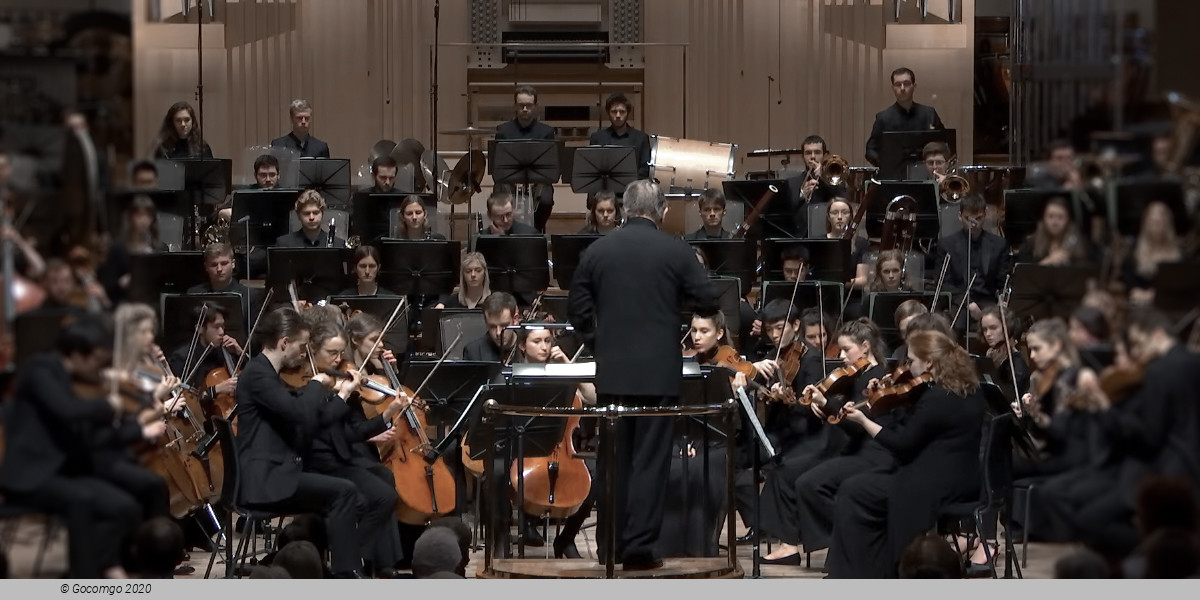
ORF Vienna Radio Symphony Orchestra

Beijing National Grand Theater (NCPA), Concert Hall, Beijing, China
All photos (1)
Select date and time
7:30 PM

E-tickets: Print at home or at the box office of the event if so specified. You will find more information in your booking confirmation email.

You can only select the category, and not the exact seats.
If you order 2 or 3 tickets: your seats will be next to each other.
If you order 4 or more tickets: your seats will be next to each other, or, if this is not possible, we will provide a combination of groups of seats (at least in pairs, for example 2+2 or 2+3).

Important Info
Type: Classical Concert
City: Beijing, China
Starts at: 19:30

E-tickets: Print at home or at the box office of the event if so specified. You will find more information in your booking confirmation email.

You can only select the category, and not the exact seats.
If you order 2 or 3 tickets: your seats will be next to each other.
If you order 4 or more tickets: your seats will be next to each other, or, if this is not possible, we will provide a combination of groups of seats (at least in pairs, for example 2+2 or 2+3).

Programme
Overview

The ORF Vienna Radio Symphony Orchestra is a top orchestra of world renown. It defines itself in the Vienna orchestral tradition. Cornelius Meister took over as Principal Conductor and Artistic Director in September 2010. The Vienna RSO is known for its exceptional, bold programming. By combining 19th century repertoire with contemporary pieces and rarely performed works of other periods, the programming often places Romantic era classics in unexpected contexts.

All Vienna RSO performances are broadcast on the radio, particularly on the Österreich 1 station, but also internationally. Moreover, it has been possible to hear each and every RSO concert across the globe on the internet for one week after the initial broadcast. Through its growing presence on European television, as well as its collaboration with the FM4 young people's station, the RSO is constantly reaching out to new music lovers. Approximately 1,000 fans support the "Friends of the RSO" association.

The RSO regularly performs in two subscription series in Vienna, in the Musikverein and the Konzerthaus. In addition, it appears every year at major Austrian and international festivals. The orchestra has close ties to the Salzburg Festival, the Wiener Festwochen, musikprotokoll im steirischen herbst and Wien Modern. Tours to Japan and China are a regular part of the RSO schedule as well. The orchestra has also recently played concerts in Thailand and the USA, South America and Germany at the Berlin, Cologne and Essen Philharmonic Halls among others. Since 2007, the RSO has successfully collaborated with the Theater an der Wien, thereby gaining an excellent reputation as an opera orchestra. Yet the RSO is also entirely at home in the film music genre. Every year, the orchestra is conducted by composers who have won an Oscar for Best Achievement in Music Written for Motion Pictures. In 2012, the RSO recorded the soundtrack to the film Die Vermessung der Welt (Measuring the World) and in 2016 it was actively involved in two features films: Kater (Tomcat) by Händl Klaus, winner of the Teddy Award at the Berlin International Film Festival, and Die Geträumten by Ruth Beckermann.

Alain Altinoglu, Leonard Bernstein, Ernest Bour, Christoph von Dohnányi, Christoph Eschenbach, Michael Gielen, Jakub Hrůša, Ingo Metzmacher, Andris Nelsons, Kirill Petrenko, Wolfgang Sawallisch, Guiseppe Sinopoli, Hans Swarowsky, Jeffrey Tate and Simone Young are among the guests who have stood on the podium of the Vienna RSO. Composers Luciano Berio, Friedrich Cerha, Peter Eötvös, Hans Werner Henze, Ernst Krenek, Bruno Maderna, Krzysztof Penderecki and Matthias Pintscher have all conducted the orchestra. Internationally renowned soloists who make regular appearances with the Vienna RSO include Renaud and Gautier Capuçon, Martin Grubinger, Hilary Hahn, Patricia Kopachinskaya, Gidon Kremer, Lang Lang, Sabine Meyer, Gabriela Montero, Anna Netrebko, Heinrich Schiff and Christian Tetzlaff.

The broad scope of the RSO's recording activities includes works in every genre, among them many first recordings that represent modern Austrian classicists and contemporary Austrian composers. This is how the Neue Musik aus Österreich series of CD recordings came about. Orchestral works by Friedrich Cerha, the recording of all nine symphonies by Egon Wellesz, orchestra music by Josef Matthias Hauer and first recordings of music by Erich Zeisl are all part of this series. Among the most recent releases were the 24 CD set my RSO as well as highly praised recordings of pieces by Anton Bruckner, Richard Strauss and Béla Bartók. In November 2016 my RSO II – A Musical Journey Across Europe, a set of 12 CDs with works from 12 European countries, was released.

The Vienna RSO has also launched a comprehensive educational programme, comprising workshops for children and young people, as well as the Inside my RSOmy RSO Music Lab and the Klassische Verführung concert series. Highly talented musicians have been admitted to the orchestra's own academy since 1997. The Vienna RSO plays regularly for the final concerts of the conducting classes at the University of Music and Performing Arts Vienna. In 2013 the educational project "My RSO – Greatest Hits for Contemporary Orchestra" was awarded the Bank Austria Kunstpreis.

The Vienna RSO grew out of Austrian radio's main orchestra in 1969. Under the leadership of its principal conductors Milan Horvat, Leif Segerstam, Lothar Zagrosek, Pinchas Steinberg, Dennis Russell Davies, Bertrand de Billy and Cornelius Meister, the orchestra has continuously expanded its repertoire, gaining growing international renown.

Venue Info

Beijing National Grand Theater (NCPA) - Beijing
Location   2 W Chang'an Ave

The National Centre for the Performing Arts (NCPA) is an arts centre containing an opera house in Beijing, People's Republic of China. The Centre, an ellipsoid dome of titanium and glass surrounded by an artificial lake, seats 5,452 people in three halls and is almost 12,000 m² in size. It was designed by French architect Paul Andreu. Construction started in December 2001 and the inaugural concert was held in December 2007.

The exterior of the theater is a titanium-accented glass dome that is completely surrounded by a man-made lake. It is said to look like an egg floating on water, or a water drop. It was designed as an iconic feature, something that would be immediately recognizable.

The dome measures 212 meters in east–west direction, 144 meters in north–south direction, and is 46 meters high. The main entrance is at the north side. Guests arrive in the building after walking through a hallway that goes underneath the lake. The titanium shell is broken by a glass curtain in north–south direction that gradually widens from top to bottom.

The location, immediately to the west of Tiananmen Square and the Great Hall of the People, and near the Forbidden City, combined with the theatre's futuristic design, created considerable controversy. Paul Andreu countered that although there is indeed value in ancient traditional Chinese architecture, Beijing must also include modern architecture, as the capital of the country and an international city of great importance. His design, with large open space, water, trees, was specially designed to complement the red walls of ancient buildings and the Great Hall of the People, in order to melt into the surroundings as opposed to standing out against them.

Internally, there are three major performance halls:

The Opera Hall is used for operas, ballet, and dances and seats 2,416 people.
The Music Hall is used for concerts and recitals and seats 2,017 people.
The Theatre Hall is used for plays and the Beijing opera. It has 1,040 seats.
The NCPA also distributes filmed and recorded performances of its concerts, plays and operas through the in-house label NCPA Classics, established in 2016.

The initial planned cost of the theatre was 2.688 billion yuan. When the construction had completed, the total cost rose to more than CNY3.2 billion. The major cause of the cost increase was a delay for reevaluation and subsequent minor changes as a precaution after a Paris airport terminal building collapsed. The cost has been a major source of controversy because many believed that it is nearly impossible to recover the investment. When the cost is averaged out, each seat is worth about half a million CNY. The Chinese government answered that the theater is not a for profit venture.

The government sanctioned study completed in 2004 by the Research Academy of Economic & Social Development of the Dongbei University of Finance and Economics, of the upkeep costs of the building were publicized in domestic Chinese media:

The water and electricity bills and the cleaning cost for the external surface would be at least tens of millions CNY, and with another maintenance cost, the total could easily exceed one billion CNY. Therefore, at least 80 percent of the annual operational costs must be subsidized by the government for at least the first three years after the opening, and for the rest of its operational life, at least 60 percent of the annual operational cost must be subsidized by the government.

The director of the art committee of the National Centre for the Performing Arts and the standing committee member of the Standing Committee of the Chinese People's Political Consultative Conference, Mr Wu Zuqiang (吴祖强) and the publicist / deputy director of the National Centre for the Performing Arts Mr Deng (邓一江) have announced that 70 percent of the tickets would be sold at low price for ordinary citizens, while 10% of the tickets would be sold at relatively expensive prices for separate market segments, and the 60% of annual operating cost needed to be subsidized by the government would be divided between the central government and the Beijing municipal government.

Important Info
Type: Classical Concert
City: Beijing, China
Starts at: 19:30
Top of page