
Beijing National Grand Theater (NCPA) 18 April 2024 - Max Pommer and National Ballet of China Symphony Orchestra | GoComGo.com

Max Pommer and National Ballet of China Symphony Orchestra

Beijing National Grand Theater (NCPA), Concert Hall, Beijing, China
All photos (1)
Select date and time

E-tickets: Print at home or at the box office of the event if so specified. You will find more information in your booking confirmation email.

You can only select the category, and not the exact seats.
If you order 2 or 3 tickets: your seats will be next to each other.
If you order 4 or more tickets: your seats will be next to each other, or, if this is not possible, we will provide a combination of groups of seats (at least in pairs, for example 2+2 or 2+3).

Important Info
Type: Classical Concert
City: Beijing, China
Starts at: 19:30

E-tickets: Print at home or at the box office of the event if so specified. You will find more information in your booking confirmation email.

You can only select the category, and not the exact seats.
If you order 2 or 3 tickets: your seats will be next to each other.
If you order 4 or more tickets: your seats will be next to each other, or, if this is not possible, we will provide a combination of groups of seats (at least in pairs, for example 2+2 or 2+3).

Programme
Overview

Max Pommer 

The German conductor, Max Pommer, studied piano and conducting at the Leipzig College of Music as well as musicology at the city's University. Subsequently, he spent some time as a pupil of Herbert von Karajan. In 1968 he obtained a Ph.D.

In 1974 Max Pommer took charge of the Leipziger Universitatschor, being appointed music director the following year. Together with members of Gewandhausorchester Leipzig, he founded the Neues Bachisches Collegium Musicum in 1978 with the aim of performing Baroque music, specially cantatas and choral works of J.S. Bach. His international breakthrough as a conductor came with this ensemble, which he brought to international recognition from 1978 to 1987. The recordings made by this ensemble received international awards (including the "Deutscher Schallplattenpreis" for J.S. Bach's Brandenburg Concertos) and were well known in Europe and the USA long before the reunification of Germany.

From 1987 to 1991, he was principal conductor of the Leipzig Radio Symphony Orchestra (MDR Sinfonieorchester), and he still collaborates with the MDR (Radio Saxony) in concerts and productions. Since 1990 he has been professor of orchestral directing and conducting at the Saarland Academy of Music. Here he founded the "Saar-Lor-Lux Orchestra", which brings together annually music students from Metz, Nancy, Luxembourg and Saarbrücken. His artistic contribution to European unification has already been highly commended: "His ensemble showed flawless technical mastery of the material, and the conductor's gestures, both functional and evocative, did the rest. We experienced a rousing concert of the highest quality." (Luxemburger Wort), and "Saar-Lor-Lux –orchestra de luxe" (Est-Republicain, Nancy).

In wide demand as a guest conductor, Max Pommer works regularly with orchestras such as the Saint Paul Chamber Orchestra in Minnesota, St. Gallen Symphony Orchestra, Orchestre National Bordeaux Aquitaine, and SWR Sinfonieorchester Baden-Baden & Freiburg and others in Germany. He first conducted the Salzburg Mozarteum Orchestra at the Salzburg Festival in 1991, and has since given concerts with them in Spain and on a very successful tour of North America.

Max Pommer has been closely connected with the Hamburg Camerata – one of the excellent Hamburg ensembles – since 1991. Apart from a regular concert series with them, he has guested with them at festivals including Schleswig-Holstein, Mecklenburg and MDR Musiksommer. Since 2000 he has been first regular guest conductor of the Noordhollands Philharmonisch Orkest.

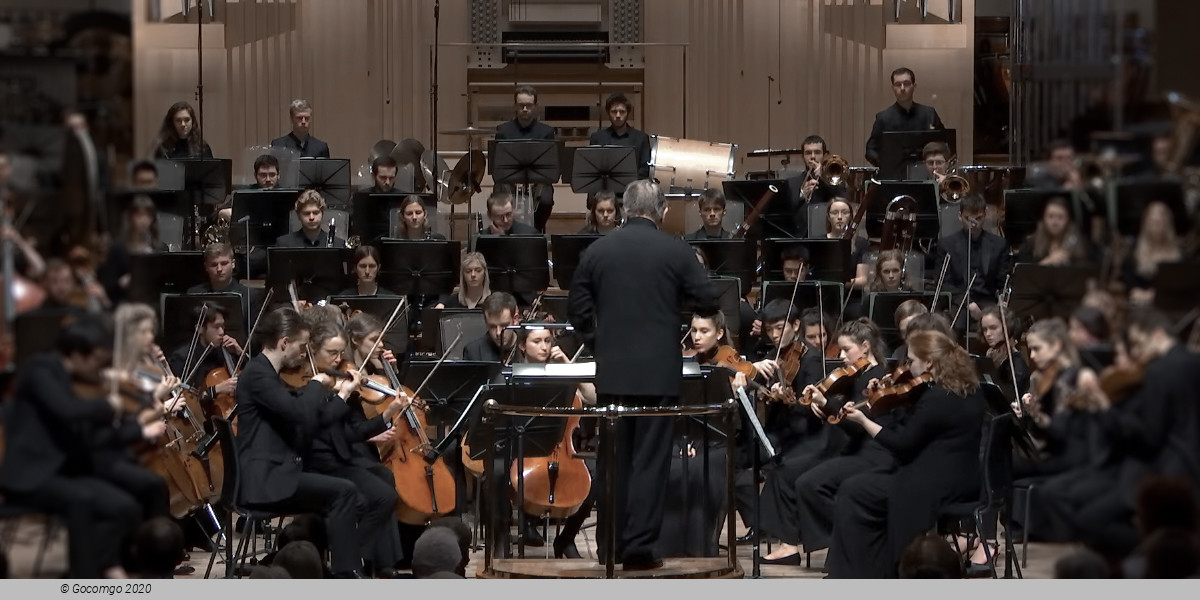
National Ballet of China Symphony Orchestra

The National Ballet of China Symphony Orchestra was established in 1959 and is affiliated with the National Ballet of China. The music director is ZHANG Yi. Chief conductor is HUANG Yi. Permanent conductor is LIU Ju. All members are graduates of higher music institutions who have received rigorous professional training and have great musical proficiency. Some senior talents have studied abroad in professional colleges and universities. In recent years, the overall artistic level of the orchestra has rapidly improved, which has attracted much attention from the industry and is praised as the most vigorous and promising national symphony orchestra in the Chinese music circles.

The National Ballet of China Symphony Orchestra has set its own banner in China and enjoys a high reputation internationally. In addition to being responsible for the music accompaniment in the ballet performances of National Ballet of China, the orchestra has also undertaken numerous accompaniment tasks for internationally renowned ballet ensembles and opera houses visiting China, such as the Opéra de Paris, British Royal Opera House, Mariinsky Theatre, Bolshoi Theatre, and ballet ensembles from Germany, Italy, Australia, Denmark, Sweden and other countries and regions.

In recent years, under the leadership of director FENG Ying and music director ZHANG Yi, the orchestra has expanded its performance of symphonic concerts, while performing excellent works that appeal to all of different eras, styles, and forms at the NCPA Concert Hall and grand theatres across China. The works include classical romantic works by Bach, Mozart, Beethoven, Mendelssohn, Schumann; modern classics by Debussy, Ravel, Stravinsky, Richard Strauss, Mahler, and Bernstein; the Russian Legion consisting of Tchaikovsky, Prokofiev, Rachmaninov, Moussorgsky, Shostakovich, and Kabalevsky wouldn’t be absent. It is also worth mentioning that a series of outstanding new works by outstanding local young composers have been premiered in cooperation with the NCPA. The cooperation with internationally famous artists stands of great significance to progress of the orchestra,such as domestic conductors TAN Lihua, ZHANG Guoyong, YANG Yang, LIN Daye, XIA Xiaotang, YUAN Ding, as well as German conductor, music director of MDR Leipzig Radio Symphony Orchestra, music director of Sapporo Symphony Orchestra,Max Pommer, tenor Carreras, Japanese animation music master Joe Hisaishi, pianists LANG Lang, CHEN Sa, TAN Xiaotang, violinist LÜ Siqing, HUANG Bin, NING Feng, HUANG Mengla, ZHU Dan, WANG Zhijiong, cellist Gustaf Ravennius and QIN Liwei.

In 2014, to celebrate the 55th anniversary of the founding of National Ballet of China, National Ballet of China Symphony Orchestra produced a set of 8 CDs live concert albums, and industry insiders gave a high evaluation of the artistic level of the albums. In 2015, the orchestra participated in important international political activities of “Permanent Five” at the United Nations Headquarters in Geneva, Switzerland. This was not only its first independent show on the international stage, but also became a highlight in the history of the orchestra.

With development of the orchestra, increasing the intensity of “bring in and go global" strategy has become the focus of its future development. More outstanding artists have cooperated with the National Ballet of China Symphony Orchestra, and the orchestra also introduces itself to more audiences outside Beijing in various forms. With deepening progress of the reform of China's literary and artistic undertakings, it should become a unique and irreplaceable force on the art stage of Beijing in the future.

Venue Info

Beijing National Grand Theater (NCPA) - Beijing
Location   2 W Chang'an Ave

The National Centre for the Performing Arts (NCPA) is an arts centre containing an opera house in Beijing, People's Republic of China. The Centre, an ellipsoid dome of titanium and glass surrounded by an artificial lake, seats 5,452 people in three halls and is almost 12,000 m² in size. It was designed by French architect Paul Andreu. Construction started in December 2001 and the inaugural concert was held in December 2007.

The exterior of the theater is a titanium-accented glass dome that is completely surrounded by a man-made lake. It is said to look like an egg floating on water, or a water drop. It was designed as an iconic feature, something that would be immediately recognizable.

The dome measures 212 meters in east–west direction, 144 meters in north–south direction, and is 46 meters high. The main entrance is at the north side. Guests arrive in the building after walking through a hallway that goes underneath the lake. The titanium shell is broken by a glass curtain in north–south direction that gradually widens from top to bottom.

The location, immediately to the west of Tiananmen Square and the Great Hall of the People, and near the Forbidden City, combined with the theatre's futuristic design, created considerable controversy. Paul Andreu countered that although there is indeed value in ancient traditional Chinese architecture, Beijing must also include modern architecture, as the capital of the country and an international city of great importance. His design, with large open space, water, trees, was specially designed to complement the red walls of ancient buildings and the Great Hall of the People, in order to melt into the surroundings as opposed to standing out against them.

Internally, there are three major performance halls:

The Opera Hall is used for operas, ballet, and dances and seats 2,416 people.
The Music Hall is used for concerts and recitals and seats 2,017 people.
The Theatre Hall is used for plays and the Beijing opera. It has 1,040 seats.
The NCPA also distributes filmed and recorded performances of its concerts, plays and operas through the in-house label NCPA Classics, established in 2016.

The initial planned cost of the theatre was 2.688 billion yuan. When the construction had completed, the total cost rose to more than CNY3.2 billion. The major cause of the cost increase was a delay for reevaluation and subsequent minor changes as a precaution after a Paris airport terminal building collapsed. The cost has been a major source of controversy because many believed that it is nearly impossible to recover the investment. When the cost is averaged out, each seat is worth about half a million CNY. The Chinese government answered that the theater is not a for profit venture.

The government sanctioned study completed in 2004 by the Research Academy of Economic & Social Development of the Dongbei University of Finance and Economics, of the upkeep costs of the building were publicized in domestic Chinese media:

The water and electricity bills and the cleaning cost for the external surface would be at least tens of millions CNY, and with another maintenance cost, the total could easily exceed one billion CNY. Therefore, at least 80 percent of the annual operational costs must be subsidized by the government for at least the first three years after the opening, and for the rest of its operational life, at least 60 percent of the annual operational cost must be subsidized by the government.

The director of the art committee of the National Centre for the Performing Arts and the standing committee member of the Standing Committee of the Chinese People's Political Consultative Conference, Mr Wu Zuqiang (吴祖强) and the publicist / deputy director of the National Centre for the Performing Arts Mr Deng (邓一江) have announced that 70 percent of the tickets would be sold at low price for ordinary citizens, while 10% of the tickets would be sold at relatively expensive prices for separate market segments, and the 60% of annual operating cost needed to be subsidized by the government would be divided between the central government and the Beijing municipal government.

Important Info
Type: Classical Concert
City: Beijing, China
Starts at: 19:30
Top of page