
Beijing National Grand Theater (NCPA) 6 November 2023 - Christian Thielemann & The Staatskapelle Dresden | GoComGo.com

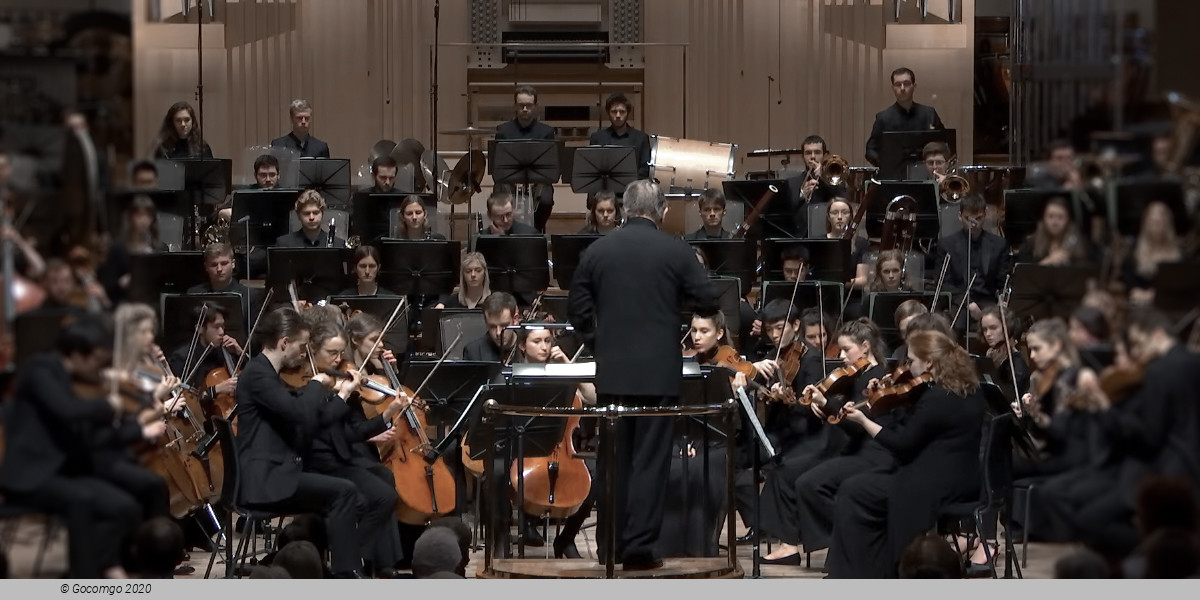
Christian Thielemann & The Staatskapelle Dresden

Beijing National Grand Theater (NCPA), Concert Hall, Beijing, China
All photos (1)
Select date and time
7:30 PM
Request for Tickets
Important Info
Type: Classical Concert
City: Beijing, China
Starts at: 19:30

E-tickets: Print at home or at the box office of the event if so specified. You will find more information in your booking confirmation email.

You can only select the category, and not the exact seats.
If you order 2 or 3 tickets: your seats will be next to each other.
If you order 4 or more tickets: your seats will be next to each other, or, if this is not possible, we will provide a combination of groups of seats (at least in pairs, for example 2+2 or 2+3).

Programme
Carl Maria von Weber: Jubel-Ouvertüre, Op. 59
Richard Wagner: Tannhäuser: Overture
Richard Strauss: Also sprach Zarathustra (Thus spoke Zarathustra), op. 30
Richard Strauss: Der Rosenkavalier, Suite, op. 59
Overview

Christian Thielemann

Principal Conductor of the Staatskapelle Dresden

Since 2012/13 season Christian Thielemann has been Principal Conductor of the Staatskapelle Dresden. Following engagements at the Deutsche Oper Berlin, in Gelsenkirchen, Karlsruhe, Hanover and Dusseldorf, in 1988 he moved to Nuremberg to occupy the post of Generalmusikdirektor. In 1997 he returned to his hometown of Berlin to direct the Deutsche Oper until 2004, when he became Music Director of the Munich Philharmonic, a post he occupied until 2011. In addition to his current position in Dresden, Thielemann has been Artistic Director of the Salzburg Easter Festival since 2013, where the Staatskapelle is resident orchestra.

In previous seasons Christian Thielemann has contributed greatly to the birthday celebrations for Wagner and Strauss. At the same time he has explored a wide range of music from Bach to Henze, Rihm and Gubaidulina in Dresden and on tour. In the Semperoper he recently conducted new productions of Der Freischütz and Ariadne auf Naxos while for the Salzburg Easter Festival he interpreted Die Walküre, Tosca and Die Meistersinger von Nürnberg.

Christian Thielemann maintains close ties to the Berlin Philharmonic Orchestra and the Vienna Philharmonic Orchestra, whose New Year’s Concert he conducted in 2019. Following his debut at the Bayreuth Festival in 2000, he has returned every year to thrill audiences with benchmark interpretations. After serving five years as the festival’s Musical Advisor, in June 2015 he became its Music Director. In addition, he has been invited to conduct the leading orchestras of Europe, the United States, Israel and Asia. As a UNITEL exclusive artist, Christian Thielemann has a comprehensive catalogue of recordings. His most recent projects with the Staatskapelle have been to record the symphonies of Johannes Brahms, Anton Bruckner and Robert Schumann as well as numerous operas.

As a UNITEL exclusive artist, Christian Thielemann has a comprehensive catalogue of recordings. His most recent projects with the Staatskapelle have been to record the symphonies of Anton Bruckner and Robert Schumann, Arnold Schoenberg’s Gurre-Lieder as well as numerous operas.

Christian Thielemann is an honorary member of the Royal Academy of Music in London and holds honorary doctorates from the Franz Liszt University of Music in Weimar and the Catholic University of Leuven, Belgium. In May 2015 he was awarded the Richard Wagner Prize by the Richard Wagner Society of the city of Leipzig, followed by the Prize of the Semperoper Trust in October 2016 and an honorary award of the state of Salzburg in April 2022. He is patron of the Richard-Wagner-Stätten in Graupa. His recordings have been showered with awards.

The Staatskapelle Dresden

Founded by Prince Elector Moritz von Sachsen in 1548, the Staatskapelle Dresden is one of the oldest orchestras in the world and steeped in tradition. Over its long history many distinguished conductors and internationally celebrated instrumentalists have left their mark on this onetime court orchestra. Previous directors include Heinrich Schütz, Johann Adolf Hasse, Carl Maria von Weber and Richard Wagner, who called the ensemble his miraculous harp. The list of prominent conductors of the last 100 years includes Ernst von Schuch, Fritz Reiner, Fritz Busch, Karl Böhm, Joseph Keilberth, Rudolf Kempe, Otmar Suitner, Kurt Sanderling, Herbert Blomstedt and Giuseppe Sinopoli. The orchestra was directed by Bernard Haitink from 2002-2004 and most recently by Fabio Luisi from 2007-2010. Principal Conductor since the 2012 / 2013 season has been Christian Thielemann. In May 2016 the former Principal Conductor Herbert Blomstedt received the title Conductor Laureate. The only person to previously hold this title was Sir Colin Davis before, from 1990 until his death in April 2013. Myung-Whun Chung has been Principal Guest Conductor since the 2012 / 2013 season.

Richard Strauss and the Staatskapelle were closely linked for more than 60 years. Nine of the composer’s operas were premiered in Dresden, including SalomeElektra and Der Rosenkavalier, while Strauss’s Alpine Symphony was dedicated to the orchestra. Countless other famous composers have written works either dedicated to the orchestra or first performed in Dresden. In 2007 the Staatskapelle reaffirmed this tradition by introducing the annual position of Capell-Compositeur. Following on from Hans Werner Henze, Sofia Gubaidulina, Wolfgang Rihm, György Kurtág, Arvo Pärt, Peter Eötvösand Aribert Reimann, the former Principal Conductor of the Staatskapelle Giuseppe Sinopoli will posthumously hold this title for the 2020/2021 season. As Capell-Virtuos, the pianist Sir András Schiff will take part in concerts in the Semperoper as well as on tour.

The Staatskapelle’s home is the Semperoper, where it performs around 260 operas and ballets each season. In addition the ensemble presents another 50 symphonic and chamber concerts in the opera house, as well as playing at various musical events in Dresden’s Frauenkirche.

As one of the world’s most celebrated and popular symphony orchestras, the Staatskapelle regularly travels abroad to the world’s leading classical venues. For ten years, from 2013 to 2022, the Staatskapelle has been the resident orchestra of the Salzburg Easter Festival.

As partner orchestra of the Gustav Mahler Youth Orchestra, the Staatskapelle supports the nurturing of young talent. Also active at the local level, the Kapelle is a partner of Meetingpoint Music Messiaen in the double city of Görlitz-Zgorzelec and, in 2010, helped found the International Shostakovich Festival in Gohrisch (Saxon Switzerland), which is the first annual event dedicated to the music and life of the composer Dmitri Shostakovich.

At a ceremony in Brussels in 2007 the Staatskapelle became the first – and so far only – orchestra to be awarded the European Prize for the Preservation of the World’s Musical Heritage.

Venue Info

Beijing National Grand Theater (NCPA) - Beijing
Location   2 W Chang'an Ave

The National Centre for the Performing Arts (NCPA) is an arts centre containing an opera house in Beijing, People's Republic of China. The Centre, an ellipsoid dome of titanium and glass surrounded by an artificial lake, seats 5,452 people in three halls and is almost 12,000 m² in size. It was designed by French architect Paul Andreu. Construction started in December 2001 and the inaugural concert was held in December 2007.

The exterior of the theater is a titanium-accented glass dome that is completely surrounded by a man-made lake. It is said to look like an egg floating on water, or a water drop. It was designed as an iconic feature, something that would be immediately recognizable.

The dome measures 212 meters in east–west direction, 144 meters in north–south direction, and is 46 meters high. The main entrance is at the north side. Guests arrive in the building after walking through a hallway that goes underneath the lake. The titanium shell is broken by a glass curtain in north–south direction that gradually widens from top to bottom.

The location, immediately to the west of Tiananmen Square and the Great Hall of the People, and near the Forbidden City, combined with the theatre's futuristic design, created considerable controversy. Paul Andreu countered that although there is indeed value in ancient traditional Chinese architecture, Beijing must also include modern architecture, as the capital of the country and an international city of great importance. His design, with large open space, water, trees, was specially designed to complement the red walls of ancient buildings and the Great Hall of the People, in order to melt into the surroundings as opposed to standing out against them.

Internally, there are three major performance halls:

The Opera Hall is used for operas, ballet, and dances and seats 2,416 people.
The Music Hall is used for concerts and recitals and seats 2,017 people.
The Theatre Hall is used for plays and the Beijing opera. It has 1,040 seats.
The NCPA also distributes filmed and recorded performances of its concerts, plays and operas through the in-house label NCPA Classics, established in 2016.

The initial planned cost of the theatre was 2.688 billion yuan. When the construction had completed, the total cost rose to more than CNY3.2 billion. The major cause of the cost increase was a delay for reevaluation and subsequent minor changes as a precaution after a Paris airport terminal building collapsed. The cost has been a major source of controversy because many believed that it is nearly impossible to recover the investment. When the cost is averaged out, each seat is worth about half a million CNY. The Chinese government answered that the theater is not a for profit venture.

The government sanctioned study completed in 2004 by the Research Academy of Economic & Social Development of the Dongbei University of Finance and Economics, of the upkeep costs of the building were publicized in domestic Chinese media:

The water and electricity bills and the cleaning cost for the external surface would be at least tens of millions CNY, and with another maintenance cost, the total could easily exceed one billion CNY. Therefore, at least 80 percent of the annual operational costs must be subsidized by the government for at least the first three years after the opening, and for the rest of its operational life, at least 60 percent of the annual operational cost must be subsidized by the government.

The director of the art committee of the National Centre for the Performing Arts and the standing committee member of the Standing Committee of the Chinese People's Political Consultative Conference, Mr Wu Zuqiang (吴祖强) and the publicist / deputy director of the National Centre for the Performing Arts Mr Deng (邓一江) have announced that 70 percent of the tickets would be sold at low price for ordinary citizens, while 10% of the tickets would be sold at relatively expensive prices for separate market segments, and the 60% of annual operating cost needed to be subsidized by the government would be divided between the central government and the Beijing municipal government.

Important Info
Type: Classical Concert
City: Beijing, China
Starts at: 19:30
Top of page