
Beijing National Grand Theater (NCPA) 28 July 2023 - The Bolshoi Ballet: Don Quixote | GoComGo.com

The Bolshoi Ballet: Don Quixote

Beijing National Grand Theater (NCPA), Opera House, Beijing, China
All photos (8)
Select date and time
7:30 PM

E-tickets: Print at home or at the box office of the event if so specified. You will find more information in your booking confirmation email.

You can only select the category, and not the exact seats.
If you order 2 or 3 tickets: your seats will be next to each other.
If you order 4 or more tickets: your seats will be next to each other, or, if this is not possible, we will provide a combination of groups of seats (at least in pairs, for example 2+2 or 2+3).

Important Info
Type: Ballet
City: Beijing, China
Starts at: 19:30
Acts: 3
Duration: 2h 45min

E-tickets: Print at home or at the box office of the event if so specified. You will find more information in your booking confirmation email.

You can only select the category, and not the exact seats.
If you order 2 or 3 tickets: your seats will be next to each other.
If you order 4 or more tickets: your seats will be next to each other, or, if this is not possible, we will provide a combination of groups of seats (at least in pairs, for example 2+2 or 2+3).

Overview

Founded in 1776, The Bolshoi Theatre of Russia has always been, and will remain, one of the main symbols of Russian culture. It is the main National theatre, a bearer of the traditions of Russian music culture and a centre of world music culture, the spearhead of the development of the country’s performing arts.

The internationally renowned Bolshoi Ballet is among the oldest and worldwide acclaimed ballet classical companies. The first ballets to be produced were by French and Italian ballet masters such as Filippo Beccari, the Morelli brothers and Jean Lamiral. Before long, however, young Russian choreographers such as Adam Glushkovsky took over, concentrating on ballets with Russian themes. From 1820-1830 the company developed in the French tradition under the influence of Felicite-Virginie Hullin-Sor and Fanny Elssler who familiarised the Moscow public with works of Jules Perrot and other masterpieces of romantic ballet. Marius Petipa's Don Quixote which received its premiere in Moscow on 26 December 1869 was acknowledged to be the visiting card of the Moscow Company, a work which, infringing all Imperial Theatres traditions, had transferred from Moscow to Petersburg. Alexander Gorsky, Petipa’s assistant and pupil, was appointed to the Bolshoi Theatre in 1900 and from then on until his death in 1924, he revised the company's stagings of the basic repertoire, making them more dramatic and realistic and laying the foundations for the company’s great future successes.

Following the October Revolution in 1917 left-wing critics demanded the removal from the repertoire of classical works. However more moderate voices prevailed and, during the Soviet period, traditional nineteenth-century ballets were performed alongside contemporary works.

With the transfer of the capital from Petrograd to Moscow, the Bolshoi became the country’s first theatre, a repository of the best creative talents. Olga Lepeshinskaya, Marina Semenova, Galina Ulanova, Maya Plisetskaya, Natalia Bessmertnova, Ekaterina Maximova, Nina Timofeyeva, Asaf Messerer, Alexei Ermolaev, Mikhail Lavrovsky, Vladimir Vasiliev, Maris Liepa were among the great principal dancers of the 20th century. Leonid Lavrovsky and Yuri Grigorovich enabled “the golden age” of Soviet ballet.

Today chef-d’oeuvres of classical ballet, such as GiselleLa Sylphide, Swan LakeThe Sleeping Beauty, La Bayadère, Don Quixote, RaymondaLe CorsaireCoppéliaChopiniana, Grand Pas from the ballet Paquita, as well as 20th century’s masterpieces by Yuri Grigorovich such as A Legend of LoveNutcrackerSpartacusIvan the Terrible occupy a leading place in the Bolshoi Ballet repertoire.

It also presents to its public specially commissioned ballets, among which are Yuri Possokhov’s The Seagull, Edward Clug's Master and Margarita, Vyacheslav Samodurov's Dancemania, Artemy Belyakov’s Les Saisons, Anton Pimonov's Made in Bolshoi, the ballet evening Four Characters in Search of a plot, which joins pieces by Bryan Arias, Simone Valastro, Dimo Milev, and Martin Chaix.

Another important goal of the Bolshoi Ballet is to introduce the Russian public to the achievements of the world’s great choreographers; its repertoire includes works by George Balanchine, Pierre Lacotte, John Cranko, John Neumeier, Alberto Alonso.

Nowadays Bolshoi dancers, Svetlana Zakharova, Ekaterina Krysanova, Anna Nikulina, Anastasia Stashkevich, Evgenia Obraztsova, Alyona Kovalyova, Eleonora Sevenard, Eva Sergeyenkova, Elizaveta Kokoreva, Vladislav Lantratov, Artem Ovcharenko, Semyon Chudin, Vyacheslav Lopatin, Denis Rodkin, Denis Savin, Artemy Belyakov, Igor Tsvirko, Egor Gerashchenko, and others ensure that the Bolshoi's standards are held as high as ever.

Makhar Vaziev, former director of the Mariinsky Theatre and Teatro alla Scala Ballet, was appointed Ballet Director in 2016. Today’s Bolshoi Ballet employing more than 200 dancers combines a pride in its artistic heritage with an awareness that it must grow and develop to prosper.

History
Premiere of this production: 26 December 1869, Ballet of the Imperial Bolshoi Theatre of Moscow, Russia

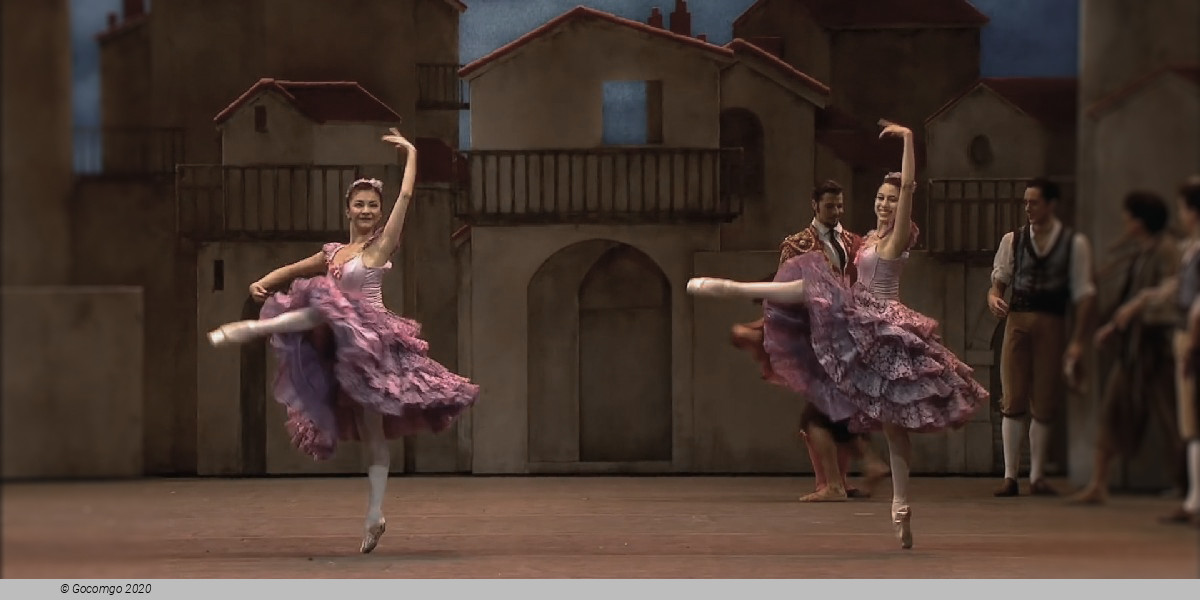
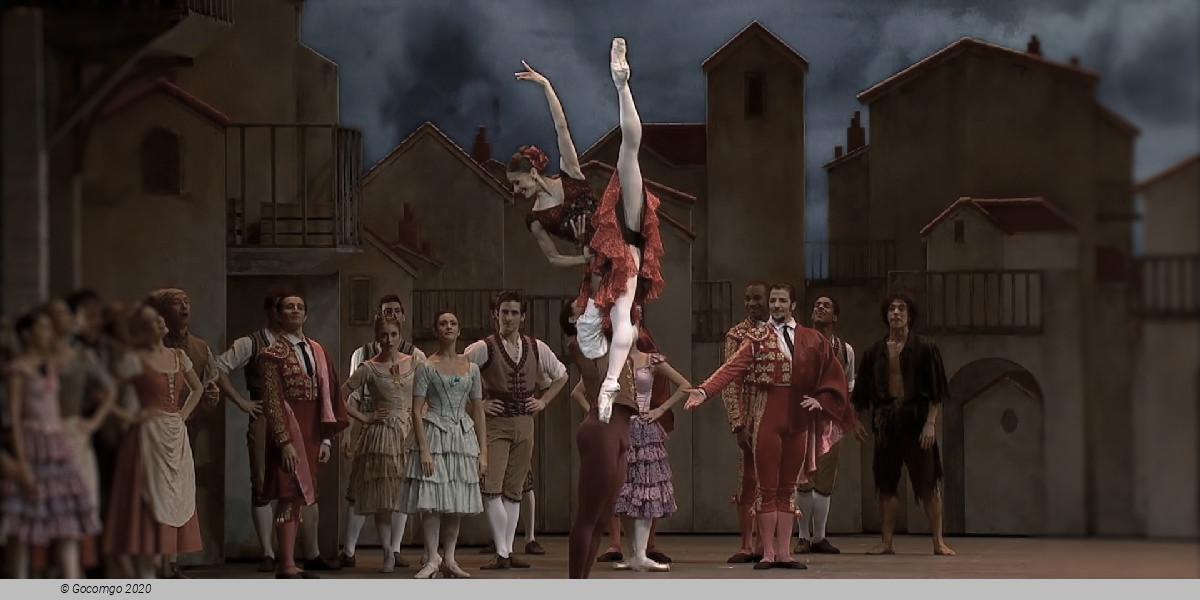
Don Quixote is a ballet in four acts and eight scenes, based on episodes taken from the famous novel Don Quixote de la Mancha by Miguel de Cervantes. It was originally choreographed by Marius Petipa to the music of Ludwig Minkus and first presented by the Ballet of the Imperial Bolshoi Theatre of Moscow, Russia on 26 December [O.S. 14 December] 1869. Petipa and Minkus revised the ballet into a far more expanded and elaborated edition in five acts and eleven scenes for the Imperial Ballet, first presented on 21 November 1871 at the Imperial Bolshoi Kamenny Theatre of St. Petersburg.

Synopsis

Don Quixote's Study

Bachelor Sanson Carrasco is seen covering a bookcase with wallpaper, while Antonina is putting some rusty old armour and a helmet made of pasteboard into a cupboard. Don Quixote de la Mancha enters, reading a book. He goes to the bookcase and, not finding it, believes it has been stolen by evil magicians. Then he settles into an armchair and continues reading. He delights in stories of brave knights, fabulous giants and other fantastical creatures, but most of all Don Quixote dreams of his beloved Dulcinea, a woman that he believes to be so lovely and noble that she must be divinity. Gradually he nods and falls asleep to dream of their romantic adventures. Darkness falls.

Suddenly his servant, Sancho Panza, climbs hurriedly through the window. In pursuit are several angry women from the market from whom he has stolen bread and a chicken. Awakened by the commotion, Don Quixote sends the women away. Don Quixote tells Sancho that he is determined to seek adventures as a knight-errant, all the while searching for his beloved Dulcinea. He shows him the pasteboard helmet, which, with one sweep from his sword, becomes a shapeless mass on the floor. Antonina suggests that he should use a shaving basin instead, which would make a splendid helmet. Don Quixote enthusiastically agrees and, placing it on his head, orders Sancho to bring him his armour, sword and spear, and to make ready his horse, Rocinante.

Act I

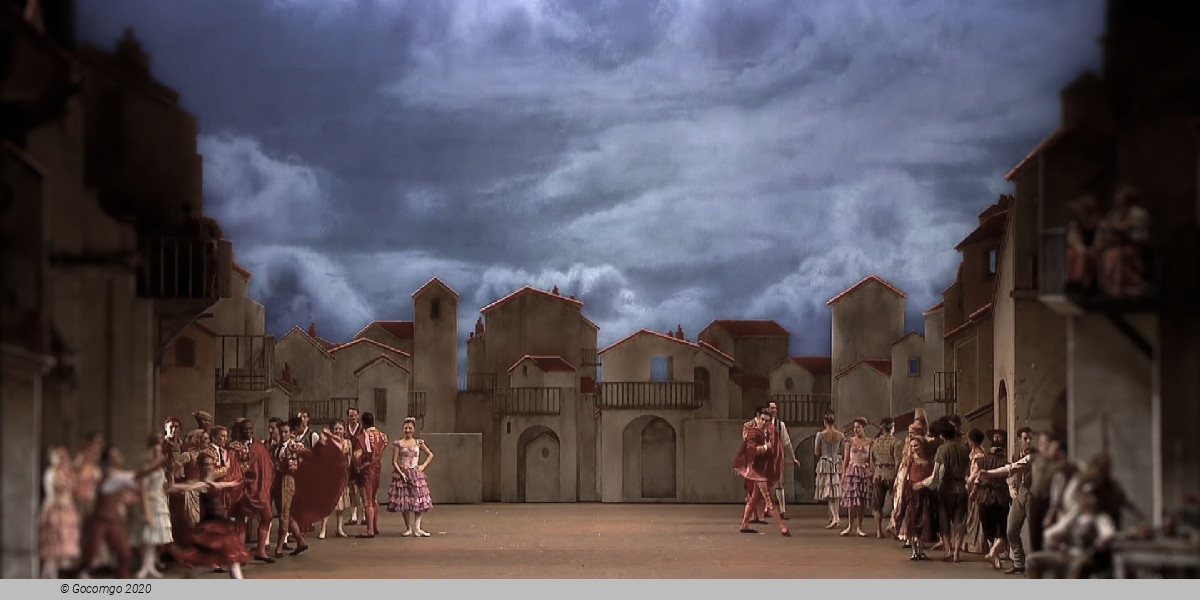
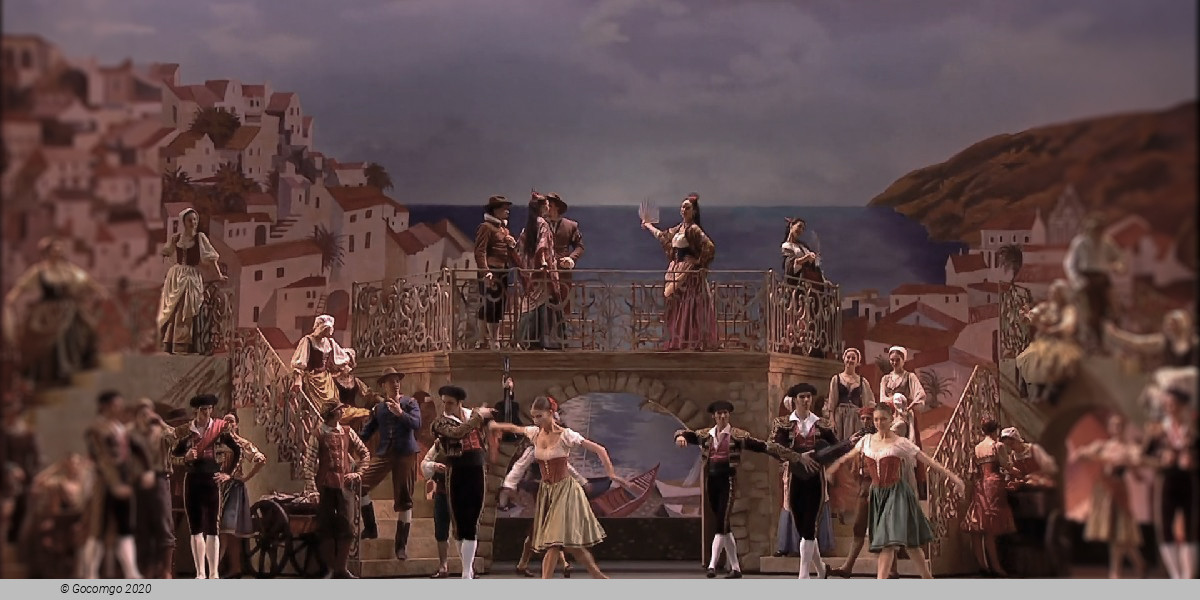
A market-place in Barcelona

Kitri, an inn-keeper's daughter, steals out of her house to meet her beloved, the barber Basilio. Her father, Lorenzo, sees the lovers and sends Basilio away, bringing Kitri to tears. Now comes the rich nobleman Gamache, who, likewise in love with Kitri, goes to Lorenzo and asks for his daughter's hand. The innkeeper accepts with delight but Kitri, appalled at the thought of wedding the foppish nobleman, runs away.

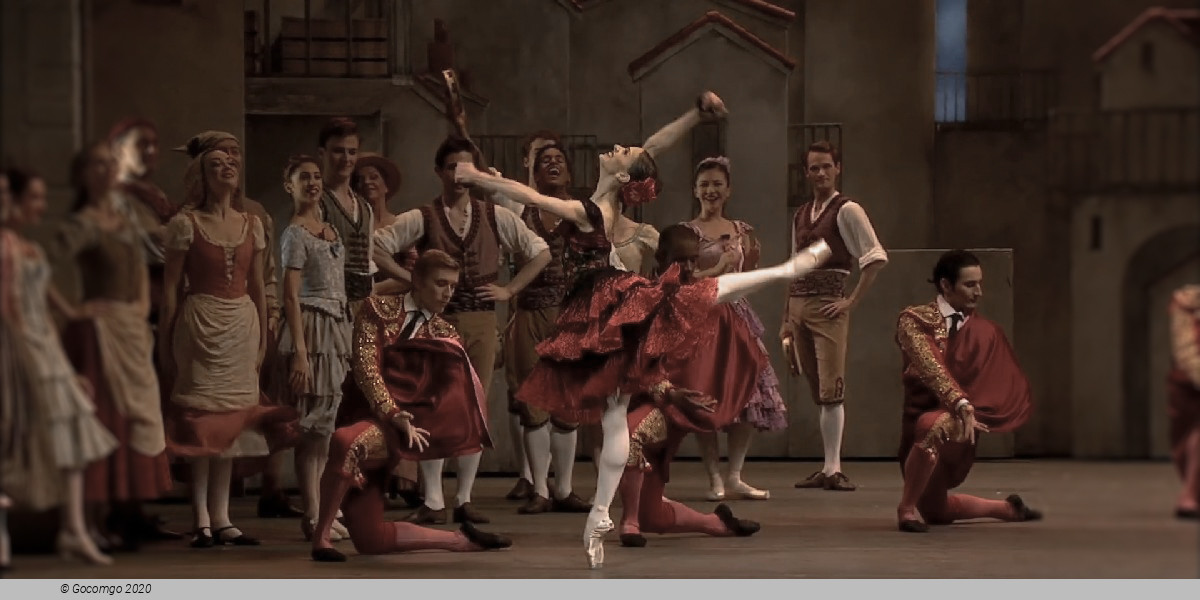
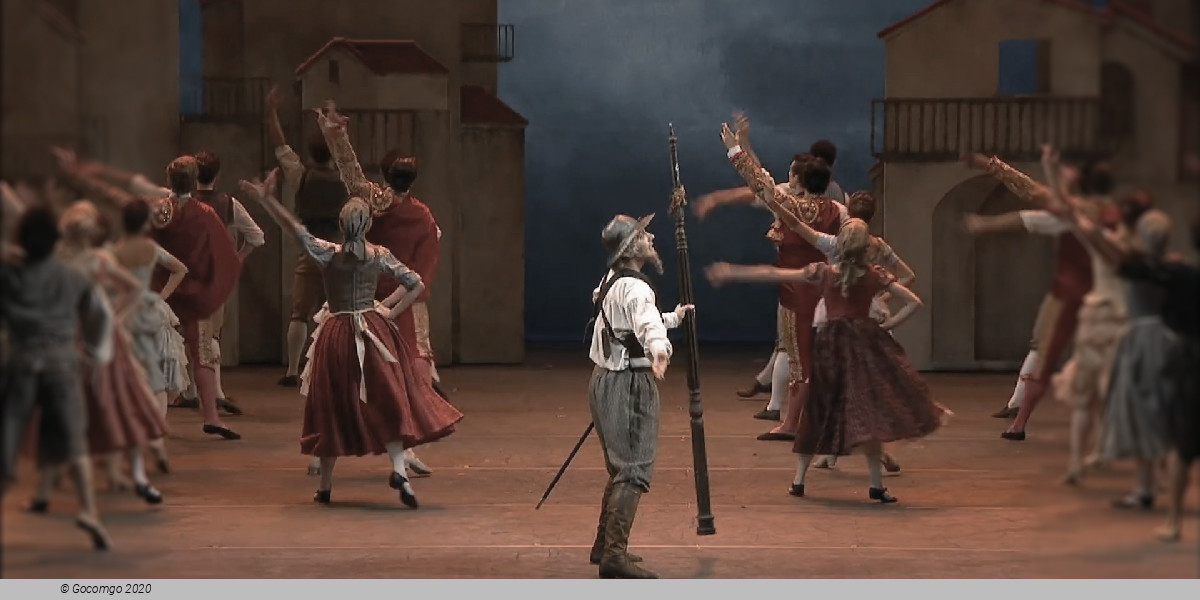
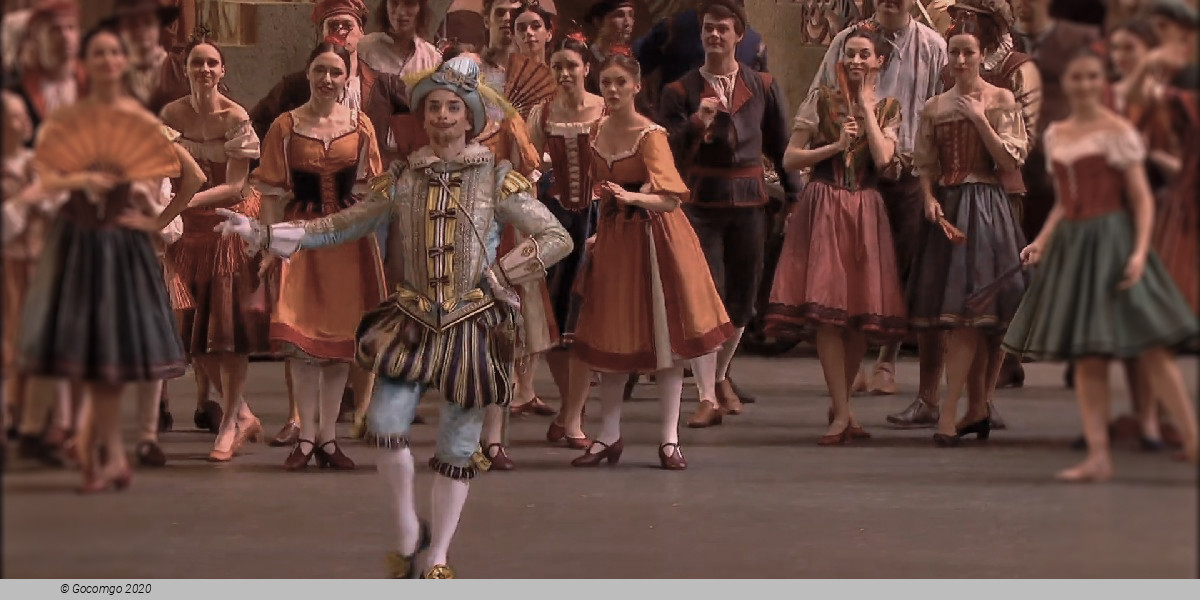
Dancing begins in the square and some toreadors try to kidnap the girls they fancy, but their relatives and lovers hasten to their aid. At this moment Don Quixote arrives mounted on Rocinante, followed by Sancho, who is riding a donkey. At his master's command Sancho sounds his rusted horn, causing the townspeople to cover their ears. Lorenzo runs out of his inn, and Don Quixote, taking him for the lord of a famous castle, dismounts Rocinante and, falling to his knees, begs to be allowed to serve him. Charmed, Lorenzo invites the knight to sit on his balcony. Sancho remains in the square where he is surrounded by girls who induce him to take part in a game of blind man's bluff. Then some boys bring in a blanket on which they place Sancho and proceed to toss him into the air. Don Quixote hurries to his assistance and sets him free.

Peasants gather in the square and dancing resumes. Kitri returns and, noticing her, Don Quixote acclaims her as his Dulcinea, whom evil magicians have reduced to human form. Becoming jealous of her affection for Basilio, Don Quixote attempts to woo her by partnering her in a minuet. Lorenzo berates Kitri for carrying on with Basilio. Kitri and Basilio then run away, and Lorenzo and Gamache follow them. Don Quixote orders Sancho to bring Rocinante, so that he may also set out in pursuit.

Act II

Scene 1 – A camp of gypsies among the windmills outside the village

Kitri, disguised as a boy is seen walking with Harlequin from a troupe of travelling actors. They guess she is a girl and ask her to stay with them.

Scene 2 - The Puppet Theatre

A clown is seen walking with Graziosa, the gypsy chief's daughter. A gypsy tells the chief of the approach of Don Quixote. The chief plans a trick for his benefit and, putting on a mantle crown, sits down as though he were a king on a throne. Don Quixote is deceived and kneels to the chief in homage. The chief bids that he sit beside him and orders a festival to be given in his honor. This begins with Gypsy dances and is followed by a performance of the marionette theatre. Don Quixote is delighted with the entertainment but, mistaking the heroine for his Dulcinea and the marionettes for soldiers attacking her, he rises to assault them. The gypsies are terrified. At this moment the clown and Graziosa run away.

Scene 3 - The Windmills

Flushed with victory, the knight kneels and renders thanks to heaven. Seeing the moon, he takes it for his Dulcinea and tries to get to her. As he approaches the windmills he can see the moon no longer and thinks that evil magicians have hidden his beloved mistress. So, spear in hand, he tilts at the wings of the windmill, which he mistakes for a giant. Alas, the knight is caught by one of the wings and flung into the air. He falls unconscious at Sancho's feet.

Scene 4 – A forest

Through the trees appears Sancho leading Rocinante, upon which sits the wounded Don Quixote. The servant lifts his master down and places him on the grass, so that he may rest. Then, tying up the horse, he goes to sleep. Don Quixote also tries to sleep, but is troubled by fantastic dreams.

Scene 5 – The enchanted Garden of Dulcinea

Fairies appear surrounded by gnomes and Don Quixote finds himself dressed in shining armor. Then comes a succession of fearsome monsters, the last being a gigantic spider, who spins a web. The knight attacks the spider, which he slashes in half with his sword. At that same moment the spider's web vanishes to reveal a beautiful garden, filled with dryads and beautiful women, presided over by the Queen of the Dryads and Amor. Among them is Dulcinea and Don Quixote kneels before his beloved. At this moment everything vanishes.

Act III

The Square

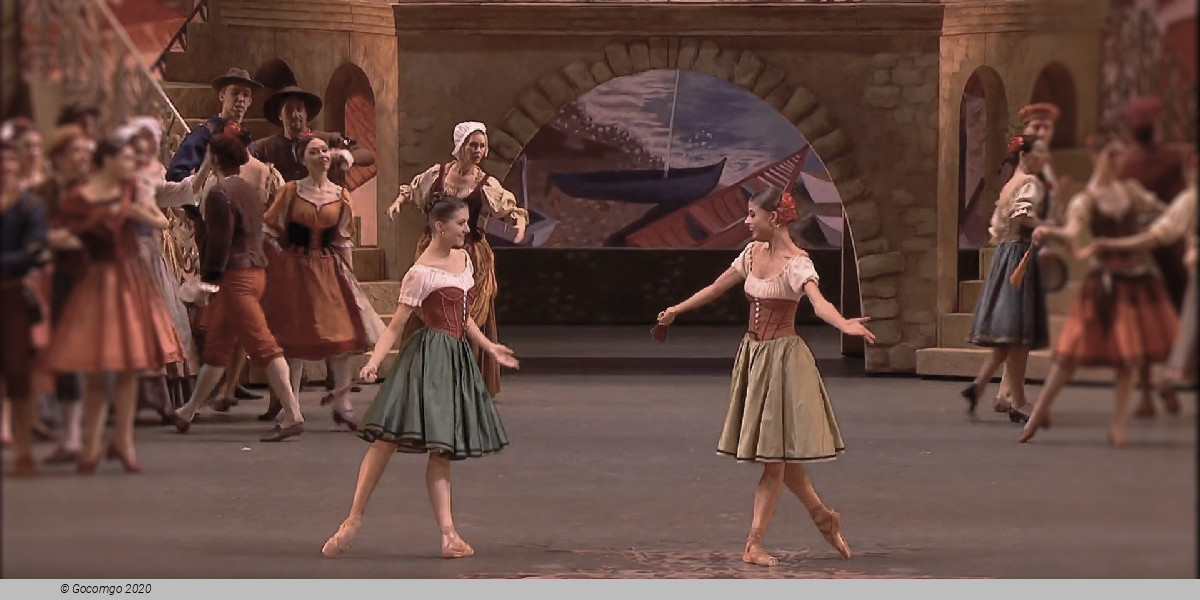
Back at the square, Kitri and Basilio join those who are dancing. At the height of the merriment, Lorenzo and Gamache arrive, followed by Don Quixote and Sancho. Seeing his daughter, Lorenzo decides to give his blessing to her union with the nobleman Gamache. Basilio becomes annoyed and, reproaching Kitri for her unfaithfulness, draws a sword and stabs himself. As he lies dying he begs Lorenzo to unite him with Kitri, but Lorenzo and Gamache refuse. Don Quixote approaches Gamache and challenges him to a duel for having refused a dying man's wish. Gamache declines to fight and the merrymakers drive him out of the inn. Taking pity, Lorenzo agrees to unite Basilio and Kitri. At this moment, Basilio pulls out the sword and tells everyone it was a joke.

Act IV

The Tavern

A magnificent feast is held in honour of Don Quixote. Suddenly the Knight of the Silver Moon challenges him to a duel, which results in the latter being vanquished. The victorious knight proves to be none other than Bachelor Sanson Carrasco, who forces Don Quixote to vow that he will not unsheathe his sword for a whole year. The sorrowful knight, true to his vow, takes up his warlike gear and, followed by Sancho, sets out for home.

Venue Info

Beijing National Grand Theater (NCPA) - Beijing
Location   2 W Chang'an Ave

The National Centre for the Performing Arts (NCPA) is an arts centre containing an opera house in Beijing, People's Republic of China. The Centre, an ellipsoid dome of titanium and glass surrounded by an artificial lake, seats 5,452 people in three halls and is almost 12,000 m² in size. It was designed by French architect Paul Andreu. Construction started in December 2001 and the inaugural concert was held in December 2007.

The exterior of the theater is a titanium-accented glass dome that is completely surrounded by a man-made lake. It is said to look like an egg floating on water, or a water drop. It was designed as an iconic feature, something that would be immediately recognizable.

The dome measures 212 meters in east–west direction, 144 meters in north–south direction, and is 46 meters high. The main entrance is at the north side. Guests arrive in the building after walking through a hallway that goes underneath the lake. The titanium shell is broken by a glass curtain in north–south direction that gradually widens from top to bottom.

The location, immediately to the west of Tiananmen Square and the Great Hall of the People, and near the Forbidden City, combined with the theatre's futuristic design, created considerable controversy. Paul Andreu countered that although there is indeed value in ancient traditional Chinese architecture, Beijing must also include modern architecture, as the capital of the country and an international city of great importance. His design, with large open space, water, trees, was specially designed to complement the red walls of ancient buildings and the Great Hall of the People, in order to melt into the surroundings as opposed to standing out against them.

Internally, there are three major performance halls:

The Opera Hall is used for operas, ballet, and dances and seats 2,416 people.
The Music Hall is used for concerts and recitals and seats 2,017 people.
The Theatre Hall is used for plays and the Beijing opera. It has 1,040 seats.
The NCPA also distributes filmed and recorded performances of its concerts, plays and operas through the in-house label NCPA Classics, established in 2016.

The initial planned cost of the theatre was 2.688 billion yuan. When the construction had completed, the total cost rose to more than CNY3.2 billion. The major cause of the cost increase was a delay for reevaluation and subsequent minor changes as a precaution after a Paris airport terminal building collapsed. The cost has been a major source of controversy because many believed that it is nearly impossible to recover the investment. When the cost is averaged out, each seat is worth about half a million CNY. The Chinese government answered that the theater is not a for profit venture.

The government sanctioned study completed in 2004 by the Research Academy of Economic & Social Development of the Dongbei University of Finance and Economics, of the upkeep costs of the building were publicized in domestic Chinese media:

The water and electricity bills and the cleaning cost for the external surface would be at least tens of millions CNY, and with another maintenance cost, the total could easily exceed one billion CNY. Therefore, at least 80 percent of the annual operational costs must be subsidized by the government for at least the first three years after the opening, and for the rest of its operational life, at least 60 percent of the annual operational cost must be subsidized by the government.

The director of the art committee of the National Centre for the Performing Arts and the standing committee member of the Standing Committee of the Chinese People's Political Consultative Conference, Mr Wu Zuqiang (吴祖强) and the publicist / deputy director of the National Centre for the Performing Arts Mr Deng (邓一江) have announced that 70 percent of the tickets would be sold at low price for ordinary citizens, while 10% of the tickets would be sold at relatively expensive prices for separate market segments, and the 60% of annual operating cost needed to be subsidized by the government would be divided between the central government and the Beijing municipal government.

Important Info
Type: Ballet
City: Beijing, China
Starts at: 19:30
Acts: 3
Duration: 2h 45min
Top of page