
Warsaw Grand Theatre - Polish National Opera (Teatr Wielki): Dead End Tickets | Event Dates & Schedule | GoComGo.com

Dead End Tickets

Warsaw Grand Theatre - Polish National Opera (Teatr Wielki), Warsaw, Poland
Important Info
Type: Opera
City: Warsaw, Poland
Acts: 3
Sung in: Polish
Titles in: Polish,English

E-tickets: Print at home or at the box office of the event if so specified. You will find more information in your booking confirmation email.

You can only select the category, and not the exact seats.
If you order 2 or 3 tickets: your seats will be next to each other.
If you order 4 or more tickets: your seats will be next to each other, or, if this is not possible, we will provide a combination of groups of seats (at least in pairs, for example 2+2 or 2+3).

Cast
Performers
Choose the date to see the peformers
Overview

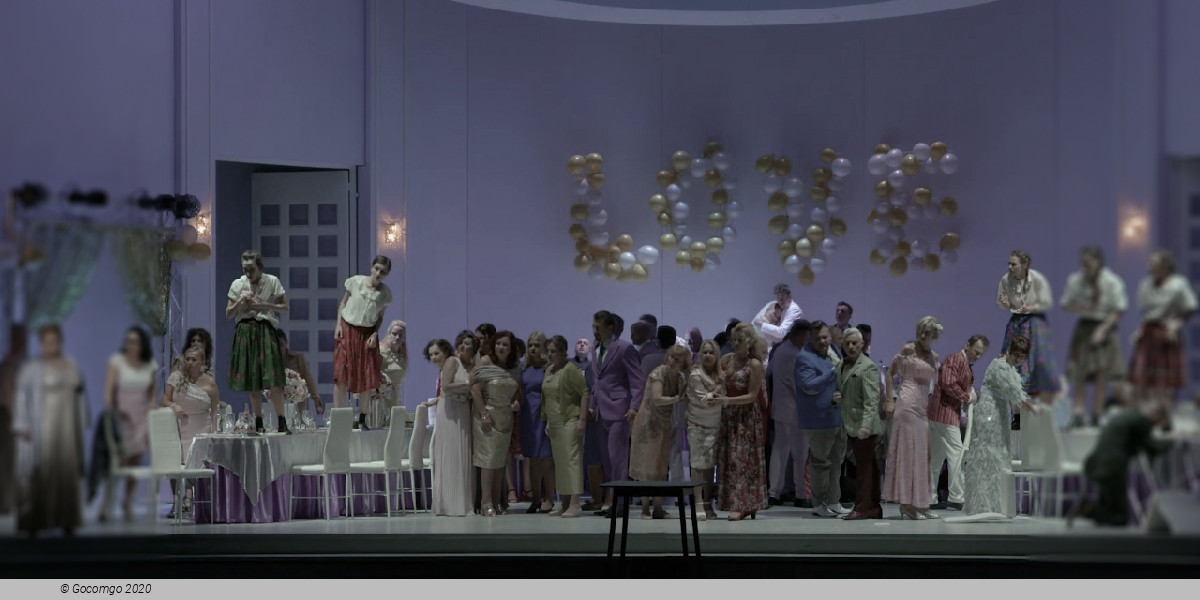
Dead End is a remarkable work: an opera exploring current issues, written by two prominent Polish artists, Krzysztof Meyer and Antoni Libera.

Krzysztof Meyer is considered one of the most prominent present-day composers. He was a noteworthy student of Krzysztof Penderecki, then a pupil of Nadia Boulanger and Witold Lutosławski, and finally, a professor of composition of the Cologne University of Music, now retired. As an eminent expert on Shostakovich, he penned a monograph on the composer and composed the third act of The Gamblers. A composer of mainly large-scale symphonic pieces and chamber music, he also wrote a youthful opera after Stanisław Lem’s The Cyberiad. The composer has a number of prestigious awards to his name.

Antoni Libera is a recognised writer and translator. His bestselling novel Madame was translated into more than twenty languages and was shortlisted for the International IMPAC Dublin Literary Award in 2002. He is an expert on Samuel Beckett and translator of his works. He rendered into Polish all the Irish Nobel laureate’s dramas and directed many of them in Poland and abroad. He is the author of new translations of many classics, including the works of Sophocles, Shakespeare, Racine, Hölderlin and Kavafis.

And so we find ourselves at a little railway station in the fictional principality of Alpos – in the very centre of Europe – located close to the key transportation routes connecting the continent’s major capitals. Passengers travelling to different destinations meet here on the way to Bern where they can catch an international express train.

The passengers represent opposing world views and social attitudes. First off, we have the Modernists heading to a huge congress in Paris to settle on the flag for the Earth. Next up are the Conservatives on their way to the ‘Days of Holiness’ in Rome. Finally, there are the suspicious Barbarians/Terrorists departing on a mission to Berlin.

Because of the persistent delays plaguing the railway services, all the passengers face the risk of missing their connections. They are unexpectedly bailed out by a Suicide handcuffed to the train track. In an attempt to rescue the man and to avoid a disaster, the stationmaster forces an international express train to make an emergency stop, which allows the relieved passengers to board it illegally.

The originality of Dead End lies in it being is a philosophical tale presented in the operatic form. The composition is governed by the number three: three acts, three groups of passengers, three suicide attempts (hence the subtitle: ‘Third time’s the charm’). The principal characters are the Stationmaster and the Suicide. The former is a proponent of maintaining order at all costs (despite his lack of illusions), the latter is the epitome of disaffection associated with excess and decadence. Sadly, when the age-old dispute about the meaning of existence unfolds, a third (‘dark’) force enters into the equation and brings doom on everybody.  

Libera openly references the poetics of the Theatre of the Absurd and particularly Sławomir Mrożek’s late plays permeated with bitterness and deep-seated pessimism. The numerous comedic and grotesque elements play up the gloomy tenor of the work. Black humour is used to produce irony and sarcasm. It all perfectly corresponds with Meyer’s music, whose tone often shifts from buffo to serio and back again. It seems a perfect vehicle for the ideas presented in the libretto: formally elegant, technically pristine, logical and well put together (just like the Stationmaster), it evokes anxiety, dissonance and passion tinged with dread and despair (just like the Suicide). All of this unambiguously applies to contemporary Western civilisation, tormented by dramatic dilemmas and conflicts and threatened by naked violence from outside (think Russian aggression against Ukraine).   

The production is directed by Marek Weiss, who returns to the Polish National Opera after the success of his take on Ignacy Jan Paderewski’s Manru.

This promises to be a staging that is not only visually and musically appealing but also intellectually intriguing. It is also sharp, witty and has a ironically sarcastic message that is open to more than one interpretation. Works with such characteristics and of such caliber are not often seen in opera.

Venue Info

Warsaw Grand Theatre - Polish National Opera (Teatr Wielki) - Warsaw
Location   plac Teatralny 1

The Grand Theatre in Warsaw is a theatre and opera complex situated on the historic Theatre Square in central Warsaw. The Warsaw Grand Theatre is home to the Polish National Ballet and is one of the largest theatrical venues in the world.

The Theatre was built on Theatre Square between 1825 and 1833, replacing the former building of Marywil, from Polish classicist designs by the Italian architect Antonio Corazzi of Livorno, to provide a new performance venue for existing opera, ballet and drama companies active in Warsaw. The building was remodeled several times and, in the period of Poland's political eclipse from 1795 to 1918, it performed an important cultural and political role in producing many works by Polish composers and choreographers.

It was in the new theatre that Stanisław Moniuszko's two best-known operas received their premieres: the complete version of Halka (1858), and The Haunted Manor (1865). After Frédéric Chopin, Moniuszko was the greatest figure in 19th-century Polish music, for in addition to producing his own works, he was director of the Warsaw Opera from 1858 until his death in 1872.

While director of the Grand Theatre, Moniuszko composed The Countess, Verbum Nobile, The Haunted Manor and Paria, and many songs that make up 12 Polish Songbooks.

Also, under Moniuszko's direction, the wooden Summer Theatre was built close by in the Saxon Garden. Summer performances were given annually, from the repertories of the Grand and Variety (Rozmaitości) theatres. Józef Szczublewski writes that during this time, even though the country had been partitioned out of political existence by its neighbors, the theatre flourished: "the ballet roused the admiration of foreign visitors; there was no equal troupe of comedians to be found between Warsaw and Paris, and Modrzejewska was an inspiration to drama."

The theatre presented operas by Władysław Żeleński, Ignacy Jan Paderewski, Karol Szymanowski and other Polish composers, as well as ballet productions designed by such choreographers as Roman Turczynowicz, Piotr Zajlich and Feliks Parnell. At the same time, the repertoire included major world opera and ballet classics, performed by the most prominent Polish and foreign singers and dancers. It was also here that the Italian choreographer Virgilius Calori produced Pan Twardowski (1874), which (in the musical arrangement first of Adolf Sonnenfeld and then of Ludomir Różycki) has for years been part of the ballet company's repertoire.

During the 1939 battle of Warsaw, the Grand Theatre was bombed and almost completely destroyed, with only the classical façade surviving. During the Warsaw Uprising of 1944 the Germans shot civilians in the burnt-out ruins. The plaque to the right of the main entrance commemorates the suffering and heroism of the victims of fascism.

Important Info
Type: Opera
City: Warsaw, Poland
Acts: 3
Sung in: Polish
Titles in: Polish,English

E-tickets: Print at home or at the box office of the event if so specified. You will find more information in your booking confirmation email.

You can only select the category, and not the exact seats.
If you order 2 or 3 tickets: your seats will be next to each other.
If you order 4 or more tickets: your seats will be next to each other, or, if this is not possible, we will provide a combination of groups of seats (at least in pairs, for example 2+2 or 2+3).

Top of page